LONDON: British anti-Islam activist Stephen Yaxley-Lennon on Wednesday lost his appeal against his 18-month sentence after he previously admitted contempt of court for repeating false allegations against a Syrian refugee.
Yaxley-Lennon, known as Tommy Robinson, was jailed in October after he admitted contempt of court by breaching an injunction banning him from repeating the allegations against Jamal Hijazi, who successfully sued him for libel.
In a ruling on Wednesday, three judges at London’s Court of Appeal dismissed Yaxley-Lennon’s appeal.
They said that a previous judge’s “application of the law and his reasoning on the appropriate sanction in this case both exhibit a meticulous approach.”
Britain’s Solicitor General took legal action against Yaxley-Lennon over comments in online interviews and a documentary titled ‘Silenced’, which has been viewed millions of times and was played in London’s Trafalgar Square in July.
Last month, the 42-year-old self-styled journalist was refused permission to bring a legal challenge over the decision to keep him in segregation at Woodhill Prison in central England.
Yaxley-Lennon, who counts US billionaire Elon Musk among his supporters, was accused by some media and politicians of inflaming tensions which led to days of rioting across Britain in late July after the murder of three young girls at a dance workshop in Southport.
Yaxley-Lennon’s social media account said in January that the US billionaire was paying some of his legal fees, though Musk has not confirmed this.

UK anti-Islam activist ‘Tommy Robinson’ loses appeal against prison sentence
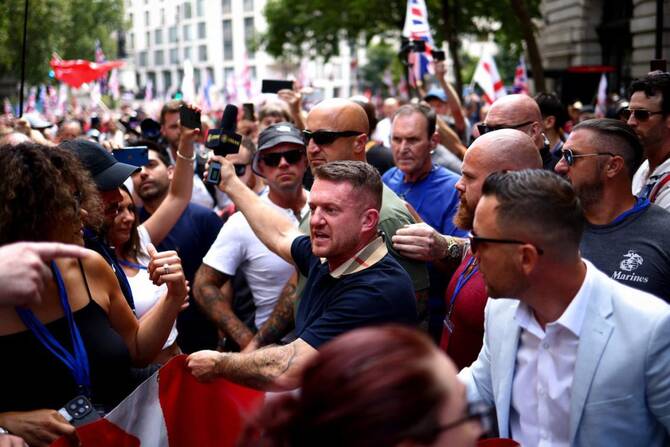
https://arab.news/zdyu6
UK anti-Islam activist ‘Tommy Robinson’ loses appeal against prison sentence
- Yaxley-Lennon was jailed in October after he admitted contempt of court by breaching an injunction banning him from repeating allegations against Jamal Hijazi
Rubio meets Orbán in Budapest as US and Hungary are to sign a civilian nuclear pact
- Trump has been outspoken in his support for the nationalist Orbán in the Hungarian leader’s bid for reelection in two months
BUDAPEST, Hungary: US Secretary of State Marco Rubio was in the Hungarian capital on Monday for meetings with Prime Minister Viktor Orbán and his government during which they plan to sign a civilian-nuclear cooperation agreement heralded by US President Donald Trump.
Trump has been outspoken in his support for the nationalist Orbán in the Hungarian leader’s bid for reelection in two months. Orbán and his Fidesz party are facing their most serious challenge in the April 12 vote since the right-wing populist retook power in 2010.
The stop in Hungary’s capital follows Rubio’s visit to Slovakia on Sunday, after he previously attended the Munich Security Conference in Germany.
Led by Euroskeptic populists who oppose support for Ukraine and vocally back Trump, Slovakia and Hungary represent friendly territory for Rubio as he pushes to shore up energy agreements with both Central European countries.
Widely considered Russian President Vladimir Putin’s most reliable advocate in the European Union, Orbán has maintained warm relations with the Kremlin despite its war against Ukraine while currying favor with Trump and his MAGA — short for the 2016 Trump campaign slogan “Make America Great Again” — movement.
Many in MAGA and the broader conservative world view Hungary as a shining example of successful conservative nationalism, despite the erosion of its democratic institutions and its status as one of the EU’s poorest countries.
In a post on his Truth Social site earlier this month, Trump endorsed Orbán for the coming elections and called him a “truly strong and powerful Leader” and “a true friend, fighter, and WINNER.”
Trump has praised Orbán’s firm opposition to immigration, exemplified by a fence his government erected on Hungary’s southern border in 2015 as hundreds of thousands of refugees fled Syria and other countries in the Middle East and Africa.
Other US conservatives admire Orbán’s hostility to LGBTQ+ rights. His government last year banned the popular Budapest Pride celebration and allowed facial recognition technology to be used to identify anyone participating despite the ban. It has also effectively banned same-sex adoption and same-sex marriage, and disallowed transgender individuals from changing their sex in official documents.
Orbán has remained firmly committed to purchasing Russian energy despite efforts by the EU to wean off such supplies, and received an exemption from US sanctions on Russian energy after a November meeting in the White House with Trump.
Apparently trusting that his political and personal affinity with the US leader could pay even greater dividends, Orbán and his government have sought to woo Trump to Hungary before the pivotal April 12 elections — hoping such a high-profile visit and endorsement would push Orbán, who is trailing in most polls, over the finish line.
Budapest has hosted several annual iterations of the Conservative Political Action Conference, or CPAC, and another was hastily rescheduled this year to fall in March, just before Hungary’s elections.


