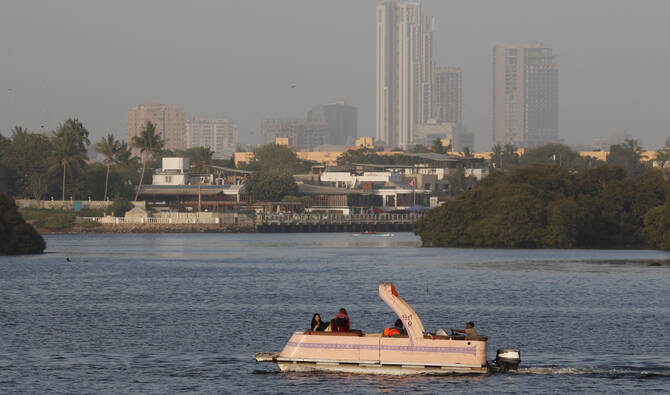
KARACHI: Authorities in Pakistan’s largest city of Karachi are bracing for a heatwave expected to hit the metropolis next Sunday, with the mercury already surging to high levels in some parts of the southern Sindh province.
The Pakistan Meteorological Department forecast “heatwave conditions” are likely to continue in Sindh, South Punjab and Balochistan till Apr. 18. It said that a shallow westerly wave is expected to affect the upper parts of the country from Wednesday afternoon until Apr. 20.
The highest temperature during the day in Sindh was recorded in Nawabshah, 47° C., as per the Met Office. The temperature in other cities of Sindh such as Larkana and Jacobabad surged to 46° C.
“Mainly hot and dry weather is expected over most parts of the country, while very hot in southern parts,” the Met Office said. “However, dust/thunderstorm-rain is expected at isolated places in upper Khyber Pakhtunkhwa, Potohar region, Islamabad, northeast Punjab, Kashmir and Gilgit-Baltistan during (evening/night).”
Meteorologist Anjum Zaigham told Arab News that a heatwave situation is anticipated in Karachi from Sunday onwards. He said the temperature in the city these days is “more or less normal,” ranging between 34 to 37 degrees Celsius.
“Starting this coming Sunday, there will be an increase in the intensity of heat in Karachi, and it is expected that the temperature may reach close to 40 degrees Celsius, potentially creating a heatwave-like situation,” Zaigham said.
He noted that high humidity, particularly in the morning, contributes to a higher “feels like” temperature.
“From this coming Sunday until Wednesday or Thursday, a heatwave like situation may develop in Karachi,” he said.
Relief stalls were set up in different districts of Karachi, with the commissioner’s office spokesperson saying more roadside relief centers will be established to provide water and first aid in case of emergency.
Climate change is exacerbating heat waves in Pakistan, leading to more frequent extreme temperatures. Pakistan ranks among the top ten most vulnerable to climate change impacts and also faces increased risks of untimely downpours, floods and droughts.
These heat waves contribute to various illnesses, significant economic losses and weather-related deaths during the summer season. A deadly heat wave in Karachi in 2015 resulted in over 2,000 deaths, while devastating floods in 2022 killed approximately 1,700 people and affected over 33 million nationwide, requiring extensive rebuilding efforts.

Karachi braces for heatwave this week as mercury soars in southern Pakistan
https://arab.news/bkrnk
Karachi braces for heatwave this week as mercury soars in southern Pakistan
- Starting this Sunday, Karachi’s temperature may surge close to 40 degrees Celsius, says meteorologist
- More relief centers will be set up providing water and first aid to citizens, says commissioner’s office
Pakistan, UK sign £35 million Green Compact to strengthen climate resilience
- Pakistan ranks among nations most vulnerable to climate change and has seen erratic changes in its weather patterns
- UK will help Pakistan mobilize climate finance, strengthen regulatory frameworks and develop bankable climate projects
ISLAMABAD: Pakistan and the United Kingdom (UK) have formalized a comprehensive climate partnership with the launch of a Green Compact that aims to enhance climate resilience, accelerate clean energy transition and scale up nature-based solutions, including mangrove conservation, Pakistani state media reported on Sunday.
The agreement, signed in Islamabad by Federal Minister for Climate Change and Environmental Coordination Dr. Musadik Malik and UK Minister for International Development Jennifer Chapman, unlocks £35 million in targeted support for green development and long-term climate action, according to Radio Pakistan broadcaster.
Pakistan ranks among nations most vulnerable to climate change and has seen erratic changes in its weather patterns that have led to frequent heatwaves, untimely rains, storms, cyclones, floods and droughts in recent years. In 2022, monsoon floods killed over 1,700 people, displaced another 33 million and caused over $30 billion losses, while another 1,037 people were killed in floods this year.
Mohammad Saleem Shaikh, a spokesperson for Pakistan’s Ministry of Climate Change, described the compact as a “decisive move toward action-oriented climate cooperation,” noting that its implementation over the next decade will be critical for Pakistan which regularly faces floods, heatwaves and water stress.
“The Compact is structured around five core pillars: climate finance and investment, clean energy transition, nature-based solutions, innovation and youth empowerment, and adaptation and resilience,” the report read.
“Under the agreement, the UK will work with Pakistan to mobilize public and private climate finance, strengthen regulatory frameworks for green investment, and develop bankable climate projects.”
Clean energy forms a central component of Pakistan’s transition, with Islamabad planning to expand solar and wind generation to reduce fossil fuel dependence, improve energy security and stabilize power costs, according to Shaikh.
“Renewable energy is now economically competitive, making the transition both environmentally and financially viable,” he was quoted as saying.
“Nature-based solutions, particularly large-scale mangrove restoration, will protect coastal communities from storm surges and erosion while enhancing biodiversity and carbon sequestration.”
Under the Compact, technical support, mentoring and access to investors will be provided to climate-smart startups and young innovators, reflecting Pakistan’s recognition of youth-led initiatives as central to future climate solutions.
On the occasion, Chapman, on her first official visit to Pakistan, underscored the urgency of climate action, highlighting the UK’s support for renewable energy, mangrove and ecosystem restoration, early-warning systems, climate budgeting and international investment flows into Pakistan.
Shaikh described the Green Compact as “a strategic turning point” in Pakistan–UK relations on climate change, saying its effective implementation is essential for Pakistan to meet its national climate targets.