

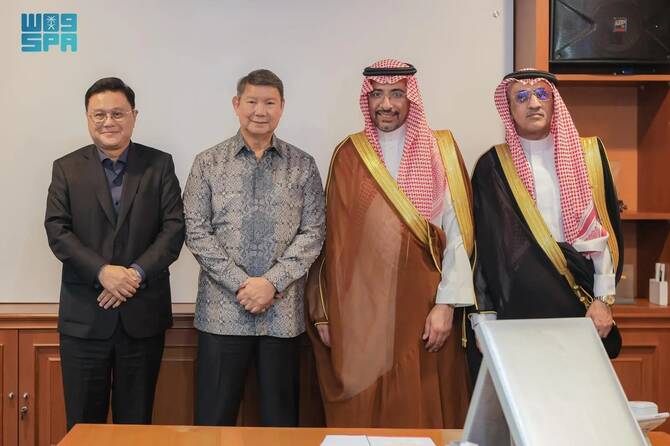

JEDDAH: Economic ties between Saudi Arabia and Indonesia are set to deepen as the Kingdom’s top minister visits Jakarta to explore investment opportunities and enhance cooperation in the mining and industrial sectors.
Saudi Minister of Industry and Mineral Resources Bandar Alkhorayef is leading a high-level delegation to Indonesia from April 15 to 17, aiming to strengthen bilateral business relations and forge strategic partnerships across mining, food, pharmaceuticals, and auto parts industries, the Saudi Press Agency reported.
This comes as the Kingdom aims to position mining as a foundational pillar of its industrial economy, with its mineral wealth estimated at SR9.4 trillion ($2.4 trillion).
In a post on his X account, Alkhorayef said: “At the start of my visit to Indonesia, I met with the Special Presidential Envoy for Energy and Environmental Affairs to discuss cooperation in mining and explore opportunities to strengthen bilateral partnerships.”
His meeting with Special Envoy Hashim Djojohadikusumo focused on enhancing collaboration in the mining sector. The Indonesian official highlighted promising prospects in the production of strategic minerals, including nickel and copper, according to a statement from the Saudi Ministry of Industry.
Alkhorayef emphasized the alignment of Saudi-Indonesian priorities, citing the mining sector’s key role in Saudi Arabia’s economic diversification under Vision 2030.
The Saudi minister also held a meeting with Industry Minister Agus Gumiwang Kartasasmita and Minister of State-Owned Enterprises Erick Thohir.
“During the two meetings, we discussed ways to enhance industrial cooperation and expand partnerships between private sector entities in the two countries, in addition to reviewing investment opportunities and the Kingdom’s goals to become an industrial and logistics hub in the region.” Alkhorayef said.
As part of his trip, Alkhorayef also visited PT Vale Indonesia Tbk and Mining Industry Indonesia, or MIND ID, to learn about their pioneering efforts in mineral exploration and mining.
During these visits, he held discussions with senior executives on ways to boost cooperation in strategic minerals — particularly nickel, cobalt, and copper — while promoting sustainable practices and outlining Saudi Arabia’s National Mining Strategy and investor-friendly ecosystem.
The talks also focused on strengthening private sector collaboration, attracting investment, and sharing expertise in critical minerals essential to the global energy transition.
Technology and innovation were highlighted as key drivers of growth in the mining sector, aligned with broader sustainable development goals.
At MIND ID, both sides discussed best practices in mining operations and explored potential partnerships to develop strategic minerals sustainably.
Conversations with PT Vale underscored the importance of innovation and technology in shaping the future of mining.
Alkhorayef noted that Indonesia’s mining achievements align closely with Saudi Arabia’s mining strategy, which aims to unlock domestic mineral resources, localize value chains, and position the Kingdom as a global hub for mining investment and innovation.
Indonesia ranks among the world’s top producers of strategic minerals, including nickel, cobalt, copper, tin, and gold. In 2023, the mining sector contributed 11.9 percent to the country’s gross domestic product, underscoring its critical role in the national economy.
The country continues to attract international investment focused on developing downstream industries and reinforcing global mineral supply chains — goals that mirror Saudi Arabia’s own strategy to localize value chains and maximize its mineral wealth, the ministry’s statement added.


