


JEDDAH: I was in Baghdad a mere two months before Saddam Hussein invaded Kuwait on Aug. 2, 1990. I was there with a group of editors and journalists accompanying the late King Fahd to the 17th Arab Summit in the Iraqi capital on May 30, 1990. I saw Saddam up close, with only a couple of feet between us.
At that time there was no inkling that he would invade Kuwait. Yes, there were rumblings of discontent and disagreements over Kuwait’s ownership of Bubiyan Island. But nobody imagined that two months after he hosted the Arab leaders, his tanks would roll into Kuwait in what King Fahd rightly described as Iraq’s “most horrible aggression.”
The invasion of Kuwait set off a chain of events with repercussions that continue today. It shattered forever the idea of Arab unity and fragmented the Arab world. That world never recovered, never returned to “normal” after the Gulf War.
There were countries that did not side with Saddam, but they remained quiet and this led to a deepening of the suspicions that lingered in the unfortunate post-1945 Arab history. Those suspicions had become reinforced, embedded and fixed in the minds of the Arabs. There was mutual suspicion of each other’s intentions. While the Palestinians, the Jordanians and the Yemenis did not openly support the invasion, their wait-and-see policy angered the Gulf states.
How we wrote it

Arab News reported King Fahd’s denunciation of Iraq’s “most horrible” aggression against Kuwait and the ensuing international condemnation.
Could we say that today’s problems in our region have their roots in the 1990 invasion of Kuwait? I would say yes. Most of the Arab world’s issues today are a direct result of Saddam’s aggression.
First, the invasion led directly to the destruction of Iraq. And those responsible were the Iraqi government and, more specifically, Saddam. It was Saddam who handed an excuse to forces that wanted to break up an Arab state. If Saddam had not invaded Kuwait, there would very likely have been no Al-Qaeda, no Daesh. The Kuwaiti invasion was the ultimate moment for those who wished to see Arabs violently disagreeing with, and actually fighting, each other.
I remember an insightful piece I read in London’s Daily Telegraph newspaper in 1968 about differences that had cropped up during that year’s Arab Summit. It included a quote that is still relevant: “The Arab world, despite its brimming coffers, lacks one thing that money cannot buy — leadership.”
Coming back to the invasion, and how we at Arab News covered it, I was awakened by a telephone call on the morning of Aug. 2, 1990. Mohammed Ali, the teleprinter operator at Arab News, was on the line. In those days, the teleprinter brought us the news, sometimes in trickles and sometimes in floods. Ali told me that information was trickling in about Kuwait being invaded by Iraqi troops.
Key Dates
-
1
Iraq invades Kuwait.
-
2
UN Resolution 660 condemns the invasion and “demands that Iraq withdraw immediately and unconditionally.”
-
3
Saddam installs Alaa Hussein Ali, holder of dual Iraq-Kuwaiti nationality and a lieutenant in the Kuwaiti army, as head of a four-day puppet government in Kuwait.

-
4
UN Resolution 678 gives Iraq an ultimatum to withdraw from Kuwait by Jan. 15, 1991.

-
5
Saudi F-15s and Tornados take part in the first of a series of allied bombing raids on Iraqi military targets in Iraq and Kuwait.
-
6
Iraq fires the first of more than 80 Scud missiles it will unleash on Israel and Saudi Arabia during the brief conflict.
-
7
Iraqi forces seize the Saudi town of Khafji on the Kuwait border, but are driven out after two days.

-
8
Coalition ground troops cross into Iraq from Saudi Arabia.
-
9
US and Allied forces enter and begin the swift liberation of Kuwait.

-
10
A Scud missile hits US Army barracks in Dhahran, Saudi Arabia, killing 28 US soldiers.
-
11
Iraqi forces flee Kuwait, setting fire to oil wells as they leave. Thousands die on Highway 80, the so-called Highway to Death, when retreating troops are attacked by allied aircraft.

-
12
With Kuwait liberated, US President George H.W. Bush declares a cease-fire and Kuwait’s government returns from exile.

I jumped out of bed, dressed and headed straight to the office at around 6 a.m. We called a couple of other staff members and started reading the reports. In those days, communication was far from quick. There was no internet and no mobile phones. To get a firsthand report of what was actually happening, I called one of my friends in Kuwait who had worked with the Arab Times.
He said: “Yes, I see Iraqi tanks in the streets. There is no resistance from the Kuwaitis.” We maintained contact for about three-and-a-half hours before his phone went dead.
Armed with all the information and leads I had, I sat with the editorial team and discussed the next day’s edition. However, there was an order from the Ministry of Information telling newspapers not to write about the invasion. From the editor-in-chief’s point of view, this was a great story but there were directives not to print it.
I was unwilling to take no for an answer, so I got in my car with my colleague, Khaled Nazer, and we went to the office of the minister of information at the time, Ali Al-Shaer. Once there, I begged and pleaded with him, saying how important it was to report this story, but he refused to budge. It was the darkest day in my life as a journalist.
Luckily, there was an Islamic conference taking place in Cairo at the time, and we used that story as a way to discuss the rumblings and tensions along the border between Iraq and Kuwait. That was it.

US Air Force fighters during Operation Desert Storm. Getty Images
The next day, however, we began reporting details of plundering and rampaging by Saddam’s troops in Kuwait. I told the publishers how important it was for the paper to have a full team close to the Saudi border with Iraq, in addition to the office we already had in the Eastern Province.
On Aug. 8, I went to the Eastern Province and, by September, we had a full team in place. It included Wahib Ghorab, Khaled Nazer, Mohammed Samman, Saeed Haider, Maher Abbas, Hani Naqshbandi, the photographer Giovanni Pasquale and an American intern, Aldo Svaldi.
By that time, an army of international journalists had arrived in the Eastern Province. The liberation of Kuwait was still a couple of weeks away.
When King Fahd addressed the nation, and the world, on Thursday, Aug. 9, 1990, we were given detailed information about the invasion. Our front-page headline the following day was “Fahd denounces Iraq’s ‘most horrible aggression’.”
From the Eastern Province, we began writing reports, war dispatches and human-interest stories. Everything was new to us and our circulation soared. The “Green Truth,” as Arab News was known in those days, became the most sought-after publication, the go-to source for information.
International journalists from Voice of America, the BBC and CNN visited our offices, and we formed lifelong friendships with many of them. They were surprised by our knowledge, keenness and openness. There was even a story about a small burger joint that was making Scud Burgers, named for the missiles that Saddam was using to attack the Kingdom.
None of my staff was allowed to feel any less important than those high and mighty foreign journalists. I made sure of that.
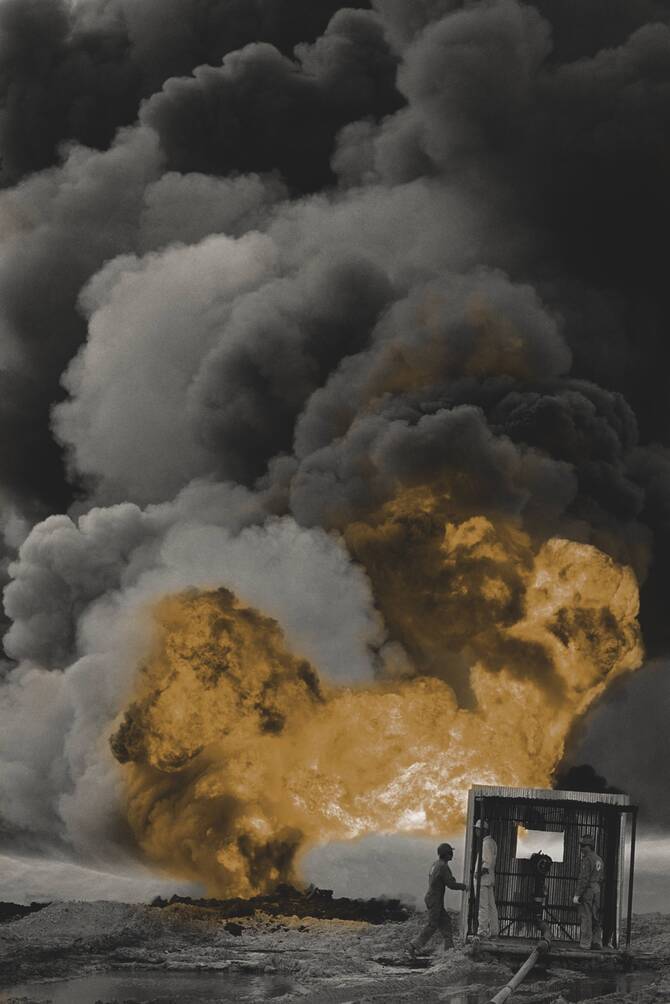
Arab News was the first newspaper to enter liberated Kuwait, while the oil wells were still burning.
- Khaled Almaeena was editor in chief of Arab News for almost 25 years, serving two terms, from May 1, 1982, to Feb. 20, 1993, and from March 1, 1998, to Oct. 8, 2011.


