

Pakistan denies claims UN rights resolution unilaterally softened to accommodate Israel’s concerns

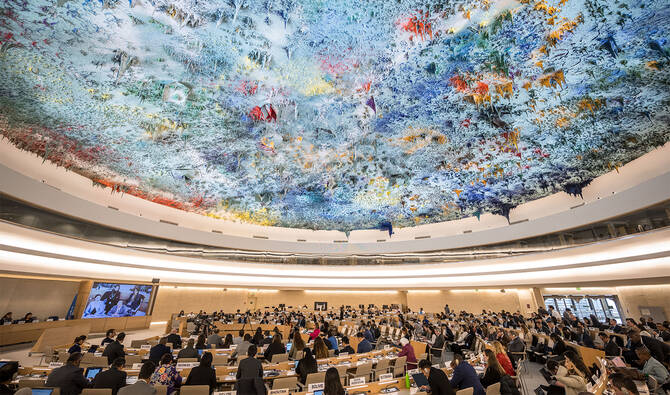
General view during a session to debate on the report of the United Nations High Commissioner for Human Rights on the situation in the Occupied Palestinian Territory at the 55th session of the United Nations Human Rights Council in Geneva on February 29, 2024. (AFP/File)
Short Url
Updated 16 April 2025
Follow

Pakistan denies claims UN rights resolution unilaterally softened to accommodate Israel’s concerns

  • Pakistan presented the resolution on behalf of the Organization of Islamic Cooperation earlier this month
  • It says the resolution is part of an annual OIC initiative and is only tabled after Palestinian endorsement

ISLAMABAD: Pakistan on Tuesday denied social media claims that a United Nations Human Rights Council (HRC) resolution presented by its diplomat in support of Palestine earlier this month was unilaterally diluted to accommodate Israeli concerns, saying the posts were based on inaccurate media reports and misrepresented the resolution’s outcome.

The statement followed a story by a global wire service, which reported that US lobbying, despite Washington’s withdrawal from the Council, had succeeded in preventing the inclusion of a powerful investigative mechanism in the Pakistan-led resolution on behalf of the Organization of Islamic Cooperation (OIC).

The report subsequently triggered criticism on social media, prompting the foreign office in Islamabad to issue a clarification.

“We have taken note of certain social media posts concerning the recently adopted Human Rights Council resolution on the Occupied Palestinian Territory (OPT),” the statement said. “These posts, based on inaccurate media reports, reflect a misunderstanding of the resolution adoption process and mischaracterize its outcome.”

The resolution, which focused on accountability for Israel’s actions in the Palestinian territories, is part of an annual OIC initiative at the Council in Geneva.

According to the foreign office, the resolution is only presented after the Palestinian delegation expresses satisfaction with the negotiated text, followed by final endorsement from the OIC member states.

“At no stage the text is modified unilaterally,” it added. “The resolution adopted during the latest HRC session adhered strictly to this process.”

The final text adopted by the Council referred the matter of setting up an independent mechanism to assist in the investigation and prosecution of those responsible for serious crimes in Palestinian territories to the UN General Assembly.

Pakistan rejected any suggestion of compromising its position on Palestine, reiterating that it does not recognize Israel and, as a matter of principle, does not engage with it in multilateral forums.

The foreign office noted that two other OIC-sponsored resolutions on Palestine were also adopted during the Council’s latest session, reinforcing Pakistan’s “unwavering and historic commitment” to the Palestinian cause.


Punjab expands Pakistan-India Wagah border arena with museum, partition-themed park

Updated 02 January 2026
Follow

Punjab expands Pakistan-India Wagah border arena with museum, partition-themed park

  • The border crossing, near eastern city of Lahore, is the primary land route between Pakistan and India and one of the most recognizable symbols of their often-tense relations
  • The site is best known for its daily flag-lowering ceremony, a choreographed military ritual performed by border forces from both countries that draws thousands of spectators

ISLAMABAD: Maryam Nawaz, chief minister of Pakistan’s Punjab province, on Thursday inaugurated the newly constructed arena at Wagah border cross between Pakistan and India, which includes a museum and a partition themed park.

The Wagah border crossing, located near the eastern city of Lahore, is the primary land route between Pakistan and India and one of the most recognizable symbols of the often-tense relationship between the two neighbors. It serves as a key point for prisoner exchanges and limited movement of travelers, while remaining tightly regulated due to security considerations.

The site is best known for its daily flag-lowering ceremony, a choreographed military ritual performed by border forces from both countries that draws thousands of spectators. Over the years, the ceremony has evolved into a popular tourist attraction, blending displays of nationalism with public spectacle and making it one of Pakistan’s most visited landmarks, which connects with India’s Attari.

Flanked by military officials, CM Nawaz visited the crossing and inaugurated the new arena, with its seating capacity increased from 7,500 to 25,000 spectators, the state-run Radio Pakistan broadcaster reported. The chief minister also visited the martyrs’ monument and offered her respects.

“In addition to the arena’s expansion, several new constructions have been added at the Joint Check Post Wagah. These new developments include a theme park depicting the partition of the Subcontinent, featuring models of a railway station, military equipment and a Martyrs’ Memorial,” the broadcaster reported.

“A Pakistan Museum has also been established within the arena, showcasing the country’s history and culture from the Freedom Movement to the present day.”

In August 1947, Britain divided the Indian Sub-continent, its former colony, into two countries — Hindu-majority India and Muslim-majority Pakistan.

Excitement over independence was quickly overshadowed by some of the worst bloodletting that left up to 1 million people dead as gangs of Hindus and Muslims slaughtered each other.

Creating two independent nations also tore apart millions of Hindu and Muslim families in one of the world’s largest peacetime migrations, which displaced at least 15 million people.

The fate of Kashmir, then a princely state, was left undecided. The Himalayan territory continues to remain a flashpoint in relations between the neighbors, who have fought multiple wars over it.