

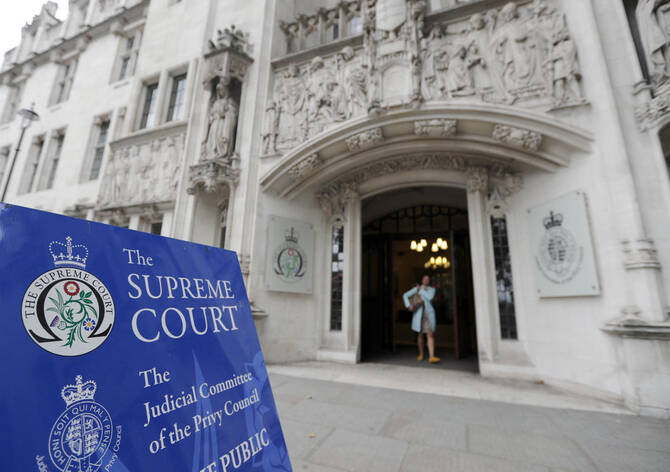

LONDON: The Supreme Court ruled Wednesday that the UK equalities law defines a woman as someone born biologically female.
Justice Patrick Hodge said five judges at the court had ruled unanimously that “the terms ‘woman’ and ‘sex’ in the Equality Act refer to a biological woman.”
The ruling means that a transgender person with a certificate that recognizes them as female should not be considered a woman for equality purposes.
The case stems from a 2018 law passed by the Scottish Parliament stating that there should be a 50 percent female representation on the boards of Scottish public bodies. That law included transgender women in its definition of women.
The women’s rights group successfully challenged that law, arguing that its redefinition of “woman” went beyond parliament’s powers.
Scottish officials then issued guidance stating that the definition of “woman” included a transgender woman with a gender recognition certificate.
FWS sought to overturn that.
“Not tying the definition of sex to its ordinary meaning means that public boards could conceivably comprise of 50 percent men, and 50 percent men with certificates, yet still lawfully meet the targets for female representation,” the group’s director Trina Budge said.
The challenge was rejected by a court in 2022, but the group was granted permission last year to take its case to the Supreme Court.
What are the arguments?
Aidan O’Neill, a lawyer for FWS, told the Supreme Court judges – three men and two women – that under the Equality Act “sex” should refer to biological sex and as understood “in ordinary, everyday language.”
“Our position is your sex, whether you are a man or a woman or a girl or a boy is determined from conception in utero, even before one’s birth, by one’s body,” he said on Tuesday. “It is an expression of one’s bodily reality. It is an immutable biological state.”
The women’s rights group counts among its supporters author J.K. Rowling, who reportedly donated tens of thousands of pounds to back its work. The “Harry Potter” writer has been vocal in arguing that the rights for trans women should not come at the expense of those who are born biologically female.
Opponents, including Amnesty International, said excluding transgender people from sex discrimination protections conflicts with human rights.
Amnesty submitted a brief in court saying it was concerned about the deterioration of the rights for trans people in the UK and abroad.
“A blanket policy of barring trans women from single-sex services is not a proportionate means to achieve a legitimate aim,” the human rights group said.


