Pakistan opposes expansion of permanent Security Council seats, calls for elected representation

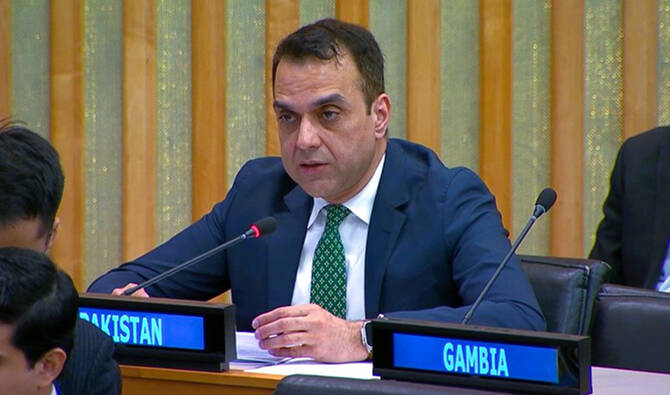
Pakistan's Deputy Permanent Representative to the United Nations, Usman Iqbal Jadoon, addresses the 4th informal meeting of the Intergovernmental Negotiations on Security Council (IGN) in New York, US, on April 15, 2025. (@PakistanUN_NY/X)
Short Url
Updated 16 April 2025
Follow

Pakistan opposes expansion of permanent Security Council seats, calls for elected representation

  • A Pakistani diplomat says ‘there is no justification for creating new centers of privilege within the UN’
  • He says the UN should accommodate interests of underrepresented blocs like the Arab Group, OIC

ISLAMABAD: Pakistan on Tuesday opposed any expansion of the permanent membership of the United Nations Security Council, warning against “creating new centers of privilege” within the world body and instead advocating for a more democratic and regionally representative Council.
The statement came during an informal meeting of the Intergovernmental Negotiations (IGN) on Security Council reform, where long-standing divisions between two key camps — the G4 nations and the Uniting for Consensus (UfC) group — were once again laid bare.
While the G4 — India, Brazil, Germany and Japan — seek permanent seats for themselves in a restructured Council, the UfC group, led by Italy and including Pakistan, favors an expansion only in the non-permanent category to ensure greater regional equity and accountability.
“We remain staunchly opposed to proposals for permanent seats, as there is no justification for creating new centers of privilege within the UN,” said Ambassador Usman Iqbal Jadoon, Pakistan’s Deputy Permanent Representative to the UN.
“Our goal is to democratize the Council and support a reform that corresponds to the interests of the large majority of member states and regional and cross-regional groups, not just a few self-appointed states,” he added.
Jadoon stressed that any increase in the Council’s size must reflect the dramatic rise in UN membership since 1945, particularly from small and medium-sized states, and warned that allocating a limited number of additional seats permanently to a handful of countries would diminish chances for broader representation.
He reiterated Pakistan’s support for the UfC proposal to raise the Council’s membership to 27, composed entirely of elected non-permanent members, with seats distributed among the UN’s five regional groups.
The approach, he continued, would better accommodate the interests of underrepresented blocs such as the Arab Group, the Organization of Islamic Cooperation (OIC) and Small Island Developing States (SIDS).
“Each seat allocated permanently to an individual country will be a permanent blow to equitable geographical distribution or regional representation in any sense of the word,” Jadoon argued.
The Pakistani diplomat maintained that permanent seats occupied by individual states, even without veto power, would entrench the status quo and undermine accountability, an outcome he described as antithetical to the spirit of reform.



Turkish defense firms eye aerospace and military co-production, tech transfer with Pakistan

Updated 14 sec ago
Follow

Turkish defense firms eye aerospace and military co-production, tech transfer with Pakistan

  • Turkish delegation meets Pakistan Engineering Council chairman to pursue joint ventures and technology transfer
  • Ankara has become one of Islamabad’s most significant partners in military hardware including warships, drones

ISLAMABAD: A high-level delegation of Turkish aerospace and defense manufacturers visited the Pakistan Engineering Council (PEC) this week to discuss joint ventures, co-production and technology-sharing opportunities with Pakistani counterparts, the state-run Associated Press of Pakistan (APP) reported on Thursday.

The visit comes as Pakistan and Türkiye move to deepen their defense and aerospace ties. Ankara has become one of Islamabad’s most significant partners in military hardware, including the supply of MILGEM-class warships, upgrades for Agosta-90B submarines and transfer of drone technology, while Pakistan Aeronautical Complex and Turkish Aerospace Industries have collaborated in aircraft modernization, avionics and training. Both countries also maintain close political and military cooperation as part of a long-standing strategic partnership.

On Thursday, a Turkish delegation, representing the Bursa Aerospace and Defense Cluster Association (BASDEC) and Türkiye’s Defense Industry Agency, met PEC Chairman Engr. Waseem Nazir to explore opportunities for joint ventures, co-production, technology transfer and long-term industrial partnerships, according to the APP report.

APP said representatives from fourteen Turkish aerospace and defense firms — including ERFA Torna, Bizpark (Ucaksan), FTS Tasarim, LEVKA, MFK, Milla Otomotiv, ONS Makine, Stamplast, Coskunoz Metal Form, Defense Systems, Rena Mekatronik, ETKA-D Otomotiv, COMIT and BASDEC — “presented their capabilities and explored avenues for collaboration, including Research and Development partnerships, co-production, localized manufacturing, and technology sharing.”

PEC Chairman Nazir briefed the delegation on Pakistan’s regulatory environment, ongoing engineering-sector reforms, digital modernization and efforts to align local industry with global standards. He praised Türkiye’s rapid advances in defense innovation and reaffirmed PEC’s commitment to strengthening international engineering linkages.

Officials from both sides discussed mechanisms for structured cooperation, including professional certification pathways, skill development programs and joint innovation initiatives aimed at supporting future industrial partnerships.

APP said the visit marked “a significant step toward deeper, technology-driven Pakistan–Turkiye engineering relations,” with both sides expressing commitment to expanding long-term aerospace and defense-sector cooperation.