Afghan children will die because of US funding cuts, aid official says

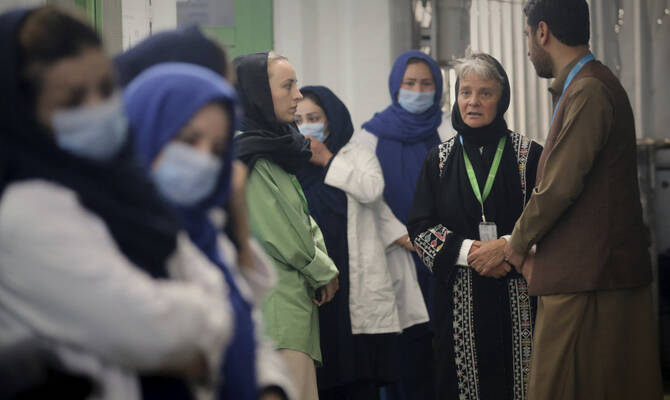
Action Against Hunger's country director Cobi Rietveld, second from right, talks to her staff at their therapeutic feeding unit in Kabul, Afghanistan, Tuesday, April 15, 2025. (AP)
Short Url
Updated 16 April 2025
Follow

Afghan children will die because of US funding cuts, aid official says

  • More than 3.5 million children in Afghanistan will suffer from acute malnutrition this year, an increase of 20 percent from 2024

Afghan children will die because of US funding cuts, an aid agency official said Tuesday.
The warning follows the cancelation of foreign aid contracts by President Donald Trump’s administration, including to Afghanistan where more than half of the population needs humanitarian assistance to survive.
Action Against Hunger initially stopped all US-funded activities in March after the money dried up suddenly. But it kept the most critical services going in northeastern Badakhshan province and the capital Kabul through its own budget, a measure that stopped this month.
Its therapeutic feeding unit in Kabul is empty and closing this week. There are no patients, and staff contracts are ending because of the US funding cuts.
“If we don’t treat children with acute malnutrition there is a very high risk of (them) dying,” Action Against Hunger’s country director, Cobi Rietveld, told The Associated Press. “No child should die because of malnutrition. If we don’t fight hunger, people will die of hunger. If they don’t get medical care, there is a high risk of dying. They don’t get medical care, they die.”
More than 3.5 million children in Afghanistan will suffer from acute malnutrition this year, an increase of 20 percent from 2024. Decades of conflict — including the 20-year US war with the Taliban — as well as entrenched poverty and climate shocks have contributed to the country’s humanitarian crisis.
Last year, the United States provided 43 percent of all international humanitarian funding to Afghanistan.
Rietveld said there were other nongovernmental organizations dealing with funding cuts to Afghanistan. “So when we cut the funding, there will be more children who are going to die of malnutrition.”
The children who came to the feeding unit often could not walk or even crawl. Sometimes they were unable to eat because they didn’t have the energy. All the services were provided free of charge, including three meals a day.
Rietveld said children would need to be referred to other places, where there was less capacity and technical knowledge.
Dr. Abdul Hamid Salehi said Afghan mothers were facing a crisis. Poverty levels among families meant it was impossible to treat severely malnourished children in private clinics.
“People used to come to us in large numbers, and they are still hoping and waiting for this funding to be found again or for someone to sponsor us so that we can resume our work and start serving patients once more.”


Moderate candidate wins emphatically over a populist in Portugal’s presidential runoff

Updated 5 sec ago
Follow

Moderate candidate wins emphatically over a populist in Portugal’s presidential runoff

LISBON: Center-left Socialist candidate António José Seguro recorded a thumping victory over hard-right populist André Ventura in Portugal’s runoff presidential election Sunday, according to official results with 99 percent of votes counted.
Seguro won a five-year term in Lisbon’s riverside “pink palace” with 66.7 percent of votes, compared with 33.3 percent for Ventura.
The ballot was an opportunity to test the depth of support for Ventura’s brash style, which has struck a chord with voters and helped make his Chega (Enough) party the second-biggest in the Portuguese parliament, as well as gauge the public appetite for Europe’s increasing shift to the right in recent years.
European Commission President Ursula von der Leyen congratulated Seguro and said on social media that “Portugal’s voice for our shared European values remains strong.”
Seguro, a longstanding Socialist politician, positioned himself as a moderate candidate who will cooperate with Portugal’s center-right minority government, repudiating Ventura’s anti-establishment and anti-immigrant tirades.
He won the backing of other mainstream politicians on the left and right who want to halt the rising populist tide.
In Portugal, the president is largely a figurehead with no executive power. Traditionally, the head of state stands above the political fray, mediating disputes and defusing tensions.
However, the president is an influential voice and possesses some powerful tools, being able to veto legislation from parliament, although the veto can be overturned. The head of state also possesses what in Portuguese political jargon is called an “atomic bomb,” the power to dissolve parliament and call early elections.
In May, Portugal held its third general election in three years in the country’s worst bout of political instability for decades, and steadying the ship is a key challenge for the next president.
Ventura, an eloquent and theatrical politician, rejected political accommodation in favor of a more combative stance.
Ventura said he will keep working to bring about a political “transformation” in Portugal.
“I tried to show there’s a different way … that we needed a different kind of president,” he told reporters.
Making it through to the runoff was already a milestone for Ventura and his party, which have recalibrated Portuguese politics.
One of Ventura’s main targets has been what he calls excessive immigration, as foreign workers have become more conspicuous in Portugal in recent years.
“Portugal is ours,” he said.
During the campaign, Ventura put up billboards across the country saying, “This isn’t Bangladesh” and “Immigrants shouldn’t be allowed to live on welfare.”
Although he founded his party less than seven years ago, its surge in public support made it the second-largest party in Portugal’s parliament in the May 18 general election.
Seguro will next month replace center-right President Marcelo Rebelo de Sousa, who has served the constitutional limit of two five-year terms.