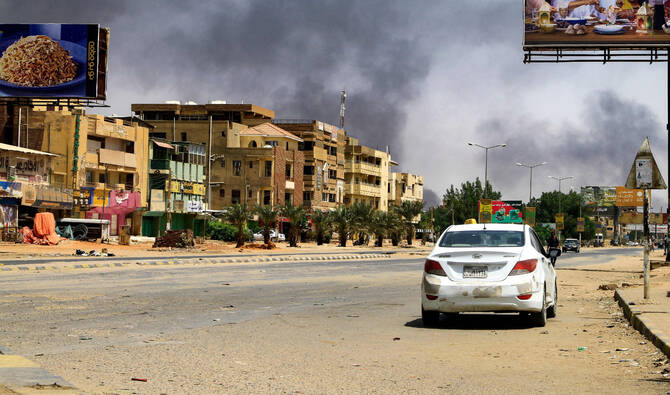

KHARTOUM: Sudan on Tuesday marked two years of a war that has killed tens of thousands, displaced 13 million and triggered the world’s worst humanitarian crisis — with no sign of peace.
Fighting erupted on April 15, 2023 between the regular army, led by Abdel Fattah Al-Burhan, and the paramilitary Rapid Support Forces, headed by his former deputy Mohamed Hamdan Dagalo.
Khartoum quickly became a battleground. Bodies lined the streets. Hundreds of thousands fled. Those left behind struggled to survive.
“I’ve lost half my bodyweight,” said 52-year-old Abdel Rafi Hussein, who stayed in the capital under RSF control until the army retook it last month.
“We’re safe (now), but still, we suffer from a lack of water and electricity and most hospitals aren’t working.”
The army’s recapture of Khartoum marked a turnaround after more than a year of setbacks.
Many civilians celebrated what they called the “liberation” of the capital from the RSF, whose fighters were accused of widespread looting and sexual violence.
But now the RSF is seeking to cement its grip on the vast western region of Darfur, where it has launched a deadly assault on El-Fasher — the last major city in the region outside its control.
More than 400 people have been killed in the offensive, the United Nations said, with the paramilitaries having claimed control of the nearby Zamzam displacement camp on Sunday.
An estimated 400,000 civilians fled the famine-hit camp as the RSF advanced, according to the International Organization for Migration.
The army said on Tuesday that it had carried out “successful air strikes” against RSF positions northeast of the city.
In total, the conflict has displaced some 13 million people, 3.8 million of them abroad, according to UN figures.
In London on Tuesday, officials from around the world were meeting to “agree a pathway to end the suffering” in Sudan, British Foreign Secretary David Lammy said.
But neither of the warring parties attended the meeting, where the African Union and European countries called for an end to the war.
“We have got to persuade the warring parties to protect civilians, to let aid in and across the country, and to put peace first,” he said, adding that the international community “simply cannot look away.”
UN refugee chief Filippo Grandi said Sudan had faced “indifference from the outside world.”
“The Sudanese are besieged on all sides — war, widespread abuses, indignity, hunger and other hardships,” he said, warning that “continuing to look away will have catastrophic consequences.”
Precise death tolls are not available because of the collapse of the health care system, but former US envoy Tom Perriello cited estimates last year of up to 150,000 dead.
Both sides have been accused of targeting civilians, shelling homes and blocking aid.
Some 25 million people face acute food insecurity, and eight million are on the brink of famine in what the UN has called the world’s largest hunger crisis.
On Tuesday, the world body said 2.1 million people are expected to return to Khartoum over the next six months following the army’s recapture.
In central Sudan — where the UN said nearly 400,000 people had returned to areas retaken by the army by March — many have come back to ruins, preferring destitution at home to displacement.
Wad Madani, just south of Khartoum, has had “no electricity for a year and a half,” 63-year-old Mohamed Al-Amin told AFP, adding that only some water treatment facilities have been restored sice the army retook the city in January.
Zainab Abdel Rahim, 38, returned to Khartoum North this month with her six children, to find their home looted beyond recognition.
“We’re trying to pull together the essentials, but there’s no water, no electricity, no medicine,” she said.
According to Catherine Russell, executive director of the UN’s children’s agency, the war has “shattered the lives of millions of children across Sudan.”
UNICEF figures show 2,776 children were killed or maimed in 2023 and 2024 — up from 150 in 2022 — and the real toll is likely higher.
The Zamzam camp, which had been sheltering up to a million people, was the first place in Sudan where famine was declared.
Other nearby camps have followed and famine is expected to take hold in El-Fasher itself by next month.
On Monday, Guterres called for an end to “the external support and flow of weapons” fueling the war.
“Those with greatest influence on the parties must use it to better the lives of people in Sudan — not to perpetuate this disaster,” he said, without naming any countries.