

Pakistan eyes Chinese investment for desalination plants in Karachi

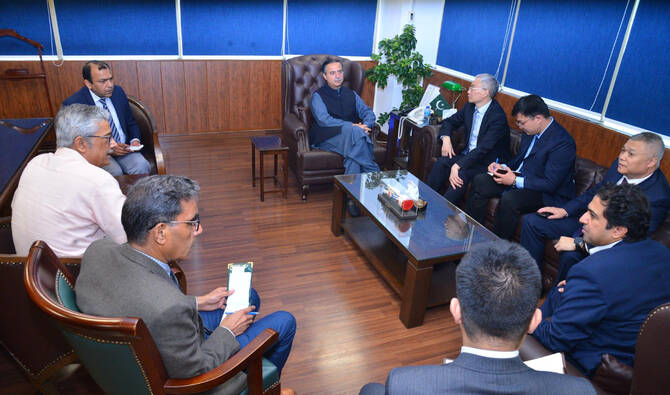
The handout photograph shows Chinese delegation meets Federal Minister for Maritime Affairs Muhammad Junaid Anwar Chaudhry (fourth right) in Islamabad, Pakistan, on April 15, 2025. (PID)
Short Url
Updated 15 April 2025
Follow

Pakistan eyes Chinese investment for desalination plants in Karachi

  • Six-member delegation of Chinese construction company meets Pakistan’s maritime affairs minister
  • Chinese company says committed to bringing advanced technologies and investment to Pakistan

ISLAMABAD: A Chinese construction company has expressed interest in installing desalination plants at Pakistan’s Port Qasim to convert seawater into drinking water, the maritime affairs ministry said on Tuesday, amid Islamabad’s efforts to resolve its water crisis. 

Pakistan has the fourth-highest rate of water consumption in the world. The country’s agriculture sector uses the most amount of freshwater than any other sector. Rainfall has steadily declined over the past few decades and experts have been warning for years the country will approach “absolute scarcity” of water by 2025.

The Chinese delegation met Maritime Affairs Minister Muhammad Junaid Anwar Chaudhry in Islamabad to discuss joint investment between the two countries. 

“One of the key topics discussed during the meeting was the installation of desalination plants at Port Qasim,” the ministry said in a statement. 

“The Chinese delegation expressed strong interest in investing in facilities to convert seawater into potable water, an initiative that would address both industrial and domestic water needs.”

Chaudhry highlighted that the desalination plants would supply drinking water and support small industrial operations around the port.

He added that these proposals were a step toward resolving regional water issues that aligned with Pakistan’s climate resilience and environmental sustainability objectives.

“Pakistan’s maritime sector offers promising opportunities for foreign investment, particularly in areas such as port development, logistics, maritime tourism and blue economy ventures,” the ministry quoted Chaudhry as saying.

He encouraged the delegation to explore investment in maritime tourism, part of Pakistan’s economic diversification plan and also invited them to upcoming forums showcasing the country’s potential as a regional maritime hub.

The ministry added the delegation was ready to carry out feasibility studies and collaborate with local stakeholders to launch the project “promptly and effectively.”

“We see tremendous potential in contributing to Pakistan’s sustainable infrastructure goals,” the ministry quoted Wang Yaodong, the head of the Chinese delegation, as saying. 

“Our company is committed to bringing advanced technologies and investment that can help improve living standards and support economic development.”


Pakistan, China agree to step up counterterrorism coordination, hold regular security talks

Updated 9 sec ago
Follow

Pakistan, China agree to step up counterterrorism coordination, hold regular security talks

  • The interior ministers of both countries agree on quarterly working-group meetings, annual high-level talks
  • Islamabad says Beijing expressed satisfaction over protection of Chinese citizens and projects in Pakistan

ISLAMABAD: Pakistan and China agreed on Wednesday to institutionalize closer collaboration on counterterrorism and internal security, committing to regular meetings and expanded coordination amid efforts by both countries to safeguard Chinese nationals and projects amid persistent militant threats in the region.

The agreement was reached during talks between Pakistan’s Interior Minister Mohsin Naqvi and his Chinese counterpart Wang Xiaohong at the headquarters of China’s Ministry of Public Security in Beijing, according to an official statement circulated in Islamabad.

China has raised concerns in the past over attacks targeting its citizens working on infrastructure and energy projects in Pakistan. Islamabad has stepped up security deployments and intelligence coordination in response, while Beijing has pushed for more structured and predictable security engagement.

“The two sides discussed joint counterterrorism measures, police training exchange programs and ways to expand cooperation in areas of mutual interest,” Pakistan’s interior ministry said in a statement, adding that the two officials agreed to hold working-level meetings every three months and annual talks at the interior ministers’ level.

Wang expressed satisfaction over Pakistan’s steps to protect Chinese citizens and projects, the statement added, praising Pakistan’s counterterrorism measures and internal security initiatives.

China also acknowledged Pakistan’s sacrifices in its fight against militancy, according to the statement.

Naqvi and Wang stressed the need to further improve coordination mechanisms to enhance operational cooperation between the two countries’ security agencies.

His meeting with his Chinese counterpart lasted for over three years.