

Fitch upgrades Pakistan’s credit rating to ‘B-’ on improving deficits and reforms

1 / 2
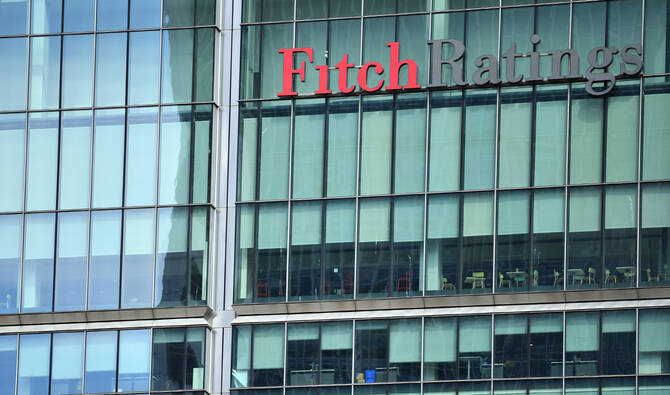
The photograph taken on May 27, 2025, shows the offices of Fitch Ratings building in London, Britain. (REUTERS/File)
2 / 2
The Fitch Ratings logo and a rising stock graph are seen in this illustration taken on January 29, 2025. (REUTERS/File)
Short Url
Updated 15 April 2025
Follow

Fitch upgrades Pakistan’s credit rating to ‘B-’ on improving deficits and reforms

  • Upgrade reflects confidence that the country would implement structural reforms, says Fitch
  • Shehbaz Sharif says improved rating sign of world’s growing confidence in Pakistan’s economy

KARACHI: Global ratings agency Fitch on Tuesday upgraded Pakistan’s foreign currency credit rating to ‘B-’ from ‘CCC+’ citing increased confidence in the country’s progress on narrowing its budget deficits, with Prime Minister Shehbaz Sharif hailing it as a sign of the world’s growing confidence in Pakistan’s economy. 

The upgrade reflects confidence that the country would implement structural reforms, supporting its International Monetary Fund (IMF) program performance and funding availability, Fitch said.

The agency said though ongoing global trade tensions could create external pressures on Pakistan, its low dependence on exports and market financing should mitigate risks.

“Prime Minister Shehbaz Sharif welcomes the improvement in Pakistan’s economic rating by global credit rating company Fitch,” a statement by the premier’s office said. 

“The improvement in the rating of Pakistan’s economy by international institutions is a manifestation of economic development and the confidence of the world community in Pakistan’s economy,” he added. 

Sharif said his government is working “tirelessly” to further improve Pakistan’s economy. 

Pakistan’s economy had been teetering on the brink of a sovereign default ever since inflation rose to a record high of 38 percent in May 2023 and reserves started declining rapidly. 

However, Pakistan’s economy was provided breathing space thanks in part to a $7 billion bailout program from the International Monetary Fund (IMF).

In March, the IMF reached a new deal with Pakistan which could unlock $1.3 billion in cash. 

Sharif’s government has vowed to implement the financial reforms, which include increasing the country’s tax base and privatizing loss-making entities to ensure sustainable growth.


Pakistan launches double-decker buses in Karachi after 65 years to tackle transport woes

Updated 31 December 2025
Follow

Pakistan launches double-decker buses in Karachi after 65 years to tackle transport woes

  • Karachi citizens will be able to travel in double-decker buses from Jan. 1, says Sindh government
  • City faces mounting transport challenges such as lack of buses, traffic congestion, poorly built roads

ISLAMABAD: The government in Sindh province on Wednesday launched double-decker buses in the provincial capital of Karachi after a gap of 65 years, vowing to improve public transport facilities in the metropolis. 

Double-decker buses are designed to carry more passengers than single-deck vehicles without taking up extra road space. The development takes place amid increasing criticism against the Sindh government regarding Karachi’s mounting public transport challenges and poor infrastructural problems. 

Pakistan’s largest city by population faces severe transportation challenges due to overcrowding in buses, traffic congestion and limited bus options. Commuters, as a result, rely on private vehicles or unregulated transport options that are often unsafe and expensive.

“Double-decker buses have once again been introduced for the people of Karachi after 65 years,” a statement issued by the Sindh information ministry said. 

Sindh Transportation Minister Sharjeel Inam Memon and Local Government Minister Syed Nasir Hussain Shah inaugurated the bus service. The ministry said the facility will be available to the public starting Jan. 1. 

The statement highlighted that new electric bus routes will also be launched across the entire province starting next week. It added that the aim of introducing air-conditioned buses, low-fare services, and fare subsidies is to make public transport more accessible to the people.

The ministry noted that approximately 1.5 million people travel daily in Karachi using the People’s Bus Service, while around 75,000 passengers use the Orange Line and Green Line BRT services.

“With the integration of these routes, efforts are being made to benefit up to 100,000 additional people,” the ministry said.
