

Pakistan condemns Israeli attack on Baptist Hospital in Gaza

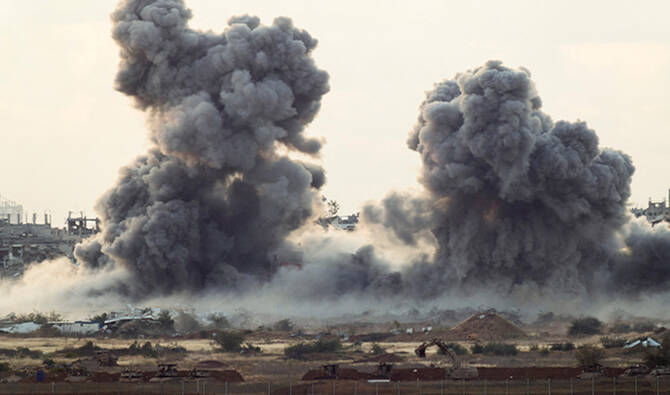
Smoke rises from Gaza after an explosion, as seen from the Israeli side of the border on April 14, 2025. (Reuters)
Short Url
Updated 15 April 2025
Follow

Pakistan condemns Israeli attack on Baptist Hospital in Gaza

  • Israeli military says took steps to reduce harm to civilians before it struck compound, saying it was used by Hamas to plan attacks
  • Health officials at hospital evacuated patients after call from someone who identified himself as Israeli security shortly before attack

ISLAMABAD: Pakistan on Tuesday condemned the bombing of the Baptist Hospital in Gaza by Israeli forces on Palm Sunday, calling it part of a pattern of targeting medical facilities, which constituted a “flagrant violation” of international humanitarian law. 

The Israeli military said in a statement it had taken steps to reduce harm to civilians before it struck the compound, which it said was being used by Hamas fighters to plan attacks. Hamas rejected the accusation and called for an international investigation. Health officials at the Al-Ahli Arab Hospital evacuated patients after a phone call from someone who identified himself as Israeli security shortly before the attack.

The hospital - an institution run by the Anglican Church in Jerusalem - was no longer operational, according to Gaza's health ministry. No casualties were reported in the strike. 

“That it occurred on Palm Sunday, a sacred occasion for Christians, underscores Israel’s blatant disregard for religious sanctity and civilian lives,” the Pakistani foreign office said. 

“Israel’s relentless assaults have crippled Gaza’s healthcare system, depriving critically ill patients of vital medical care. Coupled with the blockade on humanitarian aid, these actions reflect a deliberate strategy to prolong suffering and entrench conflict.”

Pakistan demanded an immediate end to Israel’s “ongoing atrocities,” saying they had resulted in the indiscriminate killing of innocent and unarmed Palestinians, including women and children, and the “systematic destruction” of civilian infrastructure.  

“Pakistan calls for an immediate halt to the hostilities by Israeli occupying forces and reiterates its support for the two-State solution, with a viable, independent and sovereign State of Palestine on pre-June 1967 borders with Al Quds Al Sharif as its capital,” the statement added. 

“Pakistan urges the international community to take decisive action to hold Israel accountable and protect Palestinian civilians from further violence.”

Sunday's strikes came as Hamas leaders began a fresh round of talks in Cairo in a bid to salvage a stalled ceasefire agreement with Israel, as Egypt, Qatar, and the United States attempted to bridge gaps between the sides. 

Media footage widely showed significant destruction in and outside the hospital compound's church, and patients who could not leave.

The Episcopal Church in Jerusalem said the warning to evacuate the hospital came 20 minutes before the strike that destroyed the two-storey genetic laboratory, and damaged the pharmacy and emergency department buildings and other surrounding structures.

"We call upon all governments and people of goodwill to intervene to stop all kinds of attacks on medical and humanitarian institutions," the church said in a statement.

The Palestinian foreign ministry and Hamas condemned the attack, saying Israel was destroying Gaza's healthcare system. Israel says Hamas systematically exploits civilian structures, including hospitals, which the group denies. Israeli forces have carried out numerous raids on medical facilities in Gaza.

With inputs from Reuters


Pakistan expands pilgrim travel system for Iran, Iraq with licenses to 67 new operators

Updated 9 sec ago
Follow

Pakistan expands pilgrim travel system for Iran, Iraq with licenses to 67 new operators

  • New system requires all Iraq-Iran pilgrimages to be organized by licensed groups under state oversight
  • Long-running “Salar” model relied on informal caravan leaders, leading to overstays and missing pilgrims

ISLAMABAD: Pakistan has issued registration certificates to 67 additional licensed pilgrimage companies, expanding a tightly regulated travel system designed to curb overstays, undocumented migration and security risks linked to religious travel to Iran and Iraq, the ministry of religious affairs said on Tuesday.

The move is part of a broader overhaul of Pakistan’s pilgrim management framework after authorities confirmed that tens of thousands of Pakistani pilgrims had overstayed or gone missing abroad over the past decade, raising concerns with host governments and triggering diplomatic pressure on Islamabad to tighten oversight.

“The dream of safe travel for pilgrims to Iran and Iraq through better facilities and a transparent mechanism is set to be realized,” the religious affairs ministry said in a statement, quoting Federal Minister for Religious Affairs Sardar Muhammad Yousaf, who announced that 67 new Ziyarat Group Organizers had been registered.

Pakistan’s government has dismantled the decades-old “Salar” system, under which informal caravan leaders arranged pilgrimages with limited state oversight. The model was blamed for weak documentation, poor accountability and widespread overstays, particularly during peak pilgrimage seasons. 

Under the new framework, only licensed companies are allowed to organize pilgrimages, and they are held directly responsible for ensuring pilgrims return within approved timelines.

Authorities say pilgrimages to Iran and Iraq will be conducted exclusively under the new system from January 2026, marking a full transition to regulated travel. The religion ministry said it has now completed registration of 24 operators in the first phase and 67 more in the second, with remaining applicants urged to complete documentation to obtain licenses.

The religious affairs ministry said a digital management system is being developed with the National Information Technology Board to monitor pilgrim movements and operator compliance, while a licensed ferry operator has also secured approval to explore future sea travel options.

The overhaul has been accompanied by tighter coordination with host countries. Earlier this month, Pakistan and Iraq agreed to share verified pilgrim data and restrict entry to travelers cleared under the new system, following talks between interior ministers in Islamabad and Baghdad. Pakistan has also barred overland pilgrim travel for major religious events, citing security risks in its southwestern Balochistan province, meaning travel to Iran and Iraq is now limited to approved air routes.

Officials say the reforms are aimed at balancing facilitation with accountability, as tens of thousands of Pakistani pilgrims travel annually to key Shia shrines, including Karbala and Najaf in Iraq and Mashhad and Qom in Iran. Travel peaks during religious occasions such as Arbaeen, when millions of worshippers converge on Iraq, placing heavy logistical and security demands on regional authorities.

The government says the new system is intended to restore confidence among host countries while ensuring safer, more transparent travel for Pakistani pilgrims.