

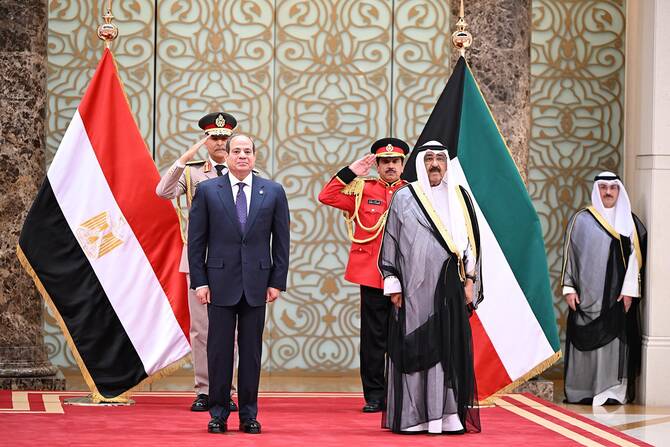
Egyptian president Abdel Fattah El-Sisi visits Kuwait as part of short Gulf tour

Egyptian President Abdel Fattah El-Sisi and Emir of Kuwait Sheikh Meshal Al-Ahmad Al-Jaber Al-Sabah. (KUNA)
Short Url
Updated 14 April 2025
Follow

Egyptian president Abdel Fattah El-Sisi visits Kuwait as part of short Gulf tour

  • He was expected to discuss with the country’s emir enhanced cooperation in the industrial, environmental, tourism, construction, housing, media and sports sectors
  • Kuwait was the 2nd stop on a 2-state tour that began in Doha, where he discussed economic partnerships with Qatar’s emir

LONDON: Egyptian President Abdel Fattah El-Sisi arrived in Kuwait on Monday afternoon on the second leg of a two-state tour of the Arabian Gulf.

He was greeted at the Amiri Airport by Kuwait’s emir, Sheikh Meshal Al-Ahmad Al-Jaber Al-Sabah, senior ministers and other officials. The national anthems of both countries were played and the Egyptian president and his delegation were honored with a 21-gun salute.

The two leaders were expected to discuss several of issues of mutual interest, as well as enhanced cooperation between their countries, following the signing of 10 memorandums of understanding in September last year covering the industrial, environmental, tourism, housing, construction, media and sports sectors, the Kuwait News Agency reported.

The emir of Kuwait visited Egypt in April last year, his first state visit after assuming power in December 2023.

El-Sisi flew to Kuwait from Qatar, where he discussed economic partnerships with Emir Sheikh Tamim bin Hamad Al-Thani. They agreed to a package of direct investments worth up to $7.5 billion, with the aim of supporting and strengthening sustainable economic development in both countries, the Middle East News Agency reported.


Hezbollah says targeted Israeli bases, tanks after strikes on Lebanon

Updated 2 sec ago
Follow

Hezbollah says targeted Israeli bases, tanks after strikes on Lebanon

BEIRUT: Lebanese militant group Hezbollah said Tuesday it targeted several Israeli military bases and tanks in response to Israeli strikes on the group’s strongholds in Lebanon, including the south Beirut suburbs.
Israel continues to carry out successive air raids, particularly on Beirut’s southern suburbs and the south of the country, after issuing evacuation warnings to residents, while Lebanese authorities on Monday recorded the displacement of more than 58,000 people from areas hit by the strikes.
Israel announced Tuesday morning it had begun a new round of “simultaneous strikes in Tehran and Beirut.”
It announced later that day that it hit “approximately 60” targets “belonging to the Hezbollah and Hamas terrorist organizations.”
The Israeli military also said it had deployed troops to several locations in southern Lebanon in what it described as a “forward defense” measure along the border.
Defense Minister Israel Katz said he “authorized the Israel Defense Forces (IDF) to advance and take control of additional strategic positions in Lebanon in order to prevent attacks on Israeli border communities.”
Lebanon was drawn into the regional war on Monday after an initial attack on Israel by Hezbollah, which said it wanted to “avenge” the killing of Iranian supreme leader Ayatollah Ali Khamenei during the US-Israeli strikes.
Israel promptly launched large-scale strikes on Lebanon, where the government on Monday declared an immediate ban on Hezbollah’s military activities.
In separate statements, Hezbollah on Tuesday claimed responsibility for 11 attacks on Israel, saying it targeted at least five Israeli tanks, three of them in Lebanese territory using guided missiles and “appropriate weapons.”
The group also said it used attack drones and rocket salvos to target several bases in northern Israel and the Golan Heights, occupied by Israel since 1967.
Additionally, it claimed to have downed an Israeli drone over the southern city of Nabatiyeh.
These attacks came “in response to the criminal Israeli aggression on dozens of Lebanese cities and towns,” Hezbollah said.
Since the early morning hours, Beirut’s southern suburbs have been subjected to a series of air strikes targeting several buildings after evacuation warnings.
AFP photographers saw huge plumes of smoke rising into the air and obscuring the sky.
Hezbollah’s Al-Manar TV broadcaster said its Beirut headquarters had been targeted overnight and announced Tuesday morning that Israel targeted the offices of Hezbollah’s Al-Nour radio broadcaster as well.
In a statement, Hezbollah condemned the strikes on “two civilian media outlets” saying they were aimed at “silencing the voice and image of the resistance.”
The southern city of Sidon, largely spared during the last Hezbollah-Israel war, was struck twice on Tuesday.
One strike hit a headquarters belonging to Jamaa Islamiya, an Islamist group allied with Hamas and Hezbollah, and the other came after an evacuation warning elsewhere in the city.
The surroundings of Tyre, further south, were also struck after evacuation warnings.