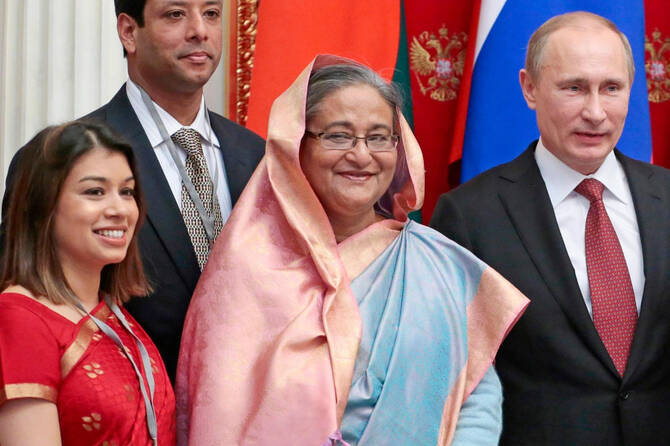
DHAKA: A judge in Bangladesh issued an arrest warrant for British lawmaker and former government minister Tulip Siddiq, a niece of Bangladesh’s former Prime Minister Sheikh Hasina, who was ousted from her 15-year rule in a mass uprising in August.
The country’s Anti-Corruption Commission has been investigating allegations against Siddiq that she and her family members, including Hasina, illegally received land in a state-owned township project near the capital, Dhaka.
Senior Special Judge of Dhaka Metropolitan Zakir Hossain passed the order on Sunday, after considering charges in three separate cases filed by the Anti-Corruption Commission, the leading Dhaka-based Bengali-language Prothom Alo newspaper reported.
Siddiq, 42, was named in the arrest warrant along with more than 50 others including her mother, Sheikh Rehana, and her brother, Radwan Siddiq, the newspaper reported.
Siddiq said the charges were “a completely politically motivated smear campaign, trying to harass me.”
“There is no evidence that I’ve done anything wrong,” she told reporters in London.
Siddiq’s lawyers also called the charges baseless. “To be clear, there is no basis at all for any charges to be made against her, and there is absolutely no truth in any allegation that she received a plot of land in Dhaka through illegal means,” the law firm Stephenson Harwood said in a statement.
The lawmaker, who represents the north London district of Hampstead and Highgate in Parliament, served in Britain’s center-left Labour Party government as economic secretary to the Treasury — the minister responsible for tackling financial corruption.
She quit that post in January after she was named in an anti-corruption investigation into Hasina and her family in Bangladesh. The investigation alleged that Siddiq’s family was involved in brokering a 2013 deal with Russia for a nuclear power plant in Bangladesh in which large sums of money were said to have been embezzled.
Siddiq said in January that she had been cleared of wrongdoing, but that the issue was becoming “a distraction from the work of the government.”
Hasina’s Bangladesh Awami League party says the charges are politically motivated to destroy the reputation of the prominent family. Hasina’s father, Sheikh Mujibur Rahman, is Bangladesh’s independence leader. The country gained independence in 1971 under his leadership after a nine-month war against Pakistan.
Hasina has been in exile in India since early August.
After the ouster of Hasina on Aug. 5 last year, Siddiq’s mother’s home in Dhaka’s upscale Gulshan area was looted and vandalized, and so far no police case has been filed over the incident. Hasina accused Bangladesh’s interim administration headed by Nobel Peace laureate Muhammad Yunus of backing mobs to attack her followers across the country. The home affairs adviser says they are trying to restore order in the country.


![]()


Bangladesh arrest warrant issued for British lawmaker linked to ex-Premier Hasina
Short Url
https://arab.news/m286g
Bangladesh arrest warrant issued for British lawmaker linked to ex-Premier Hasina
- Tulip Siddiq, 42, is a niece of ex-Bangladesh prime minister Sheikh Hasina who was ousted in violent uprising in 2024
- Country’s anti-corruption watchdog has been probing Siddiq for allegedly receiving land illegally in state-owned project
Soldiers on the streets. What’s behind South Africa’s plan to deploy army in high-crime areas
JOHANNESBURG: It’s an unusual move for the African continent’s leading democracy: South Africa’s president announced earlier this month that he will deploy the army to high-crime areas to fight the scourge of organized crime, gang violence and illegal mining.
President Cyril Ramaphosa said soldiers would take to the streets — in places that have some of the world’s highest rates of violent crime — to combat what he described as the “most immediate threat” to South Africa’s democracy and economic development.
He said the deployment would happen in three of the country’s nine provinces, without giving a timeline. Some critics, however, say the army deployment could be seen as an admission that Ramaphosa’s government is losing the battle.
A top tourist city marred by violence
With a population of some 3.8 million, the stunningly beautiful Cape Town is South Africa’s second-largest city and one of its top tourist attractions.
But the neighborhoods on its outskirts, known as the Cape Flats, are notorious for deadly gang violence.
Street gangs with names such as the Americans, the Hard Livings and the Terrible Josters have for years battled for control of the illegal drug trade, while also being involved in extortion rackets, prostitution and contract killings.
Bystanders, including children, are often caught in the crossfire and killed in gang-related shootings. According to the latest crime statistics, South Africa’s three police precincts with the most serious crime rates are all in and around Cape Town.
Ramaphosa said one part of the army would deploy in the Western Cape province, where Cape Town is located and which statistics say has around 90 percent of the country’s gang-related killings.
Two other provinces, he said, would also see troop deployments: Gauteng, which is home to Johannesburg, South Africa’s biggest city, and the Eastern Cape province.
Illegal mining run by organized crime syndicates
The outskirts of Johannesburg and the wider Gauteng province are dotted with abandoned mine shafts and authorities there have long grappled with illegal gold mining.
They say the mining gang, known as zama zamas, are typically run by heavily armed crime syndicates, brutal in protecting their operations. They use “informal miners” recruited from desperate and impoverished communities to go into the shafts, searching for leftover precious deposits.
These gangs are often connected to high-profile violence, including a 2022 case that shocked South Africa when around 80 alleged illegal miners were accused of gang raping eight women who were part of a music video shoot at an abandoned mine.
Last year, a standoff between police and illegal miners in an abandoned mine left at least 87 miners dead after police took a hard-line approach and cut off their food supplies in an attempt to force them out.
The illegal miners are often involved in other crimes in nearby communities, analysts say, and turf battles between rival gangs have forced people to leave their homes and seek safety elsewhere.
Authorities say there are an estimated 30,000 illegal miners in South Africa, operating in some of its 6,000 abandoned mine shafts.
The government has noted an increase in illegal mining, which it estimates is worth more than $4 billion a year in gold lost to criminal syndicates.
The trade is believed to be predominantly controlled by migrants from neighboring Lesotho, Zimbabwe, and Mozambique, stoking anger among South African communities against both the criminal bosses and foreigners living in the local community.
Previous army deployments linked to apartheid
Ramaphosa is well aware that South Africans old enough to remember the years of forced racial segregation under the apartheid system, which ended in 1994, likely will recall images of troops deployed to suppress pro-democracy protests.
Mindful of that painful past, he said it was important not to deploy the army “without a good reason.”
But he said it has now “become necessary due to a surge in violent organized crime that threatens the safety of our people and the authority of the state.”
Ramaphosa sought to calm concerns by saying the army would operate under police command.
There have been other recent deployments of South African troops. In 2023, soldiers fanned out into the streets after a series of truck burnings raised concerns over wider public disorder. And around 25,000 troops were deployed in 2021 to quell violent riots sparked by the imprisonment of former President Jacob Zuma.
South Africa also used soldiers to enforce strict lockdown rules during the early months of the COVID-19 pandemic in 2020.
Crime experts have expressed concern over Ramaphosa’s latest deployment plans, insisting the army is not a long-term solution to fighting crime and soldiers are not experts in domestic law enforcement.
Firoz Cachalia, the country’s police minister, has backed Ramaphosa and insisted the army will act in support of police and “their operations in particular locations.”
He said the deployment is time-limited and meant to stabilize areas “where people are losing their lives” every day.
President Cyril Ramaphosa said soldiers would take to the streets — in places that have some of the world’s highest rates of violent crime — to combat what he described as the “most immediate threat” to South Africa’s democracy and economic development.
He said the deployment would happen in three of the country’s nine provinces, without giving a timeline. Some critics, however, say the army deployment could be seen as an admission that Ramaphosa’s government is losing the battle.
A top tourist city marred by violence
With a population of some 3.8 million, the stunningly beautiful Cape Town is South Africa’s second-largest city and one of its top tourist attractions.
But the neighborhoods on its outskirts, known as the Cape Flats, are notorious for deadly gang violence.
Street gangs with names such as the Americans, the Hard Livings and the Terrible Josters have for years battled for control of the illegal drug trade, while also being involved in extortion rackets, prostitution and contract killings.
Bystanders, including children, are often caught in the crossfire and killed in gang-related shootings. According to the latest crime statistics, South Africa’s three police precincts with the most serious crime rates are all in and around Cape Town.
Ramaphosa said one part of the army would deploy in the Western Cape province, where Cape Town is located and which statistics say has around 90 percent of the country’s gang-related killings.
Two other provinces, he said, would also see troop deployments: Gauteng, which is home to Johannesburg, South Africa’s biggest city, and the Eastern Cape province.
Illegal mining run by organized crime syndicates
The outskirts of Johannesburg and the wider Gauteng province are dotted with abandoned mine shafts and authorities there have long grappled with illegal gold mining.
They say the mining gang, known as zama zamas, are typically run by heavily armed crime syndicates, brutal in protecting their operations. They use “informal miners” recruited from desperate and impoverished communities to go into the shafts, searching for leftover precious deposits.
These gangs are often connected to high-profile violence, including a 2022 case that shocked South Africa when around 80 alleged illegal miners were accused of gang raping eight women who were part of a music video shoot at an abandoned mine.
Last year, a standoff between police and illegal miners in an abandoned mine left at least 87 miners dead after police took a hard-line approach and cut off their food supplies in an attempt to force them out.
The illegal miners are often involved in other crimes in nearby communities, analysts say, and turf battles between rival gangs have forced people to leave their homes and seek safety elsewhere.
Authorities say there are an estimated 30,000 illegal miners in South Africa, operating in some of its 6,000 abandoned mine shafts.
The government has noted an increase in illegal mining, which it estimates is worth more than $4 billion a year in gold lost to criminal syndicates.
The trade is believed to be predominantly controlled by migrants from neighboring Lesotho, Zimbabwe, and Mozambique, stoking anger among South African communities against both the criminal bosses and foreigners living in the local community.
Previous army deployments linked to apartheid
Ramaphosa is well aware that South Africans old enough to remember the years of forced racial segregation under the apartheid system, which ended in 1994, likely will recall images of troops deployed to suppress pro-democracy protests.
Mindful of that painful past, he said it was important not to deploy the army “without a good reason.”
But he said it has now “become necessary due to a surge in violent organized crime that threatens the safety of our people and the authority of the state.”
Ramaphosa sought to calm concerns by saying the army would operate under police command.
There have been other recent deployments of South African troops. In 2023, soldiers fanned out into the streets after a series of truck burnings raised concerns over wider public disorder. And around 25,000 troops were deployed in 2021 to quell violent riots sparked by the imprisonment of former President Jacob Zuma.
South Africa also used soldiers to enforce strict lockdown rules during the early months of the COVID-19 pandemic in 2020.
Crime experts have expressed concern over Ramaphosa’s latest deployment plans, insisting the army is not a long-term solution to fighting crime and soldiers are not experts in domestic law enforcement.
Firoz Cachalia, the country’s police minister, has backed Ramaphosa and insisted the army will act in support of police and “their operations in particular locations.”
He said the deployment is time-limited and meant to stabilize areas “where people are losing their lives” every day.
Latest updates


© 2026 SAUDI RESEARCH & PUBLISHING COMPANY, All Rights Reserved And subject to Terms of Use Agreement.