

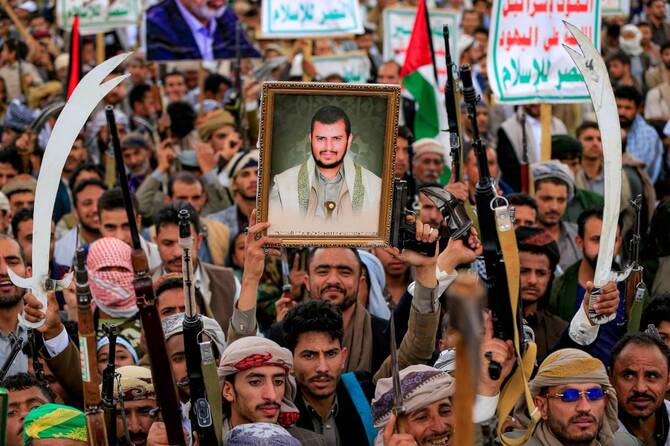
Yemen’s Houthis say six killed in US strike on Sanaa province

A demonstrator holds a framed picture of Abdul Malik al-Huthi, leader of Yemen's Huthi group, during a rally in Sanaa, Apr. 11, 2025. (AFP)
Short Url
Updated 14 April 2025
Follow

Yemen’s Houthis say six killed in US strike on Sanaa province

  • US strikes targeted various other areas in Yemen, including in the Saada and Hodeida provinces

DUBAI: Suspected US airstrikes around Yemen’s rebel-held capital killed at least six people and wounded 26 overnight, the Houthis said Monday as they also claimed shooting down another American MQ-9 Reaper drone.
Since its start nearly a month ago, the intense campaign of US airstrikes under President Donald Trump targeting the rebels over their attacks on shipping in Mideast waters — related to the Israel-Hamas war — has killed over 120 people, according to casualty figures released Monday by the Houthis’ Health Ministry.
Footage aired by the Houthis’ Al-Masirah satellite news channel showed firefighters spraying water on a raging fire they described as being sparked by the airstrikes. Rubble littered a street as rescuers carried one person away from the site, which the rebels claimed was a ceramics factory in the Bani Matar neighborhood of Sanaa, the capital.
The US military’s Central Command, which oversees American military operations, did not acknowledge the strikes. That follows a pattern for the command, which now has authorization from the White House to conduct strikes at will in the campaign that began March 15.
The American military also hasn’t been providing any information on targets hit. The White House has said over 200 strikes have been conducted so far.


Houthis claim another American drone shot down
The Houthis separately claimed Sunday night they shot down an MQ-9 Reaper drone over Yemen’s Hajjah governorate. 
Brig. Gen. Yahya Saree, a Houthi military spokesman, described the downing in a prerecorded video message as the fourth in two weeks by the rebels. Saree said the rebels targeted the drone with “a locally manufactured missile.” The Houthis have surface-to-air missiles — such as the Iranian missile known as the 358 — capable of downing aircraft.
Iran denies arming the rebels, though Tehran-manufactured weaponry has been found on the battlefield and in sea shipments heading to Yemen for the Shiite Houthi rebels despite a United Nations arms embargo.
General Atomics Reapers, which cost around $30 million apiece, can fly at altitudes over 40,000 feet (12,100 meters) and remain in the air for over 30 hours. They have been flown by both the US military and the CIA for years over Afghanistan, Iraq and now Yemen.
Central Command said it was aware of “reports” of the drone being shot down, but did not elaborate.

US strikes come as part of monthlong intense campaign
An AP review has found the new US operation against the Houthis under President Donald Trump appears more extensive than that under former President Joe Biden, as Washington moves from solely targeting launch sites to firing at ranking personnel and dropping bombs on cities.
The new campaign of airstrikes started after the rebels threatened to begin targeting “Israeli” ships again over Israel blocking aid entering the Gaza Strip. The rebels have loosely defined what constitutes an Israeli ship, meaning many vessels could be targeted.
The Houthis targeted more than 100 merchant vessels with missiles and drones, sinking two of them and killing four sailors from November 2023 until January of this year. They also launched attacks targeting American warships without success.
The US campaign shows no signs of stopping, as the Trump administration has also linked its airstrikes on the Houthis to an effort to pressure Iran over its rapidly advancing nuclear program.


Israeli police kill Bedouin man during raid in southern Israel, local official says

Updated 58 min 48 sec ago
Follow

Israeli police kill Bedouin man during raid in southern Israel, local official says

  • The shooting of 36-year-old Muhammed Hussein Tarabin threatened to worsen the already strained relations between the Israeli government and the country’s Bedouin minority

TEL AVIV: Israeli police shot and killed a Bedouin Arab man during an overnight raid in his village in southern Israel, according to media reports and a local official.
The shooting of 36-year-old Muhammed Hussein Tarabin threatened to worsen the already strained relations between the Israeli government and the country’s Bedouin minority.
Israeli police have been conducting a large-scale operation in the village of Tarabin for the past week in what they describe as a crackdown on local crime.
Talal Alkernawi, the mayor of the nearby town of Rahat, confirmed the man’s death.
Israeli police said they opened fire on a man who had “endangered” forces during an arrest raid.
The Israeli news site Haaretz cited relatives as saying Tarabin, whose family name shares the name of the village, was in his home.
In a video statement, Tarabin’s 11-year-old son, Hussein, said that men in uniform came to their house at night. He heard shots and saw his father’s body lying on the ground.
Israel’s far-right National Security Minister Itamar Ben-Gvir, who oversees the police force, expressed support for the police. “Anyone who endangers our police officers and fighters must be neutralized,” he posted on X.
Prime Minister Benjamin Netanyahu said Sunday that the country would do everything to prevent the Negev desert in southern Israel from becoming the “wild south”. He congratulated Ben-Gvir on leading the initiative and said he would visit the region in the coming days.
Israel’s more than 200,000 Bedouin are the poorest members of the country’s Arab minority, which also includes Christian and Muslim urban communities. Israel’s Arab population makes up roughly 20 percent of the country’s 10 million people. While they are citizens with the right to vote, they often suffer discrimination and tend to identify with Palestinians in the occupied West Bank and the Gaza Strip.
The Bedouin sector has grappled with crime and poverty, and about one-third of its members live in villages that the Israeli government considers illegal. Israel says it is trying to bring order to a lawless area, but Bedouin leaders accuse the government of neglect, trying to destroy their way of life or pushing to relocate them to less desirable areas.
Residents say police have made around two dozen arrests in the village of Tarabin over the past week. Nati Yefet, a spokesman for the regional council of unrecognized villages in the area, said most have been quickly released.
“They’re looking for people, crime-related things, but they didn’t find anything,” Yefet said. He accused Ben-Gvir of intensifying the raids in the run-up to elections expected later this year.
Marwan Abu Frieh, of the Arab rights group Adalah, said Israel has stepped up house demolitions in recent years, leaving thousands of residents without shelter and worsening the plight of communities often denied basic services.