

Saudi demining project clears nearly half a million explosives in Yemen

1 / 3
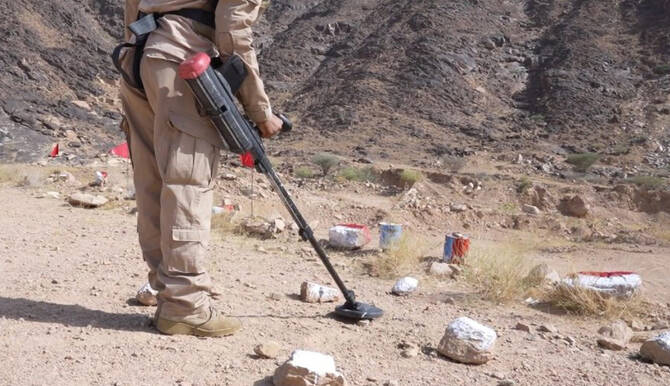
The initiative trains local demining engineers and equips them with modern tools. (Supplied/Project Masam)
2 / 3
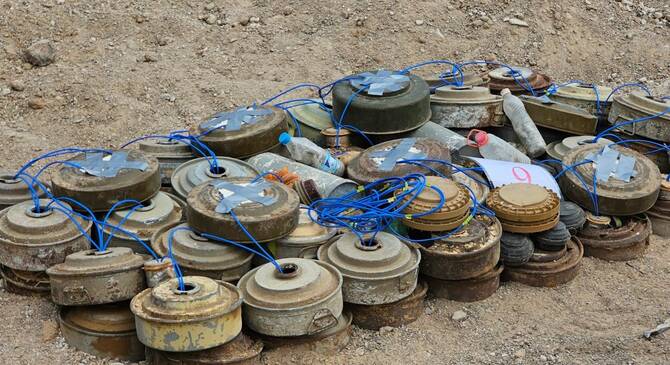
The initiative trains local demining engineers and equips them with modern tools. (Supplied/Project Masam)
3 / 3
The initiative trains local demining engineers and equips them with modern tools. (Supplied/Project Masam)
Short Url
Updated 13 April 2025
Follow

Saudi demining project clears nearly half a million explosives in Yemen

RIYADH: A Saudi-led humanitarian initiative in Yemen has cleared 486,651 land mines and unexploded ordnance since the project began in mid-2018, according to a recent report.

These include 325,378 items of unexploded ordnance, 146,285 anti-tank mines, 8,212 improvised explosive devices, and 6,776 anti-personnel mines, according to Ousama Al-Gosaibi, the project’s managing director.

Project Masam, overseen by the Saudi aid agency KSrelief, continues to remove deadly devices laid in Yemen by the Houthis. These explosives pose a threat to civilians, including children, women, and the elderly.

Last week, the project’s special teams destroyed 511 items of unexploded ordnance, 23 anti-tank mines, six anti-personnel mines, and three improvised explosive devices.

The project is carried out by Saudi personnel and international experts, with a team of 550 staff and 32 trained clearance teams working to remove various types of mines and ordnance, the Saudi Press Agency reported.

Demining operations have taken place in Marib, Aden, Jouf, Shabwa, Taiz, Hodeidah, Lahij, Sanaa, Al-Bayda, Al-Dhale, and Saada.

The initiative also trains local demining engineers and equips them with modern tools. Additionally, it provides support to Yemenis injured by these devices.

“Every mine removed is a life potentially saved, a home reclaimed, a future restored. Demining is not just about removing explosives; it is about restoring hope, stability, and economic recovery,” Al-Gosaibi said.

Since the conflict began, about 5 million people have been displaced in Yemen, many due to land mines. Masam teams work to clear villages, roads and schools, enabling the safe movement of civilians and the delivery of humanitarian aid.


Celestial spectacle in Saudi Arabia’s north on first day of Ramadan

Updated 19 February 2026
Follow

Celestial spectacle in Saudi Arabia’s north on first day of Ramadan

  • Venus-crescent moon alignment visible over Northern Borders Region skies
  • Meteorology Center completes operational plan for the holy month

ARAR/JEDDAH: The holy month of Ramadan has commenced in Saudi Arabia with a striking astronomical display in the Northern Borders Region, setting a serene tone for the month as meteorological authorities confirmed full readiness to support pilgrims in Makkah and Madinah, the Saudi Press Agency (SPA) reported.

On Tuesday evening, the skies over Arar witnessed a rare alignment as the planet Venus paired with the slender crescent moon marking the first day of Ramadan. Appearing shortly after sunset, the crescent shimmered low on the western horizon above Venus — one of the brightest celestial bodies — in a display enhanced by clear skies.

While the conjunction is a recurring astronomical phenomenon caused by the apparent proximity of the two bodies as viewed from Earth,  its coincidence with the start of the holy month added a special aesthetic and spiritual dimension to the atmosphere in the north, SPA said.

Meteorological readiness

As the faithful began their fasting, the National Center for Meteorology (NCM) announced the completion of its operational and technical preparations for Ramadan 1447 AH.

The plan includes heightened performance levels at observatories in the Kingdom’s airports to manage increased flight traffic and aviation safety. (SPA)

NCM Chief Executive Dr. Ayman bin Salem Ghulam confirmed that the center has finalized a comprehensive plan to ensure round-the-clock weather monitoring for Makkah, Madinah, and the roads leading to the Two Holy Mosques. The initiative aims to provide accurate forecasting to enhance the safety and comfort of the influx of visitors and Umrah pilgrims.

The plan includes heightened performance levels at observatories in the Kingdom’s airports to manage increased flight traffic and aviation safety.

To ensure pilgrims have real-time access to information, the NCM has integrated its data with the "Nusuk" and "Tawakkalna" smart applications. Ten-day extended forecasts and real-time alerts will also be available via the "Anwaa" app and displayed on guidance boards along highways.

The center has mobilized 14 media platforms to deliver swift weather alerts, ensuring high standards of security and logistical support throughout the season.