

Pakistan says exports to Europe grew by 9.4% during FY25

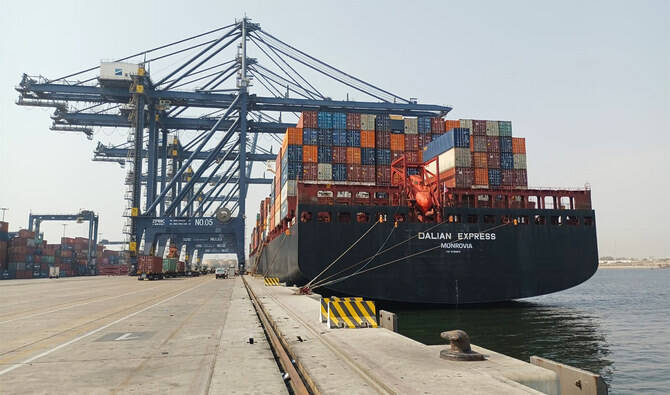
This picture taken on March 8, 2023, shows a cargo ship set to sail from a sea port in Karachi, Pakistan. (Radio Pakistan/File)
Short Url
Updated 12 April 2025
Follow

Pakistan says exports to Europe grew by 9.4% during FY25

  • Growth driven largely due to GSP Plus status, rising demand for Pakistani textiles and garments, says state media
  • European Union is Pakistan’s second-most important trading partner, accounting for over 14 percent of its total trade

ISLAMABAD: Pakistan’s exports to Europe grew by 9.41 percent during the first eight months of the current fiscal year, state-run media reported on Saturday, attributing the surge to rising demand for the country’s textile, garments and its GSP Plus status. 

The European Union (EU) is Pakistan’s second most important trading partner, accounting for over 14 percent of the country’s total trade and absorbing 28 percent of Pakistan’s total exports as per official data. Pakistani exports to the EU are dominated mostly by textiles and clothes. 

Pakistan avails the Generalized Scheme of Preferences (GSP)+ status, a special trade arrangement offered by the EU to developing economies in return for their commitment to implement 27 international conventions on human rights, environmental protection and governance.

“The demand for Pakistani products in Europe has seen a significant rise, leading to a 9.4 percent increase in exports due to the efforts of the Special Investment Facilitation Council,” state broadcaster Radio Pakistan said in a report. 

It was referring to the SIFC, a hybrid civil-military government body formed in 2023 to fast-track decisions related to international investment in Pakistan’s vital economic sectors. 

The SIFC aims to attract investment from Gulf countries, Central Asian states and regional allies in tourism, agriculture, mining and minerals, livestock and other priority sectors. 

The state media said Pakistan’s exports to Western Europe grew by 11.6 percent and while those to Northern Europe saw a “remarkable” 17.7 percent increase during the first eight months of the current fiscal year. 

“The primary reasons behind this growth are Pakistan’s GSP+ Status and the rising demand for Pakistani textiles and garments,” it added. 

The current GSP framework came to an end in December 2023 but Members of EU Parliament (MEPs) voted in October to extend the current rules on the scheme for another four years for developing countries, including Pakistan. 

Finance Minister Muhammad Aurangzeb has repeatedly stressed the importance of shifting Pakistan’s economy from an import-dependent one toward an export-led one, saying that without it sustainable economic growth is difficult to achieve.

In recent months, Pakistan has vigorously pursued economic and investment deals with Gulf countries such as Saudi Arabia, the United Arab Emirates and bilateral trade cooperation with Central Asian states, Russia and others. 


Pakistan, Muslim countries reject Israel’s plan to expel Palestinians from Gaza

Updated 4 sec ago
Follow

Pakistan, Muslim countries reject Israel’s plan to expel Palestinians from Gaza

  • Israel has announced plans to open the Rafah crossing with Egypt for Gaza residents fleeing the enclave
  • Muslim nations seek implementation of Trump’s peace plan, establishment of independent Palestinian state

ISLAMABAD: Pakistan, together with seven other Arab and Muslim countries, on Friday rejected Israel’s attempt to expel Palestinians by opening the Rafah border crossing with Egypt solely for fleeing Gaza residents, and called for adherence to the peace plan proposed by US President Donald Trump’s administration.

Trump’s Gaza plan calls on Israel to allow humanitarian aid into the territory and keep the Rafah crossing open from both sides.

However, Israel has continued to restrict aid flows, and its military said on Wednesday the crossing would open in the coming days “exclusively for the exit of residents from the Gaza Strip to Egypt.”

“The Foreign Ministers of the Islamic Republic of Pakistan, the Arab Republic of Egypt, the Hashemite Kingdom of Jordan, the United Arab Emirates, the Republic of Indonesia, the Republic of Türkiye, the Kingdom of Saudi Arabia, and the State of Qatar express their deep concern regarding the Israeli statements concerning the opening of the Rafah Crossing in one direction, with the aim of transferring residents of the Gaza Strip into the Arab Republic of Egypt,” said the joint statement circulated in Pakistan by the foreign office.

“The Ministers underscore their absolute rejection of any attempts to expel the Palestinian people from their land and stress the necessity of the full adherence to the plan proposed by US President Donald Trump, including its provisions on keeping the Rafah Crossing open in both directions, ensuring the freedom of movement for the population, and refraining from compelling any resident of the Gaza Strip to leave,” it continued.

The statement appreciated the US president’s commitment to establishing peace in the region and emphasized the importance of implementing his plan “without delay or obstruction” to help consolidate regional stability.

“The Ministers underscore the need to fully sustain the ceasefire, alleviate civilian suffering, ensure the unrestricted entry of humanitarian assistance into the Gaza Strip, initiate early recovery and reconstruction efforts, and create the conditions necessary for the Palestinian Authority to resume its responsibilities in the Gaza Strip,” the statement added.

They reaffirmed their countries’ readiness to work with the United States and all concerned regional and international actors to achieve “a just, comprehensive, and sustainable peace in accordance with international legitimacy and the two-state solution,” including the establishment of an independent Palestinian state on the pre-1967 lines with East Jerusalem as its capital.

Pakistan’s foreign office circulated the statement after Deputy Prime Minister Ishaq Dar held a telephone conversation with Saudi Foreign Minister Prince Faisal bin Farhan to discuss regional developments, particularly Gaza.

Dar condemned Israel’s plan to partially reopen the Rafah crossing only for fleeing Gaza residents, calling it a “clear violation” of the region’s peace plan.