

Chinese nationals fighting for Russia in Ukraine are mercenaries, US officials say

This handout image released by the Security Service of Ukraine (SBU) on April 9, 2025, shows a soldier presented as Chinese detained by Ukrainian authorities at an undisclosed location in Ukraine, following his capture by the Ukrainian army. (AFP)
Short Url
Updated 13 April 2025
Follow

Chinese nationals fighting for Russia in Ukraine are mercenaries, US officials say

  • Ukrainian forces had captured two men of Chinese origin in eastern Ukraine, says commander of US forces in the Indo-Pacific
  • The mercenaries have no link to the Chinese government, but China had provided Moscow with material support for its war against Ukraine

WASHINGTON: More than 100 Chinese citizens fighting for the Russian military against Ukraine are mercenaries who do not appear to have a direct link to China’s government, two US officials familiar with American intelligence and a former Western intelligence official said.
Chinese military officers have, however, been in the theater behind Russia’s lines with Beijing’s approval to draw tactical lessons from the war, the former official told Reuters.
The head of US forces in the Indo-Pacific, Admiral Samuel Paparo, confirmed on Wednesday that Ukrainian forces had captured two men of Chinese origin in eastern Ukraine after Ukrainian President Volodymyr Zelensky said his country had information about 155 Chinese citizens fighting there on Russia’s behalf.

China, which has declared a “no-limits” partnership with Russia and has refrained from criticizing Moscow’s 2022 full-scale invasion of Ukraine, had called Zelensky’s remarks “irresponsible” and said China was not a party to the war.
The US officials, speaking on condition of anonymity, said the Chinese fighters appear to have minimal training and are not having any discernable impact on Russia’s military operations.
The CIA, the US Office of the Director of National Intelligence, and the National Security Council, as well as China’s embassy in Washington, did not respond immediately to requests for comment.

The former Western intelligence official with knowledge of the issue told Reuters there were about 200 Chinese mercenaries fighting for Russia with whom the Chinese government has no link.
But Chinese military officers have, with Beijing’s approval, been touring close to Russia’s frontlines to draw lessons and tactics from the war. The officers “are absolutely there under approval,” the former official said.
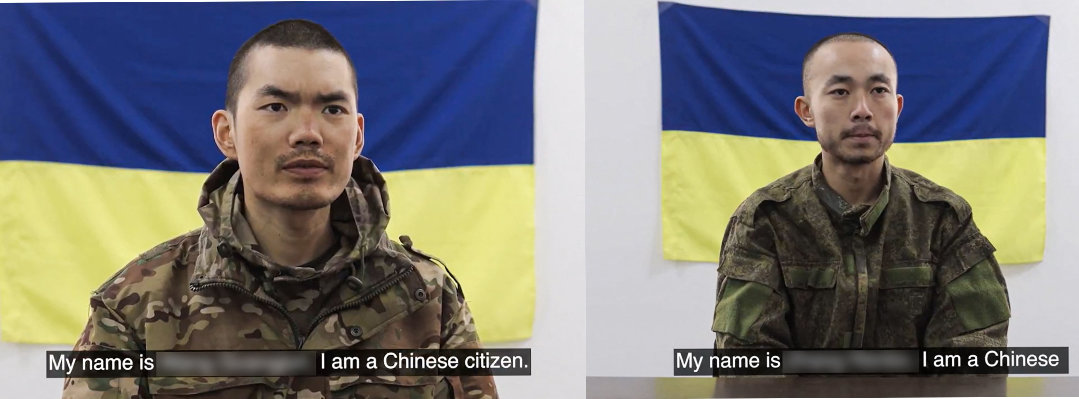


A video grab taken on April 10, 2025 from footage published on the official Facebook page of Ukrainian President Volodymyr Zelensky shows two men who were identified as Chinese answering questions at an undisclosed location inn Ukraine. (AFP)

China has for years provided Moscow with material support to help aid its war against Ukraine, primarily in the shipment of dual-use products – components needed to maintain weapons such as drones and tanks.
Beijing has also supplied Russia with lethal drones to use on the battlefield. In October, the Biden administration sanctioned for the first time two Chinese companies for providing the weapons systems to Moscow.
Volunteers from Western countries, including the US, have been fighting for Ukraine since the early days of the war, and North Korea has deployed more than 12,000 troops to support Russian forces, thousands of whom have been killed or injured in combat.



94 million need cataract surgery, but access lacking: WHO

A Somali patient undergoes free cataract surgery at Al Nuur eye Hospital in Mogadishu, on February 16, 2015. (AFP)
Updated 11 February 2026
Follow

94 million need cataract surgery, but access lacking: WHO

  • Of the 94 million affected, fewer than 20 percent are blind, while the rest suffer from impaired vision

GENEVA: More than 94 million people suffer from cataracts, but half of them do not have access to the surgery needed to fix it, the World Health Organization said Wednesday.
Cataracts — the clouding of the eye’s lens that causes blurred vision and can lead to blindness — are on the rise as populations get older, with age being the main risk factor.
“Cataract surgery — a simple, 15-minute procedure — is one of the most cost-effective medical procedures, providing immediate and lasting restoration of sight,” the WHO said.
It is one of the most frequently performed surgeries undertaken in high-income countries.
However, “half of the world’s population in need of cataract surgery don’t have access to it,” said Stuart Keel, the UN health agency’s technical lead for eye care.
The situation is worst in the WHO’s Africa region, where three in four people needing cataract surgery remain untreated.
In Kenya, at the current rate, 77 percent of people needing cataract surgery are likely to die with their cataract blindness or vision impairment, said Keel.
Across all regions, women consistently experience lower access to care than men.
Of the 94 million affected, fewer than 20 percent are blind, while the rest suffer from impaired vision.

- 2030 vision -

The WHO said that over the past two decades, global cataract surgery coverage had increased by 15 percent.

In 2021, WHO member states set a target of a 30-percent increase by 2030.
However, current modelling predicts that cataract surgery coverage will rise by only about 8.4 percent this decade.
To close the gap, the WHO urged countries to integrate eye examinations into primary health care and invest in the required surgical equipment.
States should also expand the eye-care workforce, training surgeons in a standardised manner and then distributing them throughout the country, notably outside major cities.
The WHO was on Wednesday launching new guidance for countries on how to provide quality cataract surgery services.
It will also issue guidance to help support workforce development.
Keel said the main issue was capacity and financing.
“We do need money invested to get rid of this backlog, which is nearly 100 million people,” he told a press conference.
While age is the primary risk factor for cataracts, others include prolonged UV-B light exposure, tobacco use, prolonged corticosteroid use and diabetes.
Keel urged people to keep up regular eye checks as they get older, with most problems able to be either prevented or diagnosed and treated.
The cost of the new lens that goes inside the eye can be under $100.
However, out-of-pocket costs can be higher when not covered by health insurance.
“Cataract surgery is one of the most powerful tools we have to restore vision and transform lives,” said Devora Kestel, head of the WHO’s noncommunicable diseases and mental health department.
“When people regain their sight, they regain independence, dignity, and opportunity.”
