BRUSSELS: European countries vowed Friday to sends billions of dollars in further funding to help Ukraine keep fighting Russia’s invasion, as a US envoy pursued peace efforts in a trip to meet with Russian President Vladimir Putin amid growing questions about the Kremlin’s willingness to stop the more than three-year war.
Russian forces hold the advantage in Ukraine, with the war now in its fourth year. Ukraine has endorsed a US ceasefire proposal, but Russia has effectively blocked it by imposing far-reaching conditions. European governments have accused Putin of dragging his feet.
“Russia has to get moving” on the road to ending the war, US President Donald Trump posted on social media. He said the war is “terrible and senseless.”
In Russia, the Kremlin said Trump’s envoy Steve Witkoff met with Putin in St. Petersburg. Witkoff, who has been pressing the Kremlin to accept a truce, initially met with Putin envoy Kirill Dmitriev, footage released by Russian media showed.
White House press secretary Karoline Leavitt said Witkoff during his visit to Russia was discussing efforts to end the war with Putin and other officials. “This is another step in the negotiating process toward a ceasefire and an ultimate peace deal,” she said.
Russian state news agency RIA Novosti said Witkoff’s meeting with Putin lasted 4 1/2 hours, and cited the Kremlin as saying that the two discussed “aspects” of ending the war, without providing any details.
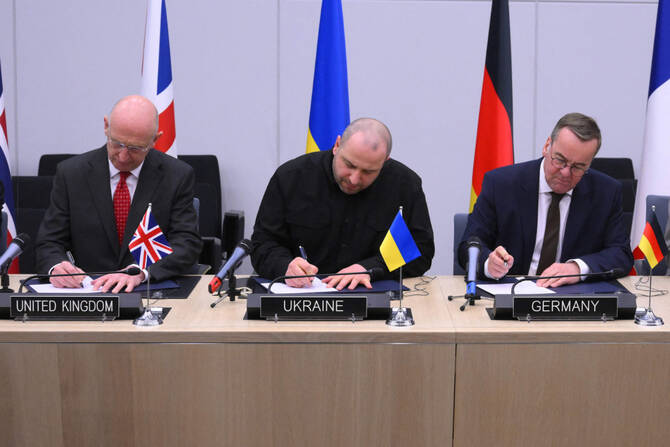
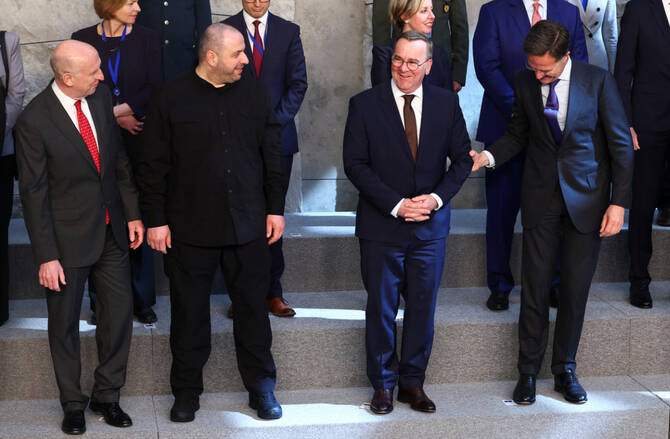
After chairing a meeting of Ukraine’s Western backers in Brussels, British Defense Secretary John Healey said that new pledges of military aid totaled over 21 billion euros ($24 billion), “a record boost in military funding for Ukraine, and we are also surging that support to the frontline fight.”
Healey gave no breakdown of that figure, and Ukraine has in the past complained that some countries repeat old offers at such pledging conferences or fail to deliver real arms and ammunition worth the money they promise.
NATO Secretary-General Mark Rutte said last week that Ukraine’s backers have provided around $21 billion so far in the first three months of this year. European Union foreign policy chief Kaja Kallas said Friday that more than $26 billion have been committed.
Ahead of the “contact group” meeting at NATO headquarters, Ukrainian Defense Minister Rustem Umerov said a key issue was strengthening his country’s air defenses.
Standing alongside Healey at the end of it, Umerov described the meeting as “productive, effective and efficient,” and said that it produced “one of the largest” packages of assistance Ukraine has received. “We’re thankful to each nation that has provided this support,” he said.
Britain said that in a joint effort with Norway just over $580 million would be spent to provide hundreds of thousands of military drones, radar systems and anti-tank mines, as well as repair and maintenance contracts to keep Ukrainian armored vehicles on the battlefield.
Ukrainian President Volodymyr Zelensky has renewed his appeals for more Patriot systems since 20 people were killed a week ago, including nine children, when a Russian missile tore through apartment buildings and blasted a playground in his home town.
Zelensky joined Friday’s meeting by video link.
Russia holds off agreeing to ceasefire
The Russian delay in accepting Washington’s proposal has frustrated Trump and fueled doubts about whether Putin really wants to stop the fighting while his bigger army has momentum on the battlefield.
“Russia continues to use bilateral talks with the United States to delay negotiations about the war in Ukraine, suggesting that the Kremlin remains uninterested in serious peace negotiations to end the war,” the Institute for the Study of War, a Washington think tank, said in an assessment late Thursday.
Washington remains committed to securing a peace deal, even though four weeks have passed since it made its ceasefire proposals, State Department spokeswoman Tammy Bruce said.
“It is a dynamic that will not be solved militarily. It is a meat grinder,” Bruce said Thursday about the war, adding that “nothing else can be discussed … until the shooting and the killing stops.”
Observers expect a new Russian offensive
Ukrainian officials and military analysts believe Russia is preparing to launch a fresh military offensive in coming weeks to ramp up pressure and strengthen the Kremlin’s hand in the negotiations.
German Defense Minister Boris Pistorius said that his country would provide Ukraine with four IRIS-T short- to medium-range systems with missiles, as well as 30 missiles for use on Patriot batteries. The Netherlands plans to supply a Hawkeye air defense system, an airborne early warning aircraft.
Estonian Defense Minister Hanno Pevkur said that his country is monitoring the world armaments market and sees opportunities for Ukraine’s backers to buy more weapons and ammunition.
Pevkur said he believes Putin might try to reach some kind of settlement with Ukraine by May 9 — the day that Russia marks victory during World War II — making it even more vital to strengthen Kyiv’s position now.
“This is why we need to speed up the deliveries as quickly as we can,” he said.
Defense Secretary Pete Hegseth was absent from the forum that the United States created and led for several years, although he spoke via video.
At the last contact group meeting in February, Hegseth warned Ukraine’s European backers that the US now has priorities elsewhere — in Asia and on America’s own borders — and that they would have to take care of their own security, and that of Ukraine, in future.


![]()
![]()

European countries vow billions in military support for Ukraine as US envoy meets Putin
Short Url
https://arab.news/b8gjc
European countries vow billions in military support for Ukraine as US envoy meets Putin
- British Defense Secretary John Healey said that new pledges of military aid totaled over 21 billion euros ($24 billion)
- Ukraine has endorsed a US ceasefire proposal, but Russia has effectively blocked it by imposing far-reaching conditions


Latest updates





© 2026 SAUDI RESEARCH & PUBLISHING COMPANY, All Rights Reserved And subject to Terms of Use Agreement.