

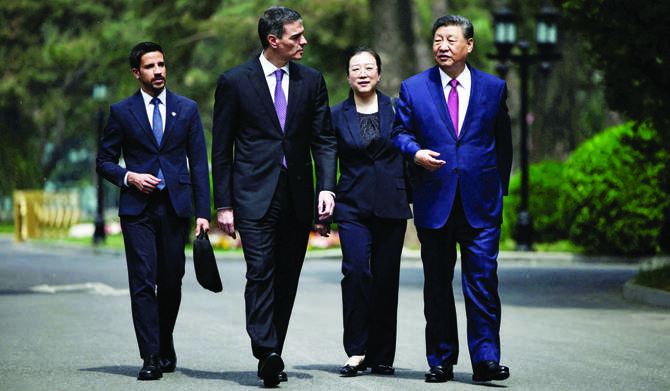

BEIJING: China calls on Western countries to work to support multilateralism and open cooperation, President Xi Jinping told Spain’s visiting Prime Minister Pedro Sanchez on Friday.
“The two sides should promote the building of a fair and reasonable global governance system, maintain world peace and security, and promote common development and prosperity,” Xi told Sanchez at the Diaoyutai State Guest House in Beijing, according to a readout of the meeting by the Xinhua News Agency.
The visit comes at a complex moment for Europe and China. The tariffs announced last week — and then paused — by US President Donald Trump could mean that the European Union pursues more trade with China, the world’s third-largest consumer market after the US and the EU.
Xi made no direct mention of Trump or the tariffs totaling 145 percent the US is imposing on Chinese goods, but he referred to “multiple risks and challenges” facing the world that can only be dealt with through “unity and cooperation.”
Sanchez is making his third trip to the country in two years as his government seeks to boost investment from the Asian giant.
He was also expected to meet with business leaders from several Chinese companies, many of which produce electric batteries or renewable energy technologies.
After meeting Xi, Sanchez said Spain favored “more balanced relations between the EU and China, of finding negotiated solutions to our differences, which we have, and of greater cooperation in common interest.”
He added: “Trade wars are not good, nobody wins. And this is clear; the world needs China and the US to talk.”
Spain’s government spokesperson Pilar Alegría said earlier this week that Sanchez’s trip “has special importance” and is an opportunity to “diversify markets” as Spain faces US tariffs.
US Treasury Secretary Scott Bessent called out Spain for its move toward China, saying on Tuesday that Spain — or any country that tries to get closer to China — would be “cutting their own throat” because Chinese manufacturers will be looking to dump goods that they cannot sell in the US.
“Expanding the trade relations that we have with other countries, including a partner as important as China, does not go against anyone,” Spain’s Agriculture Minister Luis Planas, who is accompanying Sanchez, said in Vietnam on Wednesday.
“Everyone has to defend their interests,” Planas said.
Spain — the euro zone’s fourth-largest economy and a leader in growth — has been less adversarial toward China in recent years than other EU countries.
After initially supporting EU tariffs placed last year on Chinese-made electric vehicles over concerns that they enjoy unfair advantages, Spain abstained from a vote on the proposal.
Planas insisted that Spain’s approach to China “contributes to the collective effort made by certain countries in the European Union to get out of this situation.”
While China’s investments in Spain have grown, the Iberian nation trades less with China than Germany or Italy.
“Spain’s position has changed to be more pro-China ... than the average European country,” said Alicia García-Herrero, an economist for Asia Pacific at the French investment bank Natixis and an expert on Europe’s relations with China.
The Southern European country, which generated 56 percent of its electricity last year from renewable sources, needs Chinese critical raw materials, solar panels, and green technologies — similar to other European countries transitioning from fossil fuels.
In December, Chinese electric battery company CATL announced a €4.1 billion($4.5 billion) joint venture with automaker Stellantis to build a battery factory in northern Spain. That followed deals signed last year between Spain and Chinese companies Envision and Hygreen Energy to build green hydrogen infrastructure in the country.
García-Herrero, the economist at French bank Natixis, stressed the political value of the trip for Sánchez at a time when his leftist minority coalition lacks the support needed to get much passed at home and while Europe may be looking to thaw its strained relations with China.
For Spain, the key thing is “to get a leadership position in Europe at a time when the transatlantic alliance is not only at risk but in shambles,” she said.


