

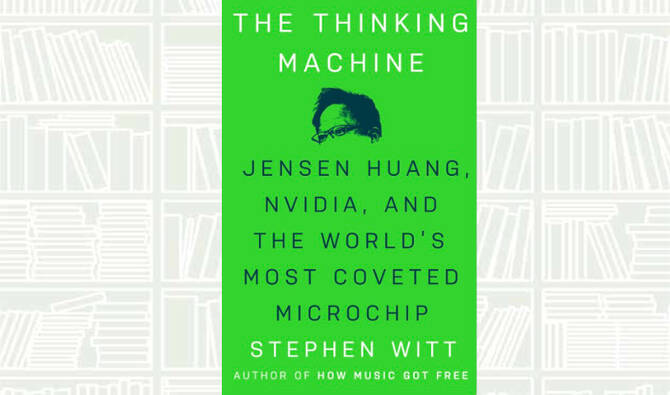
What We Are Reading Today: The Thinking Machine

Photo/Supplied
Short Url
Updated 11 April 2025
Follow

What We Are Reading Today: The Thinking Machine

  • It explores Huang’s leadership style—described as single-minded and relentless—and his ability to defy Wall Street skepticism to push a radical computing vision, making him one of the wealthiest and most influential figures in Silicon Valley

Author: Stephen Witt

“The Thinking Machine” is the story of how Nvidia evolved to supplying hundred-million-dollar supercomputers.
It is a biography that dives into the rise of Nvidia and its CEO, Jensen Huang, focusing on their pivotal role in the AI revolution.
The book highlights Huang’s bold vision, particularly his early bet on AI over a decade ago, which transformed Nvidia from a maker of video game components into a powerhouse supplying massive supercomputers for AI applications like hyper-realistic avatars, autonomous robots, and self-driving cars.
It explores Huang’s leadership style—described as single-minded and relentless—and his ability to defy Wall Street skepticism to push a radical computing vision, making him one of the wealthiest and most influential figures in Silicon Valley.
Through unprecedented access to Huang, his friends, his investors, and his employees, Stephen Witt documents for the first time the company’s epic rise and its single-minded and ferocious leader, now one of Silicon Valley’s most influential figures.

Witt is an American journalist and author known for his narrative-driven, deeply reported works on technology, culture, and innovation.

Witt’s style is noted for its clarity, wit, and ability to make dense topics accessible without sacrificing depth.


What We Are Reading Today: ‘Fixed’

Updated 22 December 2025
Follow

What We Are Reading Today: ‘Fixed’

Authors: John Y. Campbell and Tarun Tamadorai

We interact with the financial system every day, whether taking out or paying off loans, making insurance claims, or simply depositing money into our bank accounts. 

“Fixed” exposes how this system has been corrupted to serve the interests of financial services providers and their cleverest customers—at the expense of ordinary people.

John Campbell and Tarun Ramadorai diagnose the ills of today’s personal finance markets in the US and across the globe, looking at everything from short-term saving and borrowing to loans for education and housing, financial products for retirement, and insurance. 

They show how the system is “fixed” to benefit those who are wealthy and more educated while encouraging financial mistakes by those who are aren’t, making it difficult for regular consumers to make sound financial decisions and disadvantaging them in some of the most consequential economic transactions of their lives.