



ALKHOBAR: With her signature curls and radiant smile, internationally acclaimed Saudi singer-songwriter Tamtam brought her boundless energy to Alkhobar this week, aiming to nurture and connect the Kingdom’s growing music scene from the ground up.
Known mononymously as Tamtam, the artist chose early in her career to go by a single name — a decision that helped to maintain her privacy while allowing listeners to focus on her message and music. Over time, the name became synonymous with her genre-blending sound and global appeal by singing in both English and Arabic, and her bold advocacy for creative freedom.
The event, hosted at Bohemia Cafe and supported by MDLBEAST Radio, was part of Goast Flower’s community activation — a grassroots initiative launched by Tamtam to support emerging artists and independent creatives. The gathering transformed the space into a pop-up creative hub, where artists exchanged merchandise, contacts and ideas over coffee — free to anyone with a hand stamp at the door. Entrance was free with sign-up, allowing MDLBeast Radio to collect people’s contact information to stay connected.
The event at Bohemia was hosted by MDLBEAST Radio’s Ninyaz Aziza along with Tamtam.
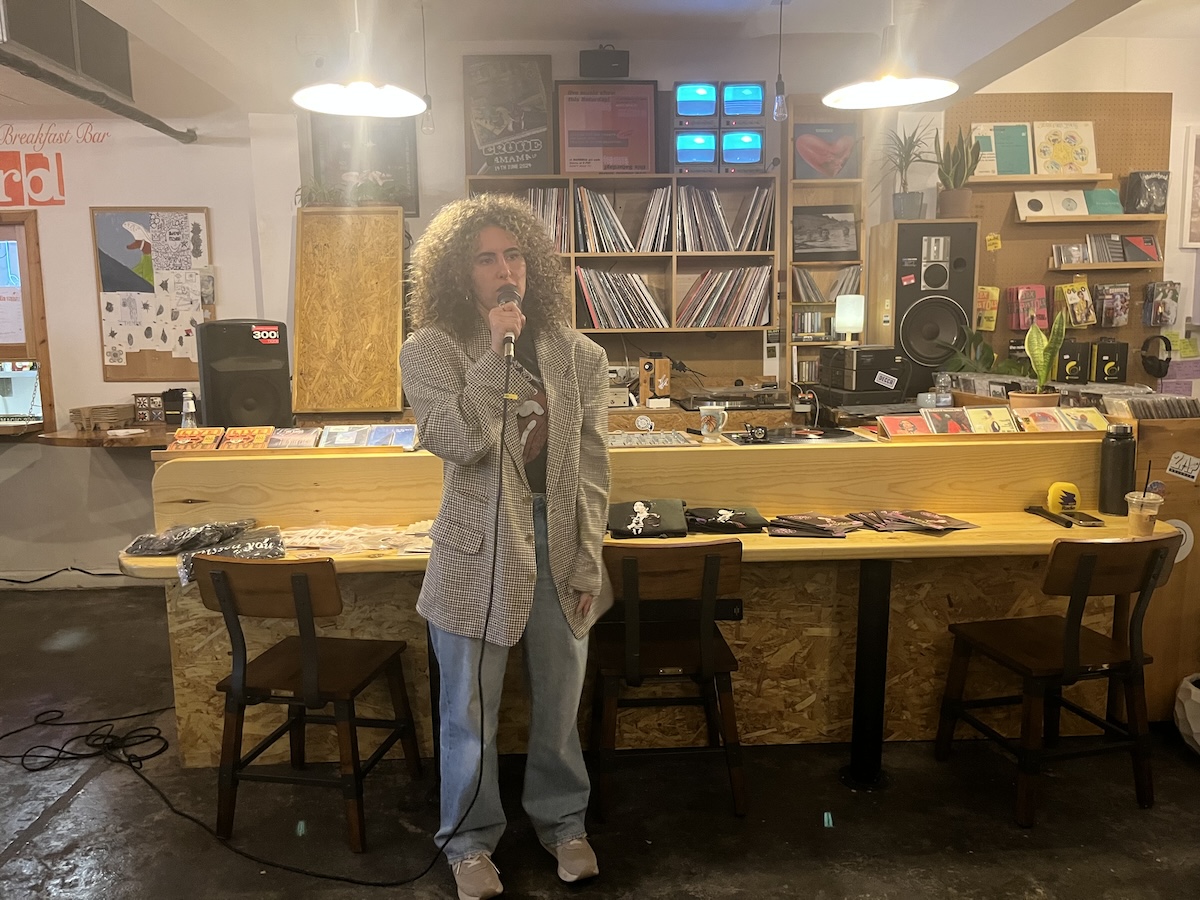
The event, hosted at Bohemia Cafe and supported by MDLBEAST Radio, was part of Goast Flower’s community activation — a grassroots initiative launched by Tamtam to support emerging artists and independent creatives. (AN photo)
MDLBEAST Radio co-hosted their first such event in Tamtam’s hometown, Riyadh, a few weeks earlier — a sahoor at Beast House — and this was their second stop on this mission.
“Honestly, I’m so, so happy. This is really cool because we get to play the music,” Tamtam told Arab News.
During the Riyadh sahoor, they merely mingled but did not perform or listen to music.
“In Alkhobar, so many people showed up — people are excited. There aren’t many events going on in Alkhobar, so I really feel like everyone is super appreciative,” Tamtam said.
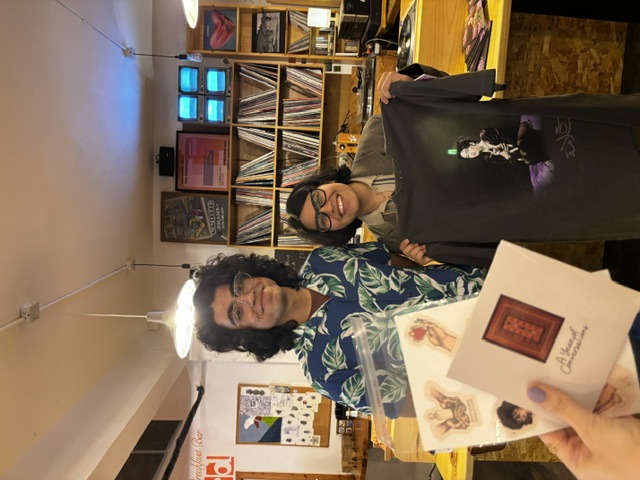
Zamzam with their merch exchange swag. (Photo by Goast Flower)
She added: “The whole point of this is for artists and people in the music industry to meet, and that’s what’s happening. Like literally everyone’s telling me, ‘I’ve met so many people, thank you so much.’ I’m so happy — we need it. The goal has been achieved again.”
Raised in Riyadh and now based between the Kingdom and Los Angeles, Tamtam’s music explores themes of identity, gender equality and cultural connection. She blends alternative R&B with pop and personal storytelling, and her independent streak led her to create her own platform for creative control.
“Goast Flower is an independent music label I started a couple of years ago,” she said. “I’ve been releasing my music through it — it was a way for me as an independent artist to have my own label because I don’t want to be controlled by anyone. It’s amazing to have that freedom as an artist. I’m very grateful.”
Beyond being a label, Goast Flower functions as a creative hub. Its first major project, the Saudi Music Community, is a public database designed to help local talent connect.
“I literally collected all the artists I knew. Fulana, another Saudi artist, collected all the artists she knew. We put together a Google document and made it live,” she explained. “Now there’s another document where people can join and add their information, and someone checks it. In this way, artists can find each other in Saudi Arabia. A lot of artists are like, ‘Hey, I’m looking for a female rapper,’ or ‘I’m looking for a guitar player for my live show.’ And now they can just go to the database and find people.”
In Alkhobar, the idea found fertile ground.
Singer-songwriter, architect, photographer and university professor, Yazeed Al-Amasi, who attended both the Riyadh and Alkhobar events, said: “I’ve been living here in Dhahran since 2011, and this is the first time I feel super connected to the music community,” he told Arab News. “I don’t want to say it, but I think people are friendlier and more open to collaborating in Alkhobar. Or maybe people in Riyadh were just tired from Ramadan.”
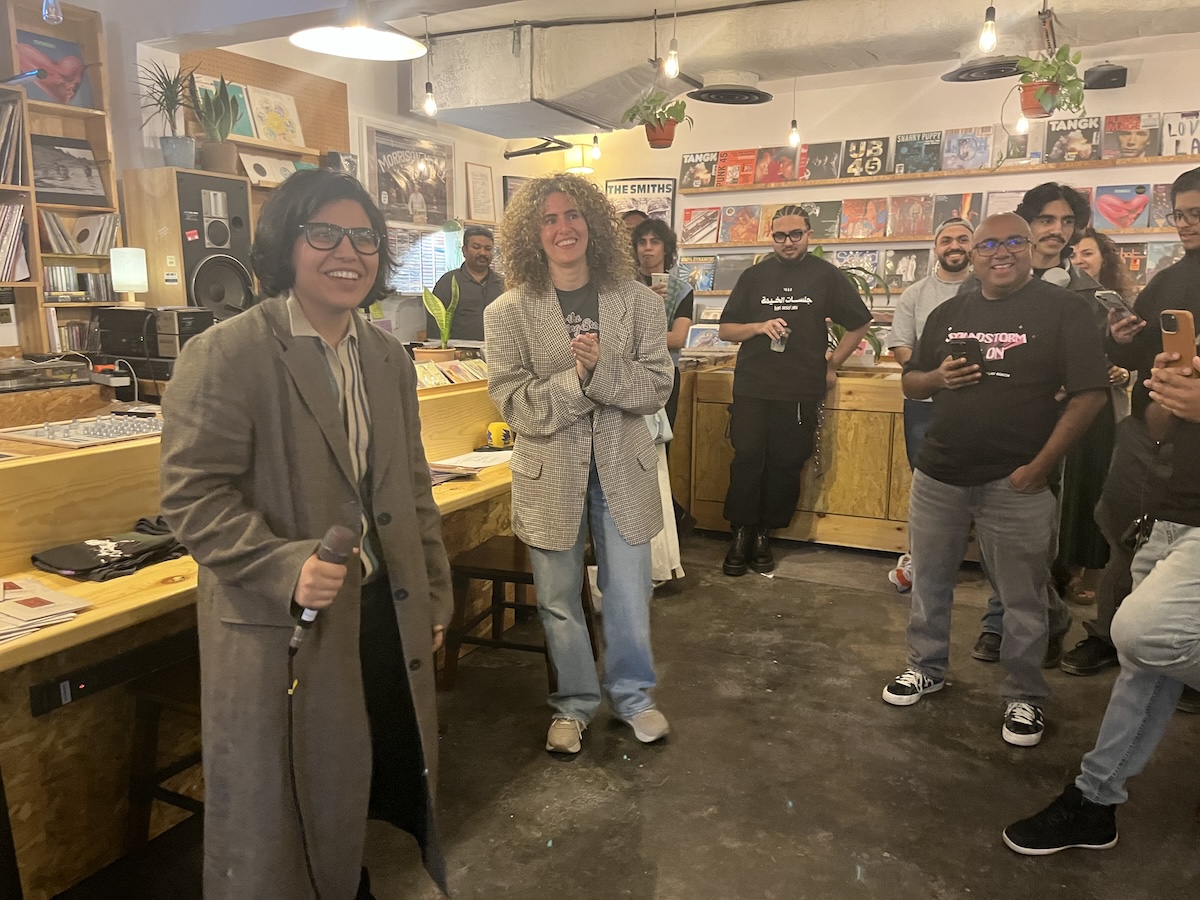
Tamtam meets Zamzam. (AN photo)
A key part of the gathering was the merchandise exchange, a concept introduced by Tamtam to encourage artistic support without the barrier of money. Participants brought T-shirts, lyric booklets, CDs, stickers and creative works to swap with one another — artist to artist.
“The idea is that instead of spending money, artists are supporting each other. It’s a gesture of support that this community is all about,” Tamtam said.
“I really, really believe in this community, and I don’t think anyone can grow without a community in any industry,” she added. “I just feel like the music industry in Saudi needs this push, and the foundation needs to be stronger.”
During the event, guests took the mic to introduce themselves and share what they were seeking — producers, vocalists, instrumentalists, collaborators. Photographers offering band headshots and live performance images also stepped forward, strengthening the bonds in the room.
“I actually discovered local musician Zamzam through the Saudi Music Community when I was putting this together,” Tamtam said.
Zamzam, a frequent Bohemia performer and lover of all music genres, walked in as Tamtam was speaking about her. Zamzam, who also goes by a mononym, found the database through Tamtam’s initiative and was excited to meet her in person.
Both shrieked in delight on noticing they were face-to-face.
“Maybe we will have a Tamtam and Zamzam collaboration in the future,” someone said in the background.
“I added myself to the database!” Zamzam told Arab News. “I follow Tamtam and I saw the (Instagram) story about Goast Flower. Whenever I see a label or something that could be a creative hub, I want to connect.”
The venue itself played a role. Bohemia Cafe has become something of a beacon for alternative and indie creatives in the Eastern Province.
One of them, Fatima Falath, shared that she had written a song inspired by her visit to Bohemia.
“Two years ago, I was sitting at Bohemia and got inspired by the drawing on their cup,” Falath told Arab News.
“I had some matcha — even in the song we mentioned matcha,” Falath said with a laugh. “I sang and wrote the lyrics, and my friend and producer, who goes by Hajj Alibaba, did the background music. I made all my friends and family listen to it — it’s a driving-around-in-the-car song. I haven’t published it yet, but I’m inspired to publish it tonight at this event because we wrote it here.”
Everyone at Bohemia had a chance to listen to Falath’s creation for the very first time, and many other musicians joined after and played their songs.
Rohit Jayakaran of MDLBEAST Radio drove in from Riyadh to support the event along with Tamtam and the team. For nearly four hours, they were fired up to be there. He was beaming as the songs were being played.
“We’re very excited to be part of the Saudi music community and support it as MDLBEAST Radio,” Jayakaran told Arab News. “We believe that great things will come out of this community. Bohemia — this is the place where people come for music in Sharqiya. What I discovered today is that there is a community — and it’s a growing community. It’s eclectic. It has all sorts of dynamic energies in here. And it’s just really nice to have this here because it didn’t exist before. It’s amazing. It’s awesome.”
Jayakaran hopes that connections made will showcase their collaborative talents at the next live show at Bohemia, in Riyadh, or just in general.
For now, Goast Flower remains Tamtam’s personal label — though she doesn’t rule out signing other artists in the future.
“I really, really respect the artist. Unless I know I can invest a lot of money in the artist — money, time and effort — I’m not going to sign them,” she said. “A lot of the big people in this industry take advantage of artists. Artists don’t make enough money from streaming. The music business has a lot of work to do.”
She hopes that Saudi Arabia can do things differently.
“Saudi is such a special place right now because it’s the beginning of the music industry. We are in a place where we can shape it in a different way — we don’t have to copy the West. We can learn from the mistakes happening in other industries.”
Next, Goast Flower is headed to Jeddah, where they will host a similar activation on April 16 at Hayy Jameel.
It will essentially go from the heart of the Kingdom to the two coasts, like a hug to the music community in Saudi Arabia.


