

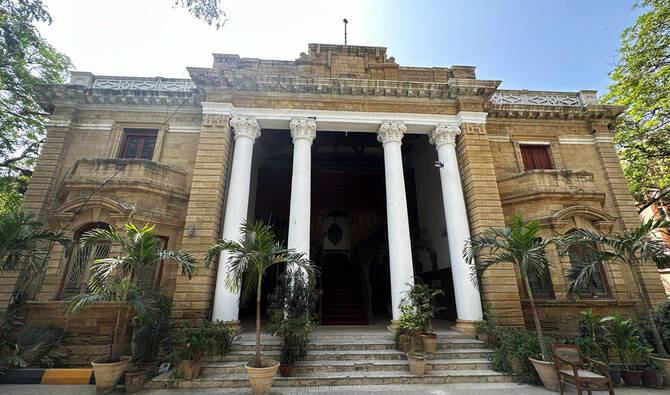

KARACHI: On Karachi’s Strachan Road, where traffic rarely slows and history is easy to miss, a grand neoclassical building stands quietly between the past and the present.
Known as the “Lodge of Hope,” the building was Karachi’s principal Freemasons Hall, one of four in the city during British rule and standing to date as a reflection of the city’s colonial inheritance and postcolonial socio-political evolution.
Flanked by tall Greek columns, their concrete softened by time, the building now houses the Sindh Wildlife Department’s offices, a natural history museum and a public library.
But long before schoolchildren and researchers wandered through its storied halls to marvel at preserved specimens of leopards, birds and reptiles, this was a place plagued by secrecy and suspicion.
Built around 1914 after a storm destroyed the fraternity’s earlier structure near the exclusive members-only Sindh Club, it served as the meeting place for members of the global freemason brotherhood whose rituals, symbols and origins trace back to the cathedral builders of medieval Europe.
What began as an elite and exclusive institution gradually became the subject of public fascination and fear, its secrecy spawning stories, conspiracy theories and, in time, an outright ban.
Freemasonry is a fraternal organization, not a religion, with roots in medieval stonemason guilds, emphasizing brotherhood, charity, and moral development through rituals and symbolic teachings. Controversy surrounding freemasonry stems from a few key factors, including its secretive nature, perceived elitism, religious and political affiliations, and the prevalence of conspiracy theories surrounding its alleged power and influence on world events.
“The masons are those who were called previously the Templars,” explained Dr. Kaleemullah Lashari, a historian and archaeologist who remained associated with the building’s conservation between 2010 and 2014.
“The first Lodge, as the story goes, was constructed where the present Sindh Club [in Karachi] is and while the Sindh Club emerged, and the Sindh Club had this opportunity to expand itself, so the Freemasons Lodge was given another alternate place, which is here on Strachan Road.”
Membership of the lodge was open to anyone — Muslim, Hindu, Parsi or Christian — who embraced the masonic ideals of fraternity and self-improvement but the secretive rituals and symbols raised suspicion.
“The people thought that they [freemasons] were doing something very secretive,” Lashari said. “This is the reason that people used to call it ‘jadu ka ghar’ [house of magic].”
Dr. Tauseef Ahmed Khan, an academic interested in Karachi’s history, described the lodge as an “elite club” during the years of British rule.
“Very few people were given membership, and they were all elite people, noblemen, bureaucrats, and then a lot of conspiracy theories were also spread,” he added.
“ESPIONAGE”
Among the suspicions was that the Freemasons building was being used for espionage. Subsequently, in 1972, amid political turbulence and rising nationalist sentiment, a staff member of a foreign mission in Karachi, who happened to be a freemason, was accused of smuggling arms into Pakistan, leading to an official ban on freemasonry.
Following this development, the building changed hands several times, briefly accommodating the Press Information Department before falling into disrepair. That changed in 1982 when the Sindh Wildlife Department moved in.
“This place has become a ray of hope for wildlife,” said Javed Ahmed Mahar, a conservator at the Sindh Wildlife Department. “We have also worked on its decoration and embellishment. If you look at its comparative images in the last 2–3 years, you will see that there is a great difference here.”
The building is also home to Sindh Wildlife Library and over 9,000 books.
“There are a lot of rare books here,” Shahid Ali Khan, the dedicated librarian who has served here for four decades, said. “There are a lot of books that are not available in the market right now. These are handwritten books.”
Despite its rebirth, the building still wears its past. Inspired by classical Greek temples with their ornate columns and symmetrical layout, the structure also incorporates Edwardian features such as dual reception rooms flanking the main entrance.
Today, the building is not only architecturally unique but also functionally vital, one of the few government spaces in Pakistan that have been both historically preserved and actively repurposed.
“This is more than just an office or museum,” Mahar said, “it’s our cultural heritage.”


