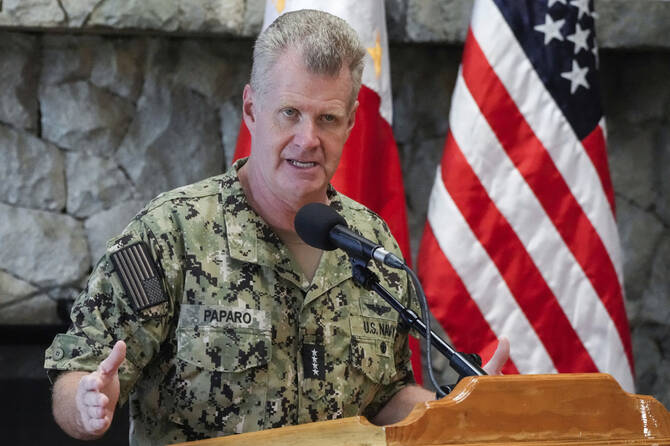
WASHINGTON: The top US commander in the Pacific warned senators Thursday that the military support China and North Korea are giving Russia in its war on Ukraine is creating a security risk in his region as Moscow provides critical military assistance to both in return.
Admiral Samuel Paparo, head of US Indo-Pacific Command, told the Senate Armed Services Committee that China has provided 70 percent of the machine tools and 90 percent of the legacy chips to Russia to help Moscow “rebuild its war machine.”
In exchange, he said, China is potentially getting help in technologies to make its submarines move more quietly, along with other assistance.
Senators pressed Paparo and Gen. Xavier Brunson, commander of US Forces Korea, on China’s advances in the region, including threats to Taiwan. And they also questioned both on the US military presence in South Korea, and whether it should be shielded from personnel cuts..
Both said the current US force there and across the Indo-Pacific is critical for both diplomacy in the region and America’s national security, as ties between Russia and China grow. The US has 28,500 forces in South Korea.
Paparo said North Korea is sending “thousands, maybe hundreds of thousands of artillery shells” and hundreds of short-range missiles to Russia. The expectation, he said, is that Pyongyang will get air defense and surface-to-air missile support.
“It’s a transactional symbiosis where each state fulfills the other state’s weakness to mutual benefit of each state,” Paparo said.
In his opening comments, Sen. Roger Wicker of Mississippi, the Republican committee chairman, said the greater alignment of Russia, China and North Korea “should be of great concern to all in the West. This concern should then lead to action. If we are to maintain global peace and stability, we must continue taking steps now to rebuild our military and reestablish deterrence.”
Brunson said North Korea has shown the ability to send munitions and troops to Russia while advancing development of its own military capabilities, including hypersonics. Pyongyang, he said, “boasts a Russian-equipped, augmented, modernized military force of over 1.3 million personnel.”
North Korea’s efforts to develop advanced nuclear weapons and ballistic missiles ”pose a direct threat to our homeland and our allies,” Paparo added.
North Korea also has sent thousands of soldiers to fight with the Russians against Ukraine. And Ukrainian President Volodymyr Zelensky said Wednesday that Russia is actively recruiting Chinese citizens to fight alongside its forces in the Ukraine war. He said more than 150 such mercenaries are already active in the battle with Beijing’s knowledge.
China has called the accusation “irresponsible.”
In other comments, Sen. Jack Reed of Rhode Island, the ranking Democrat on the panel, said observers fear that President Donald Trump will “shrink the US troop presence in Korea and Japan, reduce our military exercises with both nations, and scale back plans for our Joint Force Headquarters in Japan.” Any such actions, he said, will sow “seeds of doubt” about America’s stability and trustworthiness.
He also questioned whether recent moves by the Pentagon to shift an aircraft carrier and Patriot missile battalion from the Pacific region to the Middle East have hurt military readiness in the Indo-Pacific command.
Paparo said he owes the defense chief and the president “constant vigilance” on that matter, including a persistent awareness on whether those forces could get back to the Pacific if there is suddenly a “higher priority threat” in his region.


![]()

China, North Korea and Russia military cooperation raises threats in the Pacific, US official warns
Short Url
https://arab.news/byq35
China, North Korea and Russia military cooperation raises threats in the Pacific, US official warns
- China is providing extensive assistance to Russia to help Moscow “rebuild its war machine”, US Indo-Pacific Command chief tells Senate military committee
- Senator likewise warned that Trump's plan to shrink US troop presence in Korea and Japan will sow “seeds of doubt” about America’s stability and trustworthiness


Latest updates


Recommended



© 2026 SAUDI RESEARCH & PUBLISHING COMPANY, All Rights Reserved And subject to Terms of Use Agreement.