

Saudi Arabia was green corridor 8 million years ago: Saudi Heritage Commission 

1 / 4
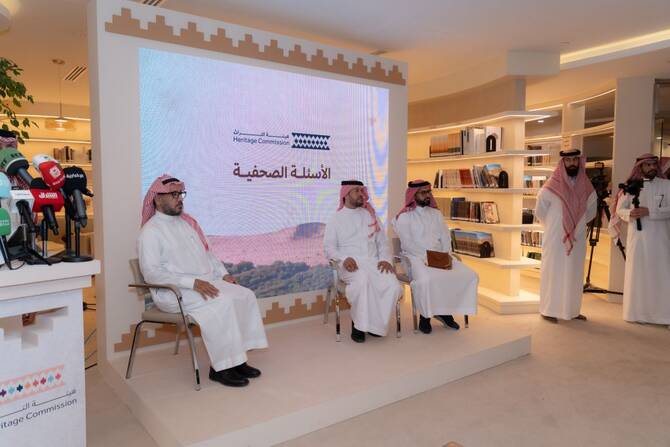
The SHC has unveiled new findings that prove that the Kingdom was a vital oasis eight million years ago. (AN Photo/Jaafar Saleh)
2 / 4
The SHC has unveiled new findings that prove that the Kingdom was a vital oasis eight million years ago. (AN Photo/Jaafar Saleh)
3 / 4
The SHC has unveiled new findings that prove that the Kingdom was a vital oasis eight million years ago. (AN Photo/Jaafar Saleh)
4 / 4
The SHC has unveiled new findings that prove that the Kingdom was a vital oasis eight million years ago. (AN Photo/Jaafar Saleh)
Short Url
Updated 10 April 2025
Follow

Saudi Arabia was green corridor 8 million years ago: Saudi Heritage Commission 

  • Mesfer Alqahtani: The core findings of this study is that the Arabian Peninsula was not always a desert, it underwent repeated humid phases that supported rich biodiversity
  • SHC, in collaboration with leading local and international institutions, led a scientific mission that looked into the oxygen and hydrogen isotopes preserved in cave formations

RIYADH: The Saudi Heritage Commission unveiled new findings this week that prove the Kingdom was a vital oasis eight million years ago.

Mesfer Alqahtani, archaeology consultant at the commission, said on Wednesday: “The core findings of this study is that the Arabian Peninsula was not always a desert, it underwent repeated humid phases that supported rich biodiversity and sustained both land and marine ecosystems, making it a natural bridge for the movement of species between Africa and Asia in the ancient world.” 

The SHC, in collaboration with leading local and international institutions, led a scientific mission that looked into the oxygen and hydrogen isotopes preserved in cave formations. It used a combination of dating techniques such as uranium-thorium and uranium lead analysis studies to document the longest-known record of ancient climate in the Arabian Peninsula, dating back about eight million years.

The study analyzed 22 speleothem samples extracted from seven desert caves located northeast of Riyadh near Shawayyah in Rumah governorate. The caves are locally known as Duhool Al-Samman. 

Experts at the SHC underlined that these findings provide clear evidence of recurrent humid and rainy periods in the region’s past. 

The study also found fossils pointing to the presence of a fertile environment.

Dr. Ajab Alotaibi, director general of the commission’s antiquities sector, said that the study highlighted the Arabian Peninsula’s crucial role as a corridor for the dispersal of organisms between Africa, Asia and Europe.

The study is part of the commission’s flagship initiative, the Green Arabia Project, which aims to explore the region’s natural and environmental history.

Michael Petralia, professor and director, Australian Research Center for Human Evolution, said: “Our archaeological work on the lakes of Arabia has now indicated that humans and early humans were in Saudi Arabia 500,000 years ago; that tells us immediately that Arabia acted as a crossroads between continents, between Africa and Asia, so this is a landscape that is very important in terms of documenting heritage, paleontology, archaeology, through time.”

The SHC-led findings have been published in the scientific journal, “Nature,” under the title “Recurrent humid phases in Arabia over the past 8 million years.” 

The research brought together 30 scientists from 28 organizations — local and international — including the Heritage Commission, the Saudi Geological Survey, King Saud University, the Max Planck Institute in Germany, Griffith University in Australia, and several universities and research centers across Germany, Italy, the UK and the US.

According to the SHC, the study marks a major milestone for the Green Arabia Project, one of Saudi Arabia’s most ambitious efforts to promote scientific research and document the natural and cultural heritage of the Arabian Peninsula.

These findings also offer valuable insights into restoring Saudi Arabia to its original, greener state, supporting pivotal projects such as Green Riyadh and the Saudi Green Initiative.

The project seeks to better understand how environmental and climatic changes have shaped the region across eras — contributing to a richer, more complete understanding of Saudi Arabia’s natural history.

Jasir Al-Herbish, CEO of the SHC, reaffirmed the commission’s commitment to advancing research and fostering international collaborations.


14 sculptures go on display at public spaces in Riyadh

Updated 11 December 2025
Follow

14 sculptures go on display at public spaces in Riyadh

  • The works were chosen by Riyadh Art from its international Tuwaiq Sculpture symposium to reflect its ‘vision of weaving beauty and intellect into the city’s fabric’
  • Initiative aligns with efforts to make art a key part of city’s identity that improves quality of life and promotes the cultural economy, says Royal Commission for Riyadh City’s Khalid Al-Hazani

RIYADH: Fourteen sculptures selected from the annual international Tuwaiq Sculpture symposium, a Riyadh Art program, went on display on Wednesday at three prominent public spaces across the Saudi capital: ROSHN Front, the SEDRA residential community, and Sports Boulevard.

The project is part of Riyad Art’s efforts to showcase artworks in public spaces, and the addition of more works in other places is expected later.

Khalid Al-Hazani, the executive vice president of the lifestyle sector at the Royal Commission for Riyadh City, said: “This step reflects (Riyadh Art’s) vision of weaving beauty and intellect into the city’s fabric, and creating vibrant and culturally rich public spaces, allowing art to become an integral part of people’s daily lives.”

It is also in line with Riyadh Art’s broader strategy for transforming the city into an open-air art gallery, he added, thereby “turning art into a central element of the city’s identity and a key contributor to improving quality of life and promoting the cultural economy.” 

The Riyadh Art Program installed on Wednesday 14 sculptures selected from the Tuwaiq International Sculpture Symposium at prominent locations in Riyadh, including the ROSHN Front, SEDRA Residential Community, and Sports Boulevard. (Supplied)

The three chosen locations were considered perfect places to host the artworks because of their vibrancy, strong community connections and accessibility, Al-Hazani noted.

“This provides residents and visitors with the opportunity to engage with the sculptures in their everyday lives,” he said.

Seven of the sculptures have been installed at ROSHN Front, considered a key urban hub. The artworks on display there form a thought-provoking artistic landscape that encourages interaction, organizers said, and explores a number of themes including the values of urban transformation, community spirit, and creative curiosity.

Three sculptures are on display at the SEDRA residential community. Chosen to complement its serene character and nature-integrated urban planning, they blend in with their surroundings to reflect the values of environmental harmony, contemplation and renewal, organizers explained.

The remaining four sculptures are at Sports Boulevard, known for its open, green spaces. These works reflect several concepts, in particular ideas of nature, balance and public health.

All of the sculptures are part of Riyadh Art’s permanent collection, which includes works created by local and international artists during the Tuwaiq Sculpture symposium.