Never take peace for granted, King Charles tells Italy parliament

1 / 2
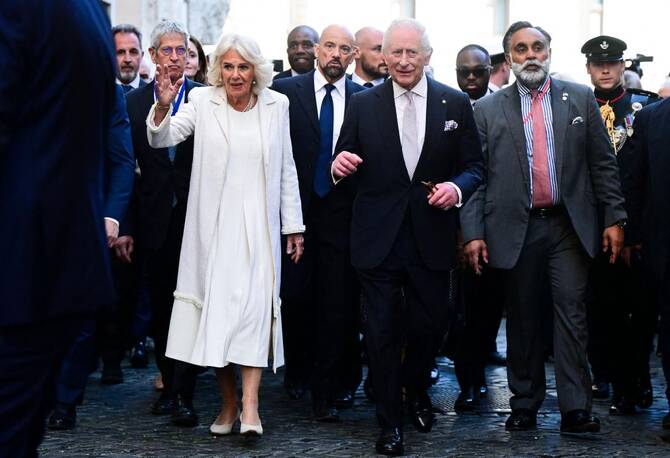
Britain's King Charles III and Britain's Queen Camilla arrive to attend a joint session at the Italian Parliament as part of a State visit in Italy on April 9, 2025. (AFP)
2 / 2
Britain's Queen Camilla (L) and Britain's King Charles III (C) meet with well wishers as they have a walk in the streets close to the Italian Parliament, in Rome, during a State visit in Italy on April 9, 2025. (AFP)
Short Url
Updated 09 April 2025
Follow

Never take peace for granted, King Charles tells Italy parliament

  • “Britain and Italy stand today united in defense of the democratic values we share,” King Charles said
  • He became the first ever British monarch to address a joint session of Italy’s parliament

ROME: King Charles III warned Wednesday that peace can never be taken for granted and hailed Italy for standing by Ukraine, as he made a historic address to parliament in Rome.
“Peace is never to be taken, never to be taken for granted,” the 76-year-old monarch said during his third day of a state visit to Italy with his wife, Queen Camilla.
“Britain and Italy stand today united in defense of the democratic values we share.
“Our countries have both stood by Ukraine in her hour of need and welcomed many thousands of Ukrainians requiring shelter.”
He noted the defense ties between Italy and the UK, through NATO and a project to develop a new fighter jet with Japan.
Speaking in English with some Italian, Charles became the first ever British monarch to address a joint session of Italy’s parliament.
The king also addressed an issue close to his heart, the environment.
“Just as we stand together in defense of our values, so too we stand together in defense of our planet,” he said.
“From the droughts in Sicily to the floods in Somerset, both our countries are already seeing the ever more damaging effects of climate change.”


Eritrea withdraws from regional bloc as UN expresses concern over tensions with Ethiopia

Updated 1 sec ago
Follow

Eritrea withdraws from regional bloc as UN expresses concern over tensions with Ethiopia

NAIROBI: Eritrea on Friday withdrew from the Intergovernmental Authority on Development, accusing the East African regional bloc of nations of acting against the country’s interests.
At the same time, the United Nations expressed concern over renewed tensions between Eritrea and neighboring Ethiopia, which signed a peace agreement 25 years ago.
Eritrea’s foreign ministry said in a statement Friday it was withdrawing “from an organization that has forfeited its legal mandate and authority; offering no discernible strategic benefit to all its constituencies and failing to contribute substantively to the stability of the region.”
Eritrea quit IGAD in 2003 and rejoined two years ago, but said Friday that the bloc had failed to contribute to regional stability. IGAD responded by saying Eritrea had not participated in regional activities since it rejoined.
In addition to Eritrea and Ethiopia, IGAD includes Djibouti, Kenya, Somalia, South Sudan, Sudan and Uganda. The organization works on regional policies concerning trade, customs, transport, communications, agriculture, natural resources and the environment, according to its website.
Eritrea and Ethiopia have in recent months accused each other of interference, sparking concerns over the possibility of a return to hostilities.
Ethiopia said it wants to peacefully gain Red Sea access through Eritrea, which it relied on heavily for trade before the secession. Ethiopian Prime Minister Abiy Ahmed said in September it was a “mistake” to lose access to the sea when Eritrea gained independence in 1993 by seceding from Ethiopia to form a separate nation. Abiy’s rhetoric has been seen as provocative by Eritrea.
The office of UN Secretary-General Antonio Guterres on Friday urged the two countries to “recommit to the vision of lasting peace and the respect for sovereignty and territorial integrity.”
The UN cited the Algiers Agreement signed in 2000, which ended nearly three decades of border war between Eritrea and Ethiopia. The UN called for a recommitment to the agreement, which it described as a “crucial framework” for peace.
Eritrea accused Ethiopia in June of having a “long-brewing war agenda” aimed at seizing its Red Sea ports. Ethiopia recently claimed Eritrea was “actively preparing to wage war against it,” as well as supporting Ethiopian rebel groups.