NEW DELHI: Indian authorities are readying for the extradition from the United States of a man that New Delhi accuses of helping plan the 2008 Mumbai siege that killed 166 people.
Tahawwur Hussain Rana, 64, a Canadian citizen born in Pakistan, is due to be extradited “shortly” to face trial, Indian media said, reporting that New Delhi had sent a multi-agency team of security officials to collect him.
India accuses him of being a member of the Pakistan-based Lashkar-e-Taiba (LeT) group, designated by the United Nations as a terrorist organization, and of aiding planning the attacks.
US President Donald Trump announced in February that Washington would extradite Rana, whom he called “one of the very evil people in the world.”
The US Supreme Court this month rejected his bid to remain in the United States, where he is serving a sentence for a planning role in another LeT-linked attack.
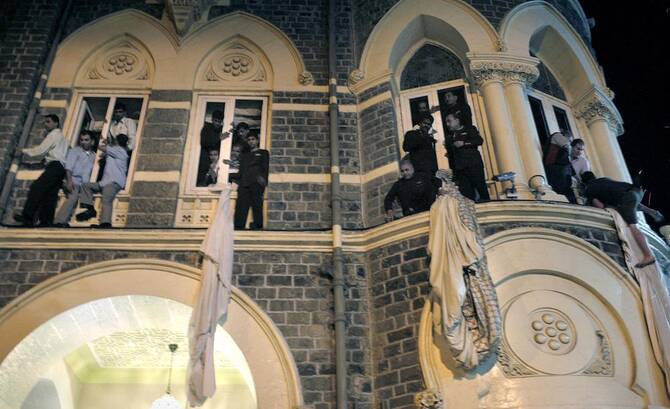
New Delhi blames the LeT group – as well as intelligence officials from New Delhi’s arch-enemy Pakistan – for the Mumbai attacks in November 2008, when 10 Islamist gunmen carried out a multi-day slaughter in the country’s financial capital.
India accuses Rana of helping his longterm friend, David Coleman Headley, who was sentenced by a US court in 2013 to 35 years in prison after pleading guilty to aiding LeT militants, including by scouting target locations in Mumbai.
Rana, a former military medic who served in Pakistan’s army, emigrated to Canada in 1997, before moving to the United States and setting up businesses in Chicago, including a law firm and a slaughterhouse.
He was arrested by US police in 2009.
A US court in 2013 acquitted Rana of conspiracy to provide material support to the Mumbai attacks. But the same court convicted him of backing LeT to provide material support to a plot to commit murder in Denmark.
Rana was sentenced to 14 years for his involvement in a conspiracy to attack the offices of the Jyllands-Posten newspaper, which had published cartoons depicting the Prophet Muhammad that angered Muslims around the globe.
But India maintains Rana is one of the key plotters of the Mumbai attacks along with the convicted Headley – and the authorities have welcomed his expected extradition.
In February, Devendra Fadnavis, chief minister of Maharashtra state which includes the megacity Mumbai, said that “finally, the long wait is over and justice will be done.”
Devika Rotawan, a survivor of the Mumbai attacks, said she believed the extradition of Rana would be a “big win for India.”
“I will never be able to forget the attack,” she told broadcaster NDTV on Wednesday.
Counterterrorism experts however suggest Rana’s involvement was peripheral compared to Headley, a US citizen, who India also wants extradited.
“They gave us a small fish but kept David Headley, so the essential outcome is going to be symbolic,” said Ajay Sahni, head of the Institute for Conflict Management, a New Delhi-based think tank.
Rana knew Headley, 64, from their days together at boarding school in Pakistan.
Headley, who testified as a government witness at Rana’s trial, said he had used his friend’s Chicago-based immigration services firm as a cover to scout targets in India, by opening a branch in Mumbai.
Rana has said he visited Mumbai ahead of the attacks – and stayed at the luxury Taj Mahal Palace Hotel that would become the epicenter of the bloody siege – but denied involvement in the conspiracy.
Sahni said that more than 16 years after the attacks, Rana’s extradition is of “historical importance” rather than a source of any “live intelligence.”
But he added that handing him over has “a chilling effect” on others abroad who India seeks to put on trial.


![]()

India readies for US extradition of Mumbai attacks suspect
Short Url
https://arab.news/ysu26
India readies for US extradition of Mumbai attacks suspect
- Tahawwur Hussain Rana, a Canadian citizen born in Pakistan, is due to be extradited ‘shortly’ to face trial
- India accuses him of being a member of the Pakistan-based Lashkar-e-Taiba group


Latest updates


© 2026 SAUDI RESEARCH & PUBLISHING COMPANY, All Rights Reserved And subject to Terms of Use Agreement.