Pakistan urges Hajj pilgrims to follow Saudi Arabia’s laws 

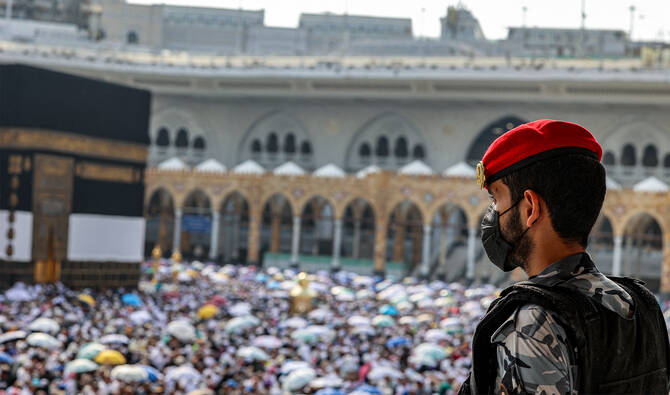
A Saudi security officer watches as Muslim pilgrims perform the farewell circumambulation or "tawaf", circling seven times around the Kaaba, Islam's holiest shrine, at the Grand Mosque in the holy city of Makkah on June 18, 2024. (AFP/File)
Short Url
Updated 08 April 2025
Follow

Pakistan urges Hajj pilgrims to follow Saudi Arabia’s laws 

  • Pakistan’s religion ministry launches second phase of mandatory training for Hajj pilgrims 
  • Pakistan to conduct mandatory vaccinations of Hajj pilgrims on Apr. 20, says ministry 

ISLAMABAD: Religious Affairs Minister Sardar Muhammad Yousaf on Tuesday urged Pakistani Hajj pilgrims to follow Saudi Arabia’s laws during their stay in the Kingdom and consider themselves as ambassadors of their country. 
The minister was speaking at a Hajj training workshop in Islamabad organized by the Religious Affairs Ministry, as Pakistan launched the second phase of its mandatory training for Hajj pilgrims on Tuesday. 
Pakistan conducted its first phase of Hajj training in January that continued across the country until late February, with intending pilgrims trained via audio-visual devices and other materials. 
“Hajj pilgrims are going as ambassadors of Pakistan, take care of the laws there,” Yousaf was quoted as telling pilgrims at the workshop. 
“Do not do anything that will bring disrespect to your country,” he added. 
He lauded the Saudi government for making impressive arrangements for pilgrims, describing the Kingdom as a “brotherly country.” 
Yousaf said Pakistani officials had reviewed Hajj arrangements in the Kingdom, vowing that pilgrims would not suffer any unpleasant experiences. 
The minister said that mandatory vaccinations of Pakistani Hajj pilgrims would be conducted on Apr. 20. 
Hajj pilgrims must comply with strict vaccination requirements set by the Saudi Ministry of Health to ensure public safety during one of the world’s largest annual gatherings. 
Mandatory vaccines include the meningitis shot, with additional recommendations for the seasonal influenza vaccine, while travelers from regions prone to yellow fever and polio must also provide corresponding immunization certificates. 
These precautions are vital to prevent the spread of infectious diseases among millions of pilgrims converging in the Kingdom from across the globe. 
Yousaf said last week around 90,000 Pakistanis are expected to perform Hajj this year under the government scheme. Saudi Arabia has allowed Pakistan a quota of 179,210 pilgrims for the Hajj, which is split equally between government and private schemes. 


Pakistan high court pauses tree-cutting in Islamabad until Feb. 2

Updated 10 sec ago
Follow

Pakistan high court pauses tree-cutting in Islamabad until Feb. 2

  • Islamabad High Court asks CDA to ‘explain and justify’ tree-cutting at next hearing
  • CDA officials say 29,000 trees were cut due to allergies, deny felling in green belts

ISLAMABAD: The Islamabad High Court has ordered an immediate halt to tree-cutting in the federal capital until Feb. 2, seeking justification from civic authorities over the legality of a large-scale felling drive that has seen thousands of trees removed in recent months.

The interim order, issued by a single-judge bench led by Justice Khadim Hussain Soomro, came during proceedings on a petition challenging the Capital Development Authority’s (CDA) tree-cutting operations in Islamabad’s Shakarparian area and H-8 sector.

At the outset of the hearing, the petitioner’s counsel argued that trees were being felled in violation of the Pakistan Environmental Protection Act 1997, the Islamabad Wildlife Ordinance 1979 and the city’s master plan.

“Respondents shall not cut trees till the next date of hearing,” Justice Soomro said in the court order released on Friday while referring to CDA officials.

“Respondents are directed to come fully prepared and to file paragraph-wise comments before the next date of hearing, along with a comprehensive report explaining the justification and legal basis for the cutting of trees,” he added.

According to the court order, the petitioner maintained that the CDA had not made any public disclosure regarding the legal basis for the operation and that the felling was causing environmental harm.

The petition sought access to the official record of tree-cutting activities and called for the penalization of CDA officials responsible for the act under relevant criminal and environmental laws.

It also urged the court to impose a moratorium on infrastructure projects in Islamabad, order large-scale replanting as compensation and constitute a judicial commission headed by a retired Supreme Court judge to probe the alleged violations.

CDA officials acknowledge around 29,000 paper mulberry trees have been cut in the capital in recent months, arguing that the species triggers seasonal allergies such as sneezing, itchy eyes and nasal congestion.

They also maintain that no trees have been removed from designated green belts and that the number of replacement trees planted exceeds those felled.

Designed in the 1960s by Greek architect Constantinos Doxiadis, Islamabad was conceived as a low-density city with green belts and protected natural zones at its core.

Critics, however, say the recent felling has extended beyond paper mulberry trees and question whether authorities are adhering to the city’s master plan and the legal protections governing forested and green areas.

The court has adjourned its hearing until Feb. 2, 2026.