


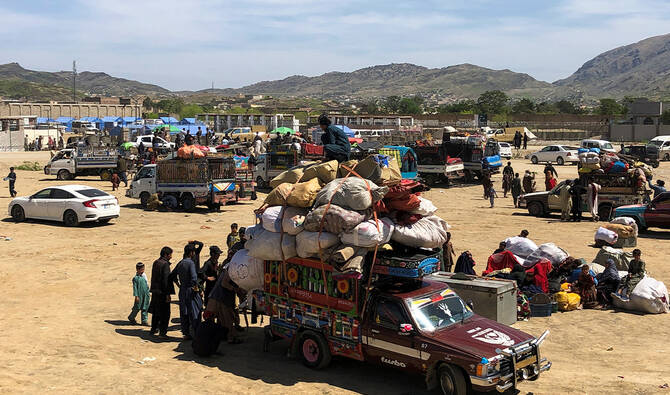

PESHAWAR: Thousands of Afghan refugees are being repatriated through the Torkham border pass in northwestern Pakistan, the Khyber Pakhtunkhwa (KP) Home and Tribal Affairs department said on Tuesday, as Islamabad intensifies its campaign to deport what it says are illegal immigrants.
Pakistani officials told Arab News on Monday that Islamabad has repatriated more than 13,500 Afghan nationals since the expiry of a Mar. 31 expulsion deadline for Afghan Citizen Card (ACC) holders, an identity card issued by Islamabad.
The latest deportation exercise is another phase in Islamabad’s campaign in recent years to return foreigners, mostly Afghans, living in Pakistan. The move is part of a larger repatriation drive of foreign citizens that began in 2023, with over 800,000 Afghans expelled from Pakistan since. The government initially said it was first focusing on expelling foreigners with no legal documentation and other categories such as ACC holders, would be included later.
“Since Apr.1, 5,568 refugees holding Afghan Citizen Cards have been sent to Afghanistan via Torkham,” the tribal affairs department said in a statement.
The department said 2,355 ACC holders and 3,042 illegal immigrants were sent via Torkham border on Monday. Since Apr. 1,160 ACC holders from Islamabad, 4,227 from Punjab and one from Gilgit-Baltistan were sent to Afghanistan via Torkham border.
It added that a total of 488,187 illegal immigrants have been sent to Afghanistan through Torkham since September 2023.
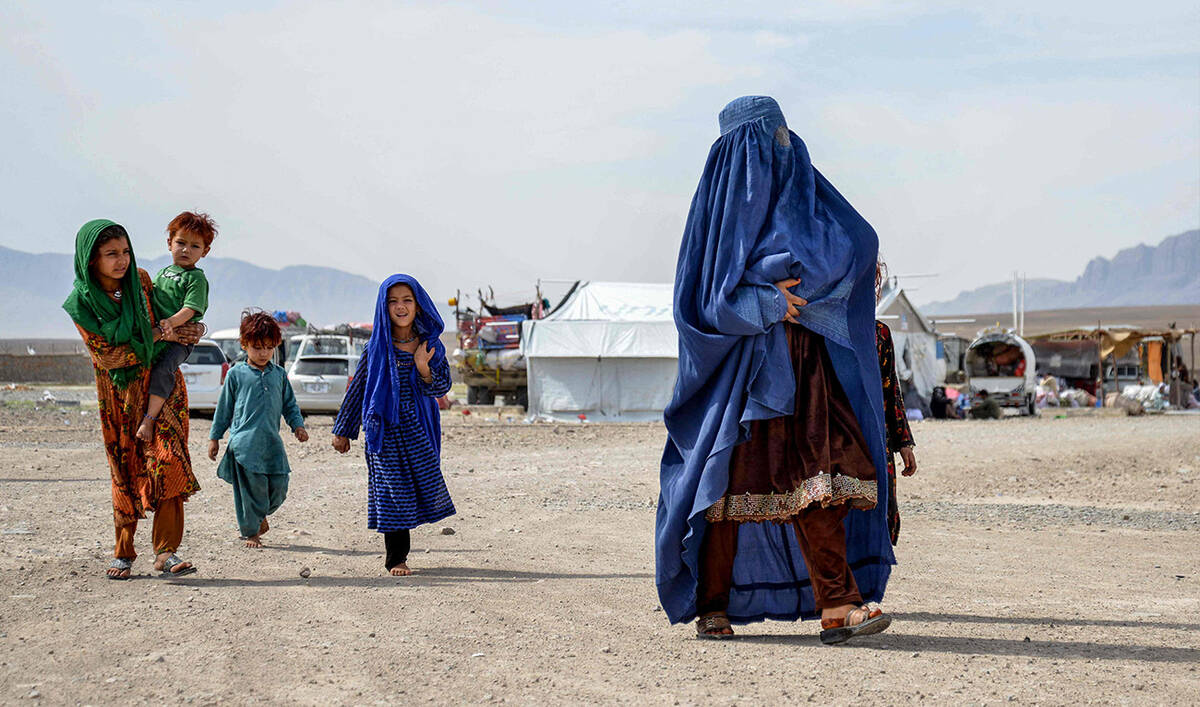
An Afghan burqa-clad refugee along with her children arrives at a registration centre in Takhta Pul district of Kandahar Province, Afghanistan, on April 7, 2025, upon their arrival from Pakistan. (AFP)
According to the United Nations (UN) data, Pakistan has hosted more than 2.8 million Afghan nationals who crossed the border in a desperate attempt to escape decades of war and instability in their home country. Around 1.3 million of them are formally registered as refugees and hold Proof of Registration (PoR) cards, which grant them legal protection while another 800,000 Afghans possess ACC.
Pakistan took the decision in 2023 to deport Afghan nationals from the country following a surge in suicide attacks in the country, particularly in KP. Islamabad blames Afghan nationals for being involved in attacks on its soil and accuses the Taliban-led government in Afghanistan of providing shelter to anti-Pakistan militants. Kabul denies the allegation and says Pakistan’s security matter is its internal responsibility.
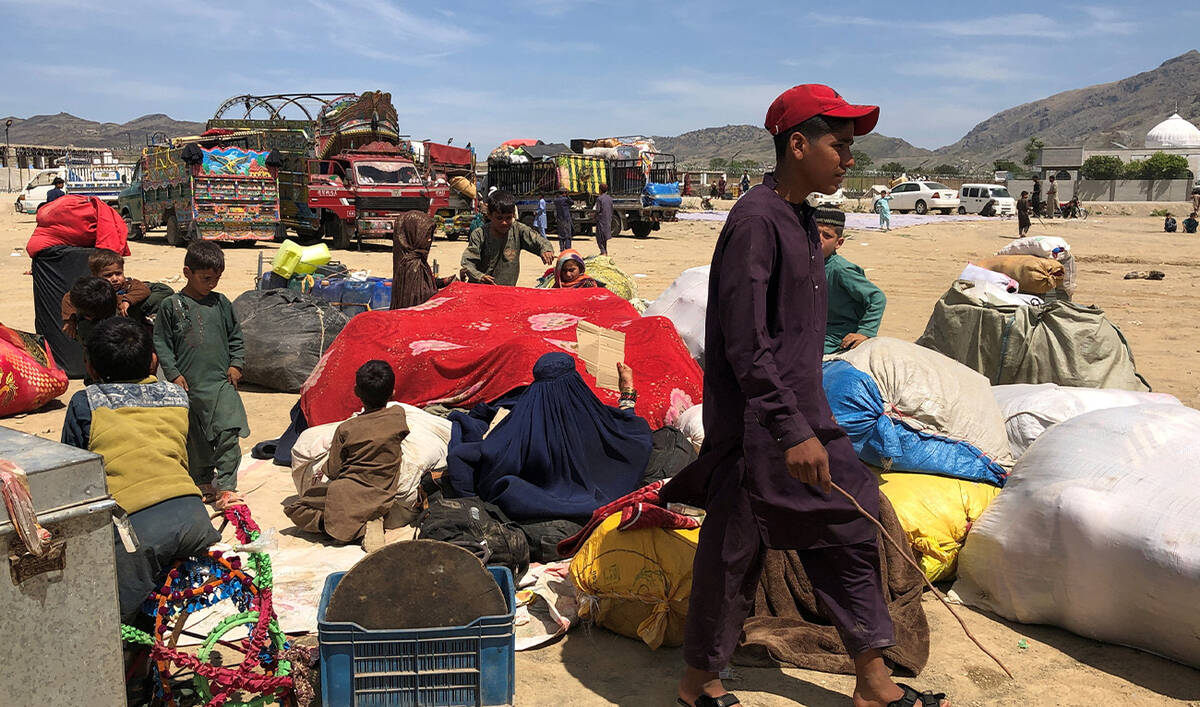
Afghan nationals with their belongings gather as they head back to Afghanistan at the Torkham border crossing, Pakistan on April 7, 2025. (Reuters)
International rights groups allege Afghan refugees face harassment and intimidation by Pakistani police and authorities in the forced expulsion drive. Pakistani officials deny the charges and say Afghan nationals are being sent to their homeland in a dignified manner.
“We faced terrible situations there,” Lal Saeed, an Afghan man recently deported from Pakistan, told Reuters on Monday. “The Pakistani police raided our home during the night. My two sons were taken away — and they’re still in prison. I have the proof.”
With belongings packed, Lal said he left a loaded car waiting outside and rushed to the prison, hoping for one last chance to bring his sons with him.
“When I got there, the police asked, ‘Where are you going?’ I said, ‘I’m going to Afghanistan.’ They replied, ‘Then go — we’ll deport your sons after you.’“


