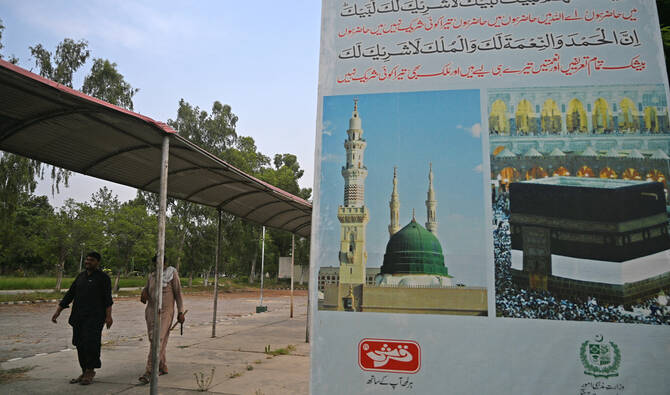
ISLAMABAD: Pakistan is set to launch today, Tuesday, the second phase of mandatory training for Hajj pilgrims, the Pakistani religion ministry said, with 142 workshops scheduled to be held in 72 cities nationwide.
Pakistan conducted its first phase of training for Hajj pilgrims in Jan. that continued across the country until late Feb., with intending pilgrims trained via audio-visual devices and other materials.
Pakistani religious affairs minister Sardar Muhammad Yousaf has said that around 90,000 pilgrims are expected to perform Hajj under the government’s scheme this year, promising to ensure the best possible facilities for them.
As part of the second phase, Hajj workshops will be held in Islamabad, Mirpur Khas, Mirpur Mathilo, Qila Saifullah, Chakwal and Pishin districts on Tuesday, while training sessions will be held in Hyderabad, Mirpur Mirs, Zhob, Qila Abdullah, Chaman, Daki, Ziarat, Mianwali and Nowshera districts on Wednesday.
“The second phase of Hajj pilgrim training will continue until April 24,” the Pakistani religion ministry said. “Overseas Pakistanis will receive training at the relevant Hajj camps after returning home.”
Training programs will be held in Tando Adam, Nowshehro Feroze, Loralai, Haripur, Khushab and Kohat districts on April 10, while workshops in Benazirabad, Dadu, Mardan and Dera Ismail Khan districts will be held on April 11, the religion ministry said.
Pakistan and Saudi Arabia signed in Jan. the Hajj 2025 agreement, under which 179,210 Pakistani pilgrims were supposed to perform the annual pilgrimage under the government and private schemes.
However, the South Asian country failed to fulfill its private Hajj quota of pilgrims, prompting Prime Minister Shehbaz Sharif last week to constitute a three-member inquiry committee to probe why Pakistani authorities had failed to comply with the Kingdom’s Hajj 2025 policy and consequently lost the quota.
Pakistan will begin its Hajj operations on Apr. 29, when the first flight carrying Hajj pilgrims will depart from the eastern city of Lahore to Saudi Arabia.

Pakistan to launch today second phase of Hajj training for pilgrims
https://arab.news/pv55g
Pakistan to launch today second phase of Hajj training for pilgrims
- The second phase of training program will include 142 workshops in 72 cities nationwide
- Overseas Pakistanis will receive training at the relevant Hajj camps after returning home
Pakistan nears $1.5 billion deal to supply weapons, jets to Sudan
- Deal may include drones, air defense systems and Karakoram-8 aircraft, with possible JF-17 fighters
- The sale is expected to bolster Sudan’s army in the ongoing civil war with the Rapid Support Forces
ISLAMABAD: Pakistan is in the final phases of striking a $1.5-billion deal to supply weapons and jets to Sudan, a former top air force official and three sources said, promising a major boost for Sudan’s army, battling the paramilitary Rapid Support Forces.
Their conflict has stoked the world’s worst humanitarian crisis for more than 2-1/2 years, drawing in myriad foreign interests, and threatening to fragment the strategic Red Sea country, a major gold producer.
The deal with Pakistan encompasses 10 Karakoram-8 light attack aircraft, more than 200 drones for scouting and kamikaze attacks, and advanced air defense systems, said two of the three sources with knowledge of the matter, who all sought anonymity.
It was a “done deal,” said Aamir Masood, a retired Pakistani air marshal who continues to be briefed on air force matters.
Besides the Karakoram-8 jets, it includes Super Mushshak training aircraft, and perhaps some coveted JF-17 fighters developed jointly with China and produced in Pakistan, he added, without giving figures or a delivery schedule.
Pakistan’s military and its defense ministry did not immediately respond to requests for comment.
A spokesman for Sudan’s army did not immediately respond to a message requesting comment.
Assistance from Pakistan, especially drones and jets, could help Sudan’s army regain the air supremacy it had toward the start of its war with the RSF, which has increasingly used drones to gain territory, eroding the army’s position.
PAKISTAN’S DEFENSE AMBITIONS
The deal is another feather in the cap for Pakistan’s growing defense sector, which has drawn growing interest and investment, particularly since its jets were deployed in a conflict with India last year.
Last month, Islamabad struck a weapons deal worth more than $4 billion with the Libyan National Army, officials said, for one of the South Asian nation’s largest arms sales, which includes JF-17 fighter jets and training aircraft.
Pakistan has also held talks with Bangladesh on a defense deal that could includes the Super Mushshak training jets and JF-17s, as ties improve ties with Dhaka.
The government sees Pakistan’s burgeoning industry as a catalyst to secure long-term economic stability.
Pakistan is now in a $7-billion IMF program, following a short-term deal to avert a sovereign default in 2023. It won IMF support after Saudi Arabia and other Gulf allies provided financial and deposit rollovers.


