ISLAMABAD: The United States (US) acknowledges the issue of US military equipment left behind in Afghanistan, Pakistan’s foreign office said on Monday, days after Islamabad urged the international community to recover foreign stockpiles in the neighboring country.
The statement came after Pakistani Deputy Prime Minister Ishaq Dar’s telephonic conversation with US Secretary of State Marco Rubio, during which the two figures discussed the issue of US-made advanced weapons in Afghanistan, Islamabad’s counter-terrorism efforts and other affairs of mutual interest.
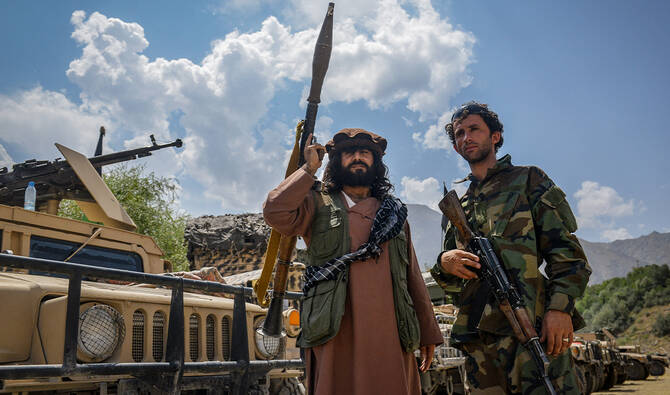
Pakistan has voiced its concerns over the presence of advanced US weapons in Afghanistan which Washington has sought to be returned by Kabul’s Afghan Taliban rulers. Islamabad last week urged the United Nations to recover these weapons, warning that militant groups like the Tehreek-e-Taliban Pakistan (TTP) and the Baloch Liberation Army (BLA) were gaining access to them.
Last month, a Geneva-based monitor, Small Arms Survey, said in its report that trafficking and illegal sale of North Atlantic Treaty Organization (NATO) and Soviet arms have continued in Afghanistan and Pakistan’s border regions more than three years after the Taliban’s takeover of Kabul and their seizure of the previous regime’s stockpiles.
“Secretary Rubio agreed on the need to resolve the issue of US Military equipment left behind in Afghanistan,” the Pakistani foreign office said in a statement.
“Dar and Secretary of State Rubio agreed to remain in close contact and to work together to advance the shared interests of both countries.”
Pakistan has struggled to contain surging militancy in its western regions that border Afghanistan in recent years, with Islamabad accusing Kabul of sheltering and supporting militant groups that launch cross-border attacks. Afghan officials deny involvement and insist that Pakistan’s security issues are an internal matter of Islamabad.
During his conversation with Rubio, Dar highlighted Pakistan’s efforts in fighting terrorism from 2013 till 2018, which caused Islamabad huge economic and human losses.
“Secretary of State Rubio also appreciated Pakistan’s efforts in the fight against terrorism and expressed the US desire to further enhance counter-terrorism cooperation,” the Pakistani foreign office added.
On Friday, Syed Atif Raza, counsellor at Pakistan’s UN Mission, told a UNSC meeting on small arms and light weapons management that militant groups possessed lethal weapons left in Afghanistan that were now used against civilians and Pakistan’s armed forces.
“We know that non-state actors do not have many of the capabilities to manufacture advanced illicit arms, thus raising questions of culpability of certain state actors in these nefarious activities,” he said.
“Pakistan is concerned at the acquisition and use of modern and sophisticated illicit arms by terrorist groups such as Tehreek-e-Taliban Pakistan, a UN-listed terrorist organization, which operates with impunity from Afghanistan, as well as the so-called Baloch Liberation Army and Majeed Brigade.”
The Pakistani diplomat asserted that militants receive external support and financing from Pakistan’s “principal adversary,” alluding to India.
He also highlighted that the evolving nature of warfare and new technologies posed challenges in combating the proliferation of increasingly lethal small arms.
The Small Arms Survey report said that as of August 2021, Afghanistan had 258,300 rifles, including M4, M16 and AK-variants, 64,300 pistols, 63,000 sniper rifles, 56,155 light, medium and heavy machine guns, 31,000 grenade launchers, 9,115 shotguns, 1,845 rounds of 60-82mm, as well as hundreds of thousands of accessories and munitions.


![]()

Pakistan says US acknowledges issue of military equipment left behind in Afghanistan
Short Url
https://arab.news/yvbvb
Pakistan says US acknowledges issue of military equipment left behind in Afghanistan
- Pakistan has voiced its concerns over the presence of advanced US weapons in Afghanistan which Washington has sought to be returned by Kabul
- Last week, Islamabad urged the UN to recover these weapons, warning that militant groups like the Pakistani Taliban were gaining access to them
Latest updates


© 2026 SAUDI RESEARCH & PUBLISHING COMPANY, All Rights Reserved And subject to Terms of Use Agreement.