

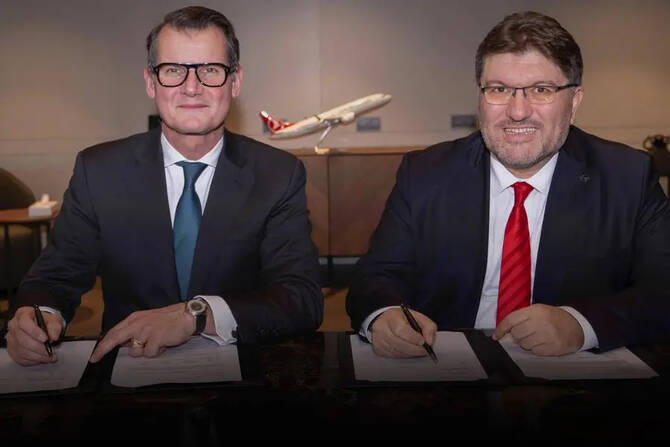
PIF’s AviLease signs deal with Turkish Airlines for 8 Airbus A320neo aircraft

According to a press statement, two aircraft have already been provided, with the remaining six scheduled for delivery throughout 2025. 
Short Url
Updated 07 April 2025
Follow

PIF’s AviLease signs deal with Turkish Airlines for 8 Airbus A320neo aircraft

RIYADH: AviLease, an aircraft leasing firm owned by Saudi Arabia’s Public Investment Fund, has signed a memorandum of understanding with Turkish Airlines for long-term contracts for eight Airbus A320neo aircraft. 

According to a press statement, two aircraft have already been provided, with the remaining six scheduled for delivery throughout 2025. 

PIF launched AviLease in 2022 to harness the potential of promising sectors within the Kingdom, aiming to drive economic diversification and contribute to the growth of the non-oil gross domestic product.

The launch of the company also aligns with Saudi Arabia’s Vision 2030 goal to establish the Kingdom as a leading player in the aviation sector. 

“We thank the Turkish Airlines team for their partnership, and we are delighted to further strengthen our relationship,” said AviLease CEO Edward O’Byrne. 

He added: “These aircraft will support Turkish Airlines’ growth plans while contributing to their fleet modernization strategy and sustainability goals.” 

The press statement further said that AviLease’s portfolio currently consists of 200 owned and managed aircraft, including purchase commitments, on lease to 48 airlines.

In March, AviLease delivered three Airbus A320neo aircraft to SDH Wings. SDH Wings is a joint venture between the Saudi firm and the Chinese sovereign fund, where the Kingdom holds a 10 percent stake.

In February this year, the company gave a specialized Aviation Financing Course to over 150 professionals in partnership with Prince Sultan University and Riyad Bank. 

At that time, AviLease, in a press statement, said that it aimed to support the Kingdom’s Vision 2030 program by preparing Saudi talent to lead the aviation finance sector on both a national and global scale.

The company added that it will continue to drive local economic opportunities and create direct and indirect jobs for Saudi nationals in the aviation and financial sectors.


Closing Bell: Saudi main index extends gains as market opens wider to foreign investment

Updated 02 February 2026
Follow

Closing Bell: Saudi main index extends gains as market opens wider to foreign investment

RIYADH: Saudi Arabia’s Tadawul All Share Index rose on Monday, gaining 153.61 points, or 1.38 percent, to close at 11,321.09.

The total trading turnover of the benchmark index was SR5.85 billion ($1.56 billion), as 207 of the listed stocks advanced, while 55 retreated.

The MSCI Tadawul Index increased, up 21.20 points or 1.41 percent, to close at 1,524.18.

The Kingdom’s parallel market Nomu gained 278.13 points, or 1.17 percent, to close at 24,013.03. This comes as 43 of the listed stocks advanced, while 29 retreated.

The best-performing stock was Saudi Pharmaceutical Industries and Medical Appliances Corp., with its share price surging by 7.26 percent to SR28.94.

Other top performers included Rasan Information Technology Co., which saw its share price rise by 6.51 percent to SR144, and Knowledge Economic City, which saw a 6.25 percent increase to SR13.09.

On the downside, the worst performer of the day was Najran Cement Co., whose share price fell by 2.11 percent to SR6.49.

Almasane Alkobra Mining Co. and Saudi Cable Co. also saw declines, with their shares dropping by 2 percent and 1.88 percent to SR103.10 and SR166.80, respectively.

On the announcement front, Riyad Bank has announced its annual financial results for 2025, with the total income from special commission of financing reaching SR24.1 billion, while net income from special commission of financing amounted to SR12 billion.

In a statement on Tadawul, the bank said: “Net income increased by 11.7 percent mainly due to an increase in total operating income and a decrease in total operating expenses.”

The bank further noted that the rise in total operating income was primarily driven by increased revenue from fees and commissions, trading activities, special commissions, gains on non-trading investments, and other operating sources. This growth was partially tempered by declines in exchange and dividend income.

“Net provision of expected credit losses and other losses decreased by 15.8 percent due to a decrease in impairment charge of credit losses and impairment charge for other financial assets, partially offset by an increase in impairment charge for investments,” it added.

RIBL’s share price closed at SR18.18 on the main market, marking a 1.43 percent increase.