Israel strikes tents near hospitals in Gaza, killing and wounding reporters

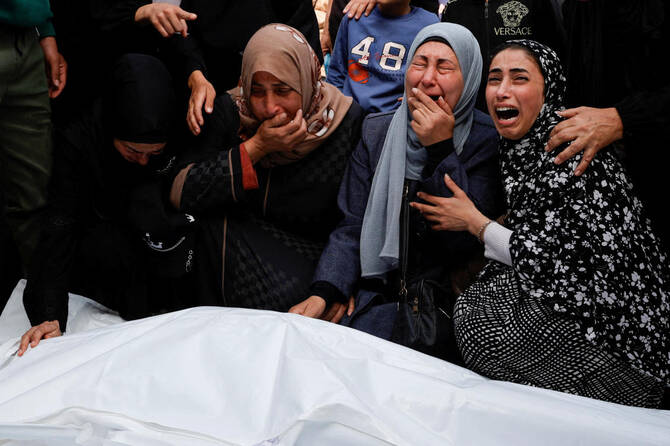
Mourners react next to the bodies of Palestinians killed in Israeli strikes, at Nasser hospital, in Khan Younis in the southern Gaza Strip on April 7, 2025. (Reuters)
Short Url
Updated 07 April 2025
Follow

Israel strikes tents near hospitals in Gaza, killing and wounding reporters

  • An attack on a media tent outside Nasser Hospital in Khan Younis at around 2 a.m. set the tent ablaze
  • Israel also struck tents on the edge of Al-Aqsa Martyrs Hospital in the central city of Deir Al-Balah

DEIR AL-BALAH, Gaza Strip: Israel struck tents outside two major hospitals in the Gaza Strip overnight, killing at least two people, including a local reporter, and wounding nine, including six reporters, medics said Monday.
Fifteen others were killed in separate strikes across the territory, according to hospitals.
A strike on a media tent outside Nasser Hospital in Khan Younis at around 2 a.m. set the tent ablaze, killing Yousef Al-Faqawi, a reporter for the Palestine Today TV station, and another man, according to the hospital. The six reporters were wounded in that strike.
The Israeli military said it struck a Hamas militant, without providing further information. The military says it tries to avoid harming civilians and blames Hamas for their deaths because it is deeply embedded in residential areas.
Israel also struck tents on the edge of Al-Aqsa Martyrs Hospital in the central city of Deir Al-Balah, wounding three people, according to the hospital.
Nasser Hospital said it received 13 other bodies, including six women and four children, from separate strikes overnight. Al-Aqsa Hospital said two people were killed and three wounded in a strike on a home in Deir Al-Balah.
Israel has carried out waves of strikes across Gaza and ground forces have carved out new military zones since it ended its ceasefire with Hamas last month. Israel has barred the import of food, fuel, medicine and humanitarian aid since the beginning of March.
Thousands of people have sheltered in tents set up inside hospital compounds throughout the 18-month war, assuming Israel would be less likely to target them.
Israel has raided hospitals on several occasions, accusing Hamas of using them for military purposes, allegations denied by hospital staff.
The war began when Hamas-led militants stormed into Israel on Oct. 7, 2023, rampaging through army bases and farming communities and killing some 1,200 people, mostly civilians. They abducted 251 people, and are still holding 59 captives — 24 of whom are believed to be alive — after most of the rest were released in ceasefires or other deals.
Israel has vowed to keep escalating military pressure until Hamas releases the remaining hostages, lays down its arms and leaves the territory. Prime Minister Benjamin Netanyahu says he will then implement US President Donald Trump’s proposal to resettle much of Gaza’s population to other countries through what the Israeli leader refers to as “voluntary emigration.”
Palestinians say they do not want to leave their homeland, and human rights experts have warned that implementing the Trump proposal would likely amount to mass expulsion in violation of international law.
Netanyahu will meet with Trump in Washington on Monday to discuss Gaza and other issues.
Israel’s military offensive has killed over 50,000 Palestinians, mostly women and children, according to Gaza’s Health Ministry, which does not say how many of the dead were militants or civilians. Israel says it has killed around 20,000 militants, without providing evidence.
The offensive has destroyed vast areas of Gaza and at its height displaced around 90 percent of its population.


Lebanese man flees hometown, months after repairing home damaged in last war

Updated 57 min 54 sec ago
Follow

Lebanese man flees hometown, months after repairing home damaged in last war

  • Lebanese man rebuilt home four times but fled new war
  • Many in Lebanon ‌were still recovering from 2024 conflict

HAZMIEH: Just days ago, Hussain Khrais was proudly showing off his newly restored home in south Lebanon, fixed up after ​being badly damaged in 2024 clashes between Israel and Hezbollah. But a new war has since erupted and his home is in the line of fire again.
Khrais fled his hometown of Khiyam, about five km (three miles) from the border with Israel, as Israel pounded Lebanon with heavy airstrikes last week in retaliation for Iran-backed group Hezbollah’s rocket and drone fire into Israel.
“Is the house I worked so hard to build, or the business I started, still there? Or is it all gone?” Khrais told Reuters from a relative’s home near the capital Beirut where he and his family are now staying.
“The feeling is ‌very, very upsetting, ‌because we still don’t know if we’ll go back or not.”
’WHAT ​KIND ‌OF ⁠LIFE IS ​THAT?’
It ⁠wasn’t Khrais’ first time — or even his second. The 66-year-old has been displaced at least four times in the last four decades by Israeli incursions and airstrikes, each time returning to a town in ruins and rebuilding patiently.
Last year, he spent months and around $25,000 repairing the damage from the last war between Hezbollah and Israel, which ended 15 months ago. Hezbollah started firing at Israel after the United States and Israel launched airstrikes against Iran on February 28.
“It really bothers me to think this is the life I’ve lived,” Khrais told Reuters. “Once ⁠again, displacement, return, rebuilding, restoration — then again displacement, return, rebuilding. What kind of life ‌is that?“
With no support from the Lebanese state and ‌little coming from Hezbollah’s social welfare program, most Lebanese whose homes were ​damaged or destroyed in the 2024 war have ‌used their own private funds to rebuild.
Reconstruction has placed a huge burden on affected Lebanese families, still ‌struggling to access their savings in commercial banks after a financial collapse in 2019.
Two weeks ago, Khrais had told Reuters he was scared that a new war would start. “I’m at an age where I can’t start all over again. That’s it,” he said.
’WORTH THE WORLD’S TREASURES’
The new war has dealt Lebanese another blow. About 300,000 people have ‌been displaced over the last week by Israel’s strikes and by the Israeli military’s evacuation orders, which encompass around 8 percent of Lebanese territory.
Khrais is staying ⁠with around 20 other ⁠displaced relatives, some displaced from Khiyam and others from Beirut’s southern suburbs, which have been hit hard by Israeli strikes.
He is glued to the television, where news bulletins have reported on Israeli troops and tanks pushing deeper into his hometown.
“I’ve been in Beirut for four days now, and these four days feel like 400 years,” Khrais said.
He misses his house dearly.
“Maybe the thing I’m most attached to, is when I open the door to my children’s bedrooms and see the pictures of their children hanging on the walls,” he said.
“That sight is worth the world’s treasures — to see my grandchildren’s pictures in Khiyam.”
Khrais has no news on the state of his home. He said he remains hopeful but that if it has been destroyed, he’ll still do what he’s always done.
“The big shock would be if I ​came back and didn’t find it. But my ​feeling says no, God willing, it will remain. And like I said, even if we don’t find the house, we’ll go back and rebuild,” he said.