President Zardari expected to leave hospital soon after COVID treatment, doctor says

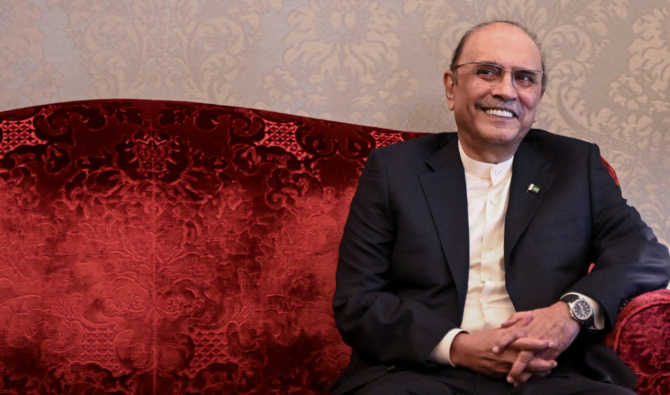
Pakistani President Asif Ali Zardari is pictured during his meeting with Portuguese President, in Lisbon on February 11, 2025. (AFP/File)
Short Url
Updated 06 April 2025
Follow

President Zardari expected to leave hospital soon after COVID treatment, doctor says

  • Asif Ali Zardari was brought to a hospital on Tuesday after he complained of suffering from fever, breathing problems
  • Dr. Asim Hussain refutes rumors about President Zardari’s ‘serious’ health condition and says it is gradually improving

KARACHI: Pakistan’s President Asif Ali Zardari, who tested positive for coronavirus this week, is likely to be discharged from hospital in next two days, his personal physician said on Saturday.
Zardari was brought to a private hospital in Karachi from Sindh’s Nawabshah city on Tuesday after he complained about suffering from fever and breathing problems, local media outlets reported.
On Wednesday, his personal physician, Dr. Asim Hussain, confirmed the president had tested positive for coronavirus and a team of medical experts was looking after him.
Speaking at a press conference on Saturday, Hussain refutes rumors about President Zardari’s ‘serious’ health condition and said it was gradually improving.
“At present, a low-risk variant of the coronavirus is still spreading in Pakistan. No matter what political opponents say or exaggerate anything, the health of the president is very good,” Hussain said.
“Asif Zardari’s meetings are restricted, only doctors have access to him. A panel of expert doctors is monitoring his health.”
Zardari, the widower of Pakistan’s slain first woman prime minister Benazir Bhutto, was appointed president for a second term in March last year. He previously served on the same post from 2008-2013.
Zardari, a landowner from Sindh and co-chairman of the Pakistan Peoples Party (PPP), a key member of Prime Minister Shehbaz Sharif’s ruling coalition, rose to prominence after his marriage to Bhutto in 1987.
He was widely criticized for corruption scandals that led to the collapse of Bhutto’s government in 1990.



Pakistan, Iran seek to boost economic cooperation through agriculture, improved connectivity

Updated 5 sec ago
Follow

Pakistan, Iran seek to boost economic cooperation through agriculture, improved connectivity

  • Pakistan-Iran trade has hovered around $3 billion in recent years, with both countries pledging to take it to $10 billion
  • Pakistan minister says improved connectivity, streamlined procedures and practical coordination can help achieve target

KARACHI: Pakistan and Iran on Tuesday agreed to step up cooperation in agriculture and food security with a focus on improving connectivity and streamlining procedures to boost broader economic ties, the Pakistani food security ministry said.

Trade between Pakistan and Iran has hovered around $3 billion in recent years and both countries signed a memorandum of understanding (MoU) in Feb. 2025 to take it to $10 billion.

Iran was prioritizing Pakistan’s rice, meat and other exports as part of a trade understanding reached between the two countries in Tehran, the Pakistani government said in Aug. last year.

On Tuesday, Iran’s agriculture minister Gholamreza Nouri Ghezeljeh met Pakistani food security and commerce ministers in Islamabad to advance bilateral cooperation in agriculture and food security.

“Federal Minister for Commerce Jam Kamal Khan also highlighted the importance of facilitating cooperation through improved connectivity, streamlined procedures, and practical coordination at the operational level,” the Pakistani food security ministry said.

“He emphasized that sustained engagement and mutual understanding would help unlock the full potential of bilateral relations across multiple sectors.”

Pakistan’s food security minister emphasized that agriculture remains a vital sector for ensuring food security, rural development, and economic stability in both countries, urging enhanced technical cooperation, exchange of expertise and strengthened coordination between relevant departments and research institutions.

The Iranian minister suggested closer cooperation in horticulture, livestock, crop management, and modern farming practices, noting that both countries possessed complementary strengths and could benefit from structured collaboration, joint initiatives and regular institutional dialogue, according to the Pakistani ministry.

Matters relating to agricultural exchange, research collaboration, capacity building, and facilitation of farmers and agri-business stakeholders were also discussed.

“The two sides acknowledged the need to promote joint research in areas such as water conservation, high-value crops, livestock improvement, and sustainable agricultural practices in view of shared climatic and environmental challenges,” the Pakistani food security ministry said.

“The ministers discussed ongoing collaboration under existing agreements, including cooperation in veterinary and animal health, plant protection and quarantine. Both sides agreed on the importance of effectively implementing signed agreements and expediting pending institutional mechanisms to ensure consistent progress.”