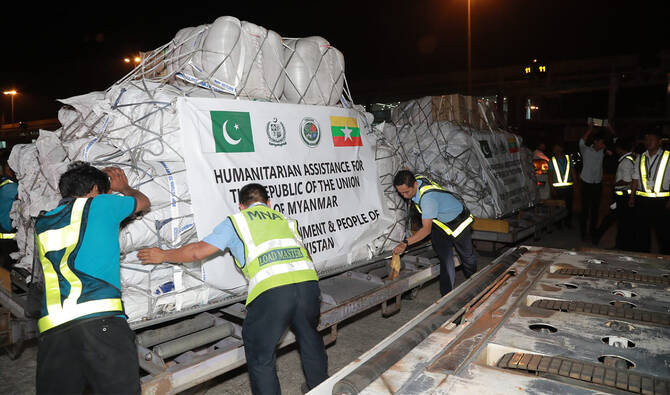
ISLAMABAD: Pakistan’s first humanitarian consignment for victims of the devastating earthquake in Myanmar was handed over to local authorities at Yangon International Airport, the National Disaster Management Authority in Islamabad said in a statement on Thursday.
The 7.7-magnitude earthquake struck nearly a week ago, with its epicenter near Mandalay, Myanmar’s second-largest city. It caused widespread devastation, toppling thousands of buildings, buckling roads and destroying key infrastructure across several regions.
The death toll has climbed to 3,085, according to an update by Myanmar’s military authorities, who said 4,715 people were injured and 341 remain missing.
Pakistan has pledged 70 tons of relief goods to Myanmar and has so far delivered half the promised amount.
“Ambassador of Pakistan at Myanmar H.E. Imran Haider along with Pakistan Embassy’s diplomats/ officials handed over the relief goods to the Chief Minister of Yangon Region and Director General Training of MoFA [Ministry of Foreign Affairs],” the NDMA said.
“The Government of Pakistan and Pakistan’s National Disaster Management Authority remains steadfast in its commitment to providing humanitarian assistance to earthquake-affected people of Myanmar,” it added.
The natural disaster has worsened an already dire humanitarian situation in Myanmar, where the military junta seized power from Aung San Suu Kyi’s elected government in 2021, triggering a nationwide civil conflict.
Even before the quake, over 3 million people had been displaced and nearly 20 million were in need of humanitarian assistance, according to the United Nations.
Media reports and aid workers warn the true toll could be far higher, as many remote areas remain inaccessible due to damaged infrastructure and disrupted communication lines.
With input from AP


Pakistan delivers first batch of quake aid to Myanmar as death toll tops 3,000
https://arab.news/8x2qu
Pakistan delivers first batch of quake aid to Myanmar as death toll tops 3,000

- Aid workers fear higher death toll from 7.7 quake as remote areas remain cut off
- Earthquake has worsened Myanmar’s deepening humanitarian crisis amid civil war

Punjab expands Pakistan-India Wagah border arena with museum, partition-themed park
- The border crossing, near eastern city of Lahore, is the primary land route between Pakistan and India and one of the most recognizable symbols of their often-tense relations
- The site is best known for its daily flag-lowering ceremony, a choreographed military ritual performed by border forces from both countries that draws thousands of spectators
ISLAMABAD: Maryam Nawaz, chief minister of Pakistan’s Punjab province, on Thursday inaugurated the newly constructed arena at Wagah border cross between Pakistan and India, which includes a museum and a partition themed park.
The Wagah border crossing, located near the eastern city of Lahore, is the primary land route between Pakistan and India and one of the most recognizable symbols of the often-tense relationship between the two neighbors. It serves as a key point for prisoner exchanges and limited movement of travelers, while remaining tightly regulated due to security considerations.
The site is best known for its daily flag-lowering ceremony, a choreographed military ritual performed by border forces from both countries that draws thousands of spectators. Over the years, the ceremony has evolved into a popular tourist attraction, blending displays of nationalism with public spectacle and making it one of Pakistan’s most visited landmarks, which connects with India’s Attari.
Flanked by military officials, CM Nawaz visited the crossing and inaugurated the new arena, with its seating capacity increased from 7,500 to 25,000 spectators, the state-run Radio Pakistan broadcaster reported. The chief minister also visited the martyrs’ monument and offered her respects.
“In addition to the arena’s expansion, several new constructions have been added at the Joint Check Post Wagah. These new developments include a theme park depicting the partition of the Subcontinent, featuring models of a railway station, military equipment and a Martyrs’ Memorial,” the broadcaster reported.
“A Pakistan Museum has also been established within the arena, showcasing the country’s history and culture from the Freedom Movement to the present day.”
In August 1947, Britain divided the Indian Sub-continent, its former colony, into two countries — Hindu-majority India and Muslim-majority Pakistan.
Excitement over independence was quickly overshadowed by some of the worst bloodletting that left up to 1 million people dead as gangs of Hindus and Muslims slaughtered each other.
Creating two independent nations also tore apart millions of Hindu and Muslim families in one of the world’s largest peacetime migrations, which displaced at least 15 million people.
The fate of Kashmir, then a princely state, was left undecided. The Himalayan territory continues to remain a flashpoint in relations between the neighbors, who have fought multiple wars over it.


