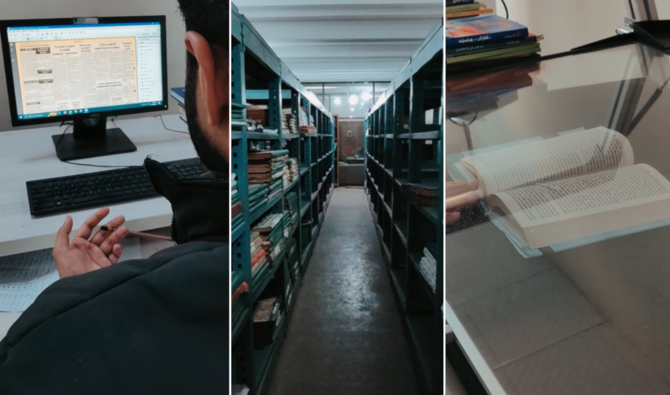

ISLAMABAD: For staff at Pakistan’s leading reference and research library, the biggest challenge is handling an overwhelming volume of data and lack of funds, the facility’s director general said this week, detailing a digitization campaign launched nearly eight years ago to preserve the country’s literary and journalistic heritage.
Established in 1951 in the federal capital of Islamabad, the National Library is the country’s largest repository of printed material and serves as the official legal depository for a variety of publications.
According to Director General Rana Javed Iqbal, the library’s main objective is to comply with the Copyright Ordinance of 1968, which mandates the preservation of “the best copy” of all publications in Pakistan, including newspapers and periodicals.
The ordinance is a legal framework designed to protect the rights of creators and authors over their original works. One of its sections mandates that a copy of every published work produced in the country, such as books and newspapers, be deposited with the library for preservation.
“In 2018, a decision was made to digitize 16 major newspapers covering the period from 1968 to 2015,” Iqbal told Arab News. “We have digitized over 5.4 million pages in Urdu and English, scanning approximately 15,000 pages daily from 2018 to 2021.”
One of the biggest challenges in the endeavor was “handling the sheer volume of data,” with the library receiving around 300-350 newspapers daily in various languages, a problem exacerbated by financial constraints.
The library is now developing Optical Character Recognition (OCR) capabilities in both English and Urdu, a technology that converts scanned text into machine-readable format, enabling efficient keyword and title searches for easier access to digitized records.
The primary objective of the digitization exercise is to make access to information more convenient for students and scholars, eliminating the need for manual searches and enabling users to retrieve information within minutes on their desktops.
The National Library also actively collaborates with government departments to prevent duplication of digitization efforts, ensuring a more streamlined and efficient approach to preserving Pakistan’s printed heritage.
“Our goal is to digitize all magazines and newspapers under copyright,” Iqbal said. “Increasing the number of scanners would further enhance our capacity.
“Digitizing is an ongoing process,” he added. “We continue to receive a large volume of newspapers, and we are working on digitizing publications from 2016 onward.”
The library initially outsourced the digitization process, but later decided to bring it in-house to reduce costs and maintain efficiency by acquiring its own equipment and leveraging skilled staff.
Iqbal said 11,000 rare books and manuscripts had also been digitized, though access was only available on various campuses, with plans to upload them online.
“Our next major initiative involves digitizing 1,500 different magazines,” he said. “We have also undertaken the digitization of the Gazette of Pakistan from 1949 onward.”
Speaking to Arab News, Rana Asad Ullah Khan, a serving additional attorney general who was visiting the facility this week, praised the library management for preserving valuable written material to promote art, education and culture.
“I found a treasure of newspapers in this library which I couldn’t in Lahore,” said Khan, who is researching the history of the Lahore High Court Bar Association, which was founded in 1861.