

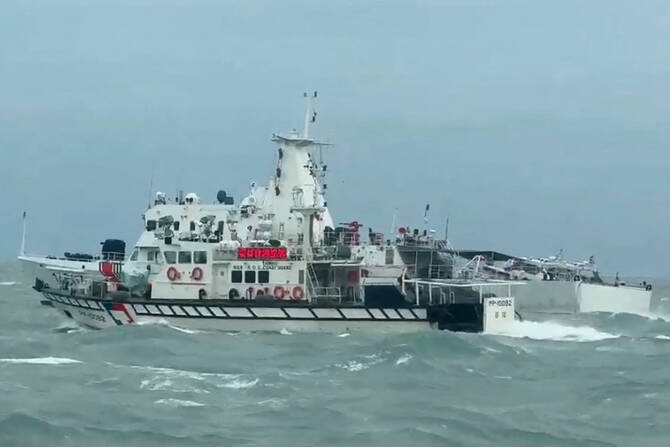

WASHINGTON/TAIPEI: The United States on Wednesday reassured its allies in the Asia-Pacific region of its “enduring commitment” of support amid what it called “China’s intimidation tactics and destabilizing behavior.”
“Once again, China’s aggressive military activities and rhetoric toward Taiwan only serve to exacerbate tensions and put the region’s security and the world’s prosperity at risk,” the US State Department said in a statement posted on its website.
“The United States supports peace and stability across the Taiwan Strait and opposes unilateral changes to the status quo, including through force or coercion,” the statement added.
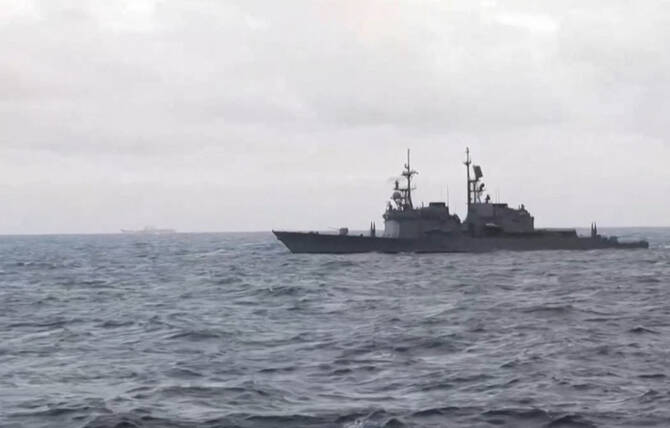
On Tuesday, China conducted large-scale drills in the waters and airspace around Taiwan that included an aircraft carrier battle group, as it again warned the self-ruled democracy against seeking formal independence.
The exercises involved navy, air ground and rocket forces and were meant to be a “severe warning and forceful containment against Taiwan independence,” according to Shi Yi, a spokesperson for the People’s Liberation Army’s Eastern Theater Command. No operational name for the drills was announced nor previous notice given.
China considers Taiwan a part of its territory, to be brought under its control by force if necessary, while most Taiwanese favor their de facto independence and democratic status. Any conflict could bring in the US, which maintains alliances in the region and is legally bound to treat threats to Taiwan as a matter of “grave concern.”
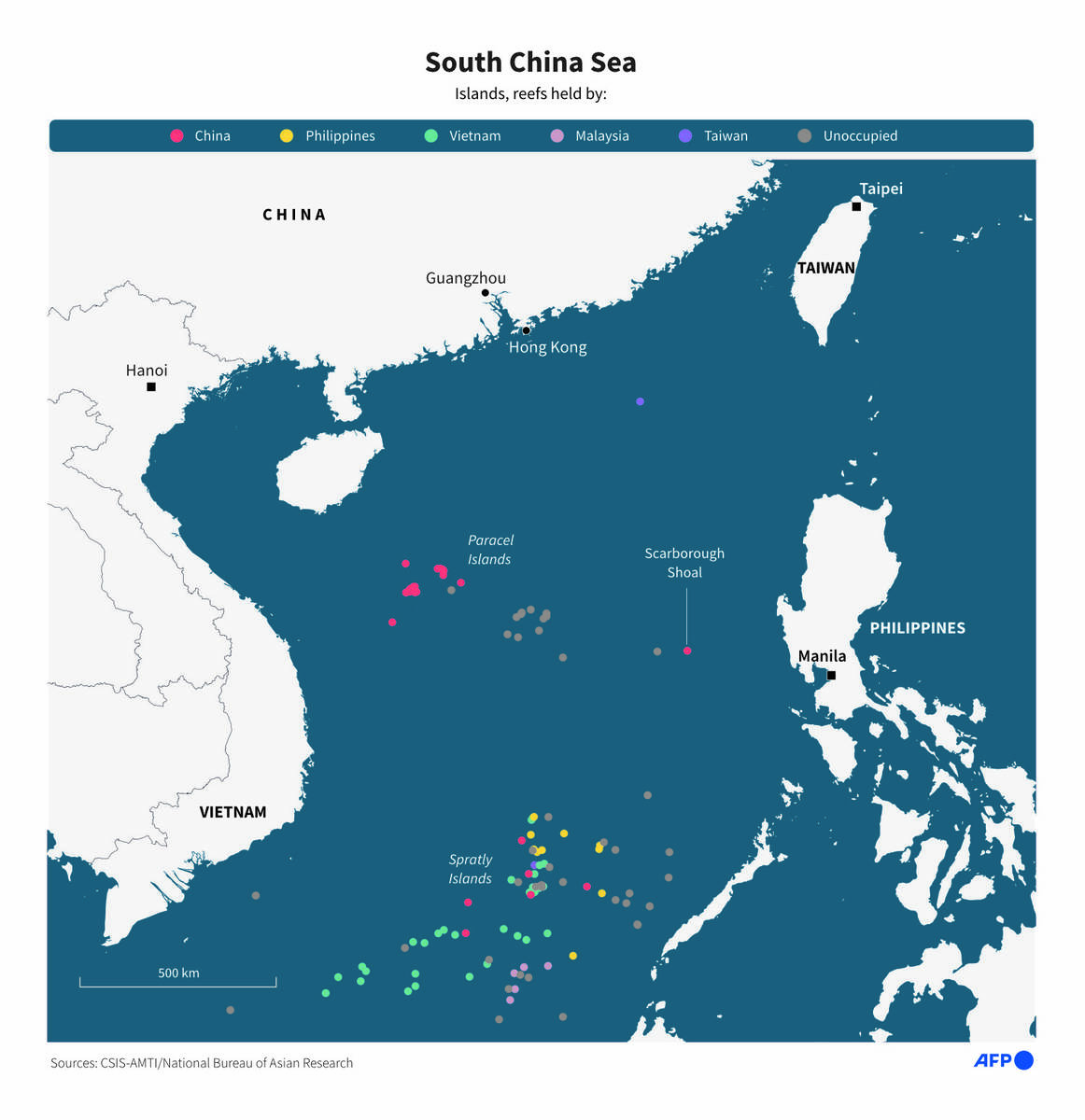
Taiwan’s Presidential Office posted on X that “China’s blatant military provocations not only threaten peace in the #Taiwan Strait but also undermine security in the entire region, as evidenced by drills near Australia, New Zealand, Japan, Korea, the Philippines & the SCS. We strongly condemn China’s escalatory behavior.”
The SCS refers to the South China Sea, the strategic and disputed waterway that China claims almost in its entirety. China’s navy also recently held drills near Australia and New Zealand for which it gave no warning, forcing the last-minute rerouting of commercial flights.
Taiwan tracks Chinese navy vessels
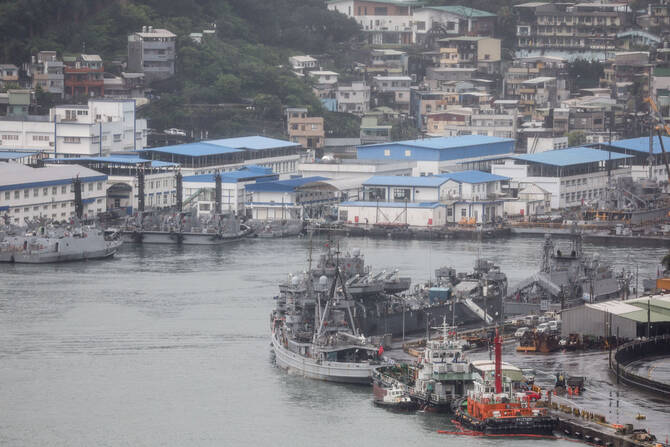
Taiwan’s Ministry of National Defense said it had tracked 19 Chinese navy vessels around the island in a 24-hour period from 6 a.m. Monday until 6 a.m. Tuesday. It added that the Shandong aircraft carrier group had entered into Taiwan’s air defense identification zone, a self-defined area tracked by the military.
Beijing sends warplanes and navy vessels toward the island on a daily basis, andin recent years it has stepped up the scope and scale of these exercises. Taiwanese officials have recently warned that China could launch a sneak attack under the guise of military exercises.
“I want to say these actions amply reflect (China’s) destruction of regional peace and stability,” said Taiwan’s Defense Minister Wellington Koo.
Taiwan has set up a central response group to monitor the latest exercises, Koo said.
On the streets of Taipei, people said the atmosphere was tense but they were more concerned about the economy and developments surrounding the administration of US President Donald Trump.
“The Chinese Communists spend so much time and effort on these things but most people don’t pay much attention,” said Lin Hui-tsung, a noodle seller in the Tiananmu district.
China’s Xinhua News Agency said the Eastern Theater Command conducted “multi-subject drills in waters to the north, south and east of Taiwan Island.”
The theater command “organized its vessel and aircraft formations, in coordination with conventional missile troops and long-range rocket launching systems, to conduct drills of air interception, assault on maritime targets, strikes on ground objects, and joint blockade and control,” Xinhua quoted the command as saying.
The exercises were “aimed at testing the troops’ capabilities of carrying out integrated operations, seizure of operational control and multi-directional precision strikes, the command said.
“The PLA organized naval and air forces to practice subjects such as sea and land strikes, focusing on testing the troops’ ability to carry out precision strikes on some key targets of the Taiwan authorities from multiple directions,” said Zhang Chi, a professor at China’s National Defense University in an interview with Chinese state television.
Beijing sends a message to Taiwan’s president
China’s Taiwan Affairs Office said the exercises were directed at Lai Ching-te, Taiwan’s strongly pro-independence president.
“Lai Ching-te stubbornly insists on a ‘Taiwan independence’ stance, brazenly labeling the mainland as a ‘foreign hostile force,’ and has put forward a so-called ‘17-point strategy’ ... stirring up anti-China sentiments,” China’s Taiwan Affairs Office said in a statement. “We will not tolerate or condone this in any way and must resolutely counter and severely punish these actions.”
In mid-March, Taiwan’s Lai put forward a 17-point strategy aimed at shoring up Taiwan’s security. The points include allowing espionage cases to be tried by military courts and making immigration rules stricter for Chinese citizens applying for permanent residency.
China’s PLA also released a series of videos to publicize their military exercise, including one in which they depict Lai as a green parasite “poisoning” the island by hatching smaller parasites. The video shows Lai’s head on the body of a bulbous green worm, with a pair of chopsticks picking him up and roasting him over a flame set over Taiwan.
Taiwan and China split amid civil war 76 years ago, but tensions have risen since 2016, when China cut off almost all contacts with Taipei.
Philippines should be ready to rescue its citizens
In the Philippines, military chief Gen. Romeo Brawner Jr. asked Filipino forces to prepare to rescue Filipinos working and living in Taiwan if China invades the island, speaking during a ceremony marking the founding anniversary of the military command that secures the Philippine region closest to Taiwan.
“If something happens to Taiwan, inevitably we will be involved. There are 250,000 overseas Filipino workers in Taiwan and we will have to rescue them,” Brawner said.


