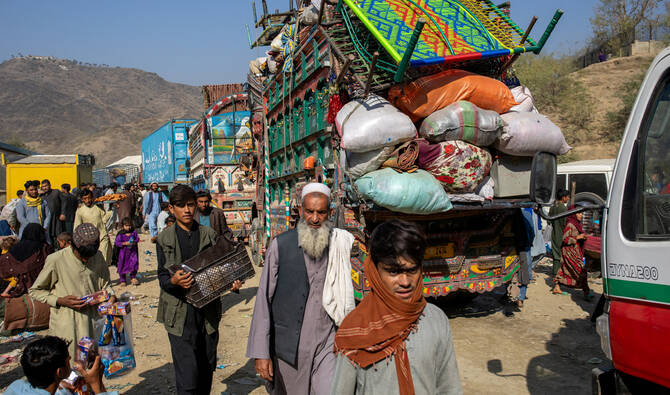
ISLAMABAD: The Taliban interim administration in Kabul on Tuesday urged Afghan refugees to return home voluntarily, as Pakistan resumed deportations following a March 31 deadline issued last month for undocumented migrants and Afghan Citizen Card (ACC) holders to leave the country.
Pakistan’s decision has coincided with the Eid Al-Fitr celebrations, casting a shadow over the religious holiday for thousands of Afghan families. The move is part of a broader repatriation drive launched in 2023, which has so far seen more than 800,000 Afghans expelled.
Pakistani authorities maintain Afghan nationals have been involved in militant attacks and organized crime, accusations Kabul denies.
The crackdown began amid a surge in violence by armed groups like the Tehreek-e-Taliban Pakistan (TTP) and the Baloch Liberation Army (BLA), whose leaders Islamabad claims are based in Afghanistan, a charge rejected by the Taliban administration.
“The Islamic Emirate has reiterated its call for the voluntary return of Afghan migrants as the celebration of Eid Al-Fitr already began,” Afghanistan’s state-run Bakhtar news agency reported on Tuesday. “This appeal comes in light of increasing deportations of Afghan refugees from neighboring countries, mainly Iran and Pakistan.”
“Mawlavi Abdul Kabir, the country’s Minister of Refugees and Repatriation, has urged neighboring countries to halt these deportations and allow Afghans to return home voluntarily,” it added. “He emphasized the importance of humane treatment for refugees, especially in light of reports of mistreatment of Afghans by border nations, including instances where individuals holding legal visas were also deported.”
The agency said Pakistan’s “renewed crackdown” had left even documented Afghan refugees uncertain about their future.
Last week, Afghan refugee leaders in Karachi held a press conference appealing to Pakistani authorities to reconsider the timing of the deportations.
“Pakistan has generously hosted us for nearly 47 years, and a large portion of these refugees were born in Pakistan,” said Hajji Abdullah Shah Bukhari, chairman of the refugee community in Sindh. “Even if the government decides to expel us, it should not be done during Eid.”
He rejected claims that Afghan refugees were involved in militancy, saying, “We ourselves are victims of war and terrorism.”
International rights groups have also urged Islamabad to halt the deportations, warning that some returning Afghans could face threats under Taliban rule.
Pakistan insists it is carrying out the deportation campaign in a humane manner, saying it respects the dignity of all Afghan nationals.
However, officials maintain that the country has hosted Afghan refugees for decades and it is now time for them to return.

Afghanistan urges voluntary return of refugees as Pakistan resumes deportations
https://arab.news/9kecb
Afghanistan urges voluntary return of refugees as Pakistan resumes deportations
- Last month, Pakistan set a March 31 deadline for Afghan Citizen Card holders to return to their country on their own
- Afghan officials in Kabul seek humane treatment for refugees, saying even people with valid documents felt uncertainty
Thousands of Afghans displaced by Kabul-Islamabad conflict
- The neighbors have clashed since Thursday when Afghanistan launched a border offensive in retaliation for Pakistani air strikes
- Islamabad has hit back along the border and with fresh air strikes, bombing multiple sites including the former US air base at Bagram
KABUL: More than 8,000 Afghans have been forced from their homes by fighting with Pakistani forces along the border in recent days, the Taliban government said Tuesday.
The neighbors have clashed along the frontier since Thursday, when Afghanistan launched a border offensive in retaliation for Pakistani air strikes.
Islamabad has hit back along the border and with fresh air strikes, bombing multiple sites including the former US air base at Bagram, the capital Kabul and the southern city of Kandahar.
“Due to these brutal bombings and attacks, 8,400 of our families have been displaced, forced to leave their villages and homes,” Afghan deputy government spokesman Hamdullah Fitrat said at a news conference.
An AFP journalist near the frontier has spoken to residents who have fled the clashes.
Afghanistan’s defense ministry reported “extensive and heavy offensive and revenge attacks” across seven provinces over the past day.
The government acknowledged earlier air strikes on Bagram for the first time.
“Yes, the enemy targeted Bagram as well, but there were no casualties or damage,” defense ministry spokesman Enayatullah Khowarazmi said.
Two residents told AFP on Sunday that they heard air strikes in Bagram, north of the capital.
Pakistani security sources said strikes at Bagram were based on “credible intelligence” to disrupt the “supply of critical equipment and stores” for Afghan soldiers and militants fighting Pakistan forces along the frontier.
They said Pakistan reserves the right to respond to the Taliban government’s “aggression along its border by striking legitimate targets at the time and place of its own choice.”
Pakistani fighter jets also flew nighttime sorties over Kabul, another security source told AFP.
UN ‘ALARMED’
Islamabad’s confirmation that its aircraft flew over the Afghan capital came hours after AFP journalists in the city heard multiple explosions.
The blasts were heard alongside anti-aircraft weapons and gunfire from across the city.
An AFP journalist in Jalalabad city, between Kabul and the frontier, reported hearing explosions and various weapons being fired.
At the nearest border crossing, around 50 kilometers (30 miles) from Jalalabad, residents in Torkham told AFP the days-long fighting was ongoing.
The latest casualties include three children killed in a “crime committed by the Pakistani military regime” in Kunar province, Fitrat said Monday.
At least 39 civilians have been killed since Thursday, the Afghan government said, a toll which Pakistan has not commented on.
The UN children’s charity said it was “alarmed” by reports of child casualties in the conflict, and called on all sides to “exercise maximum restraint, protect civilian lives.”
Pakistan said its February air strikes that sparked the escalation were targeting militants.
Islamabad accuses Afghanistan of failing to act against militant groups that carry out attacks in Pakistan, which the Taliban government rejects.
Pakistan’s Foreign Minister Ishaq Dar said on Tuesday it was “never too late to talk,” but warned: “We will finish this menace.”
The Afghan defense ministry spokesman said more than 25 soldiers have been killed, while estimating Pakistani fatalities among troops at around 150.
Pakistan says more than 430 Afghan soldiers have been killed, with more than 630 wounded.
Casualty claims from both sides are difficult to verify independently.
The violence of recent days is the worst since October fighting killed more than 70 people on both sides, with land borders between the neighbors largely shut since.


