Myanmar declares week of mourning as quake toll passes 2,000

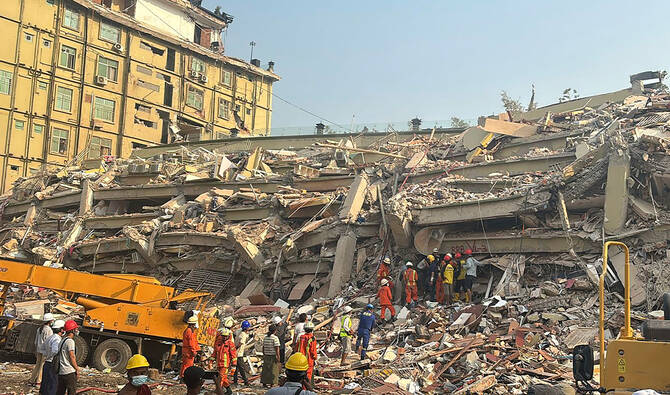
Rescuers work at the Sky Villa Condo that collapsed in Friday’s earthquake in Mandalay, Myanmar, on March 30, 2025. (AP)
Short Url
Updated 31 March 2025
Follow

Myanmar declares week of mourning as quake toll passes 2,000

  • The figure was a sharp rise compared to the 1,002 announced just hours earlier, highlighting the difficulty of confirming casualties over a widespread region
  • In neighboring Thailand, the death toll rose to 17 after the quake rocked the greater Bangkok area, home to around 17 million people, and other parts of the country

MANDALAY: Myanmar declared a week of national mourning on Monday over the country’s devastating earthquake, as the death toll passed 2,000 and hopes faded of finding more survivors in the rubble of ruined buildings.
National flags will fly at half-mast until April 6 “in sympathy for the loss of life and damages” from Friday’s massive quake, the ruling junta said in a statement.
The junta also announced a minute’s silence on Tuesday, to begin at 12:51:02 p.m. (0621 GMT) — the precise time the 7.7-magnitude quake struck.
People should stop where they are to pay tribute to the victims, the junta said, while media should halt broadcasting and show mourning symbols, and prayers will be offered at temples and pagodas.
The announcement came as the tempo and urgency of rescue efforts wound down in Mandalay, one of the worst-affected cities and the country’s second-largest, with more than 1.7 million inhabitants.
“The situation is so dire that it’s hard to express what is happening,” said Aung Myint Hussein, chief administrator of Mandalay’s Sajja North mosque.
People prepared to camp out in the streets across Mandalay for a fourth successive night, either unable to return to ruined homes or nervous about the repeated aftershocks that rattled the city over the weekend.
Some have tents but many, including young children, have been bedding down on blankets in the middle of roads, trying to keep as far from buildings as possible for fear of falling masonry.
The junta said Monday that 2,056 have now been confirmed, with more than 3,900 people injured and 270 still missing, but the toll is expected to rise significantly.
Three Chinese nationals are among the dead, China’s state media said, along with two French people, according to the foreign ministry in Paris.
At least 19 deaths have been confirmed hundreds of kilometers away in Thailand’s capital Bangkok, where the force of the quake caused a 30-story tower block under construction to collapse.
Mandalay’s 1,000-bed general hospital has been evacuated, with hundreds of patients being treated outside.
Patients lay on gurneys in the hospital car park, many with only a thin tarpaulin rigged up to shield them from the fierce tropical sun.
Relatives did their best to comfort them, holding hands or waving bamboo fans over them.
“We’re trying to do what we can here. We are trying our best,” said one medic, who asked to remain anonymous.
The sticky heat has exhausted rescue workers and accelerated body decomposition, which could complicate identification.
But traffic began returning to the streets of Mandalay on Monday, and restaurants and street vendors resumed work.
Hundreds of Muslims gathered outside a destroyed mosque in the city for the first prayer of Eid Al-Fitr, the holiday that follows the Islamic fasting month of Ramadan.
The challenges facing the Southeast Asian country of more than 50 million people were immense even before the earthquake.
Myanmar has been ravaged by four years of civil war sparked by a military coup in 2021, with its economy shattered and health care and infrastructure badly damaged.
The World Health Organization (WHO) declared the quake a top-level emergency as it urgently sought $8 million to save lives, while the International Federation of Red Cross and Red Crescent Societies has launched an appeal for more than $100 million.
International aid and rescue teams have been arriving after junta chief Min Aung Hlaing made an exceptionally rare appeal for foreign assistance.
In the past, isolated Myanmar’s ruling generals have shunned foreign assistance, even after major natural disasters.
Junta spokesman Zaw Min Tun thanked key allies China and Russia for their help, as well as India, and said the authorities were doing their best.
“We are trying and giving treatment to injured people and searching for missing ones,” he told journalists.
But reports have emerged of the military carrying out air strikes on armed groups opposed to its rule, even as Myanmar grapples with the quake’s aftermath.
One ethnic minority armed group told AFP on Sunday that seven of its fighters were killed in an aerial attack soon after the quake, and there were reports of more air strikes on Monday.
Myanmar’s raging civil war, pitting the military against a complex array of anti-coup fighters and ethnic minority armed groups, has displaced around 3.5 million people.
In Bangkok, diggers continued to clear the vast pile of rubble at the site of the collapsed building.
Officials say they have not given up hope of finding more survivors in the wreckage, where 12 deaths have been confirmed and at least 75 people are still unaccounted for.


Cypriot fishermen battle invasive lionfish and turn them into a tavern delicacy

Updated 7 sec ago
Follow

Cypriot fishermen battle invasive lionfish and turn them into a tavern delicacy

LARNACA: Photis Gaitanos’ rough fingers adroitly untangle the venomous spikes of a lionfish from a net, throwing the exotic-looking creature into an ice-filled rubber bin along with other fish from the day’s catch.
Unlike a few years ago when he would have mostly caught local staples as sea bream, red mullet or bass, the veteran fisherman now hunts for the invasive species that made its way from the Red Sea to the warming waters of the Mediterranean,
Lionfish, with their red and orange-hued stripes and antennae-like barbs that menacingly ward off enemies, threaten to decimate indigenous fish stocks, wreaking havoc on the livelihoods of the roughly 150 professional fishermen in Cyprus.
The prickly fish has even made its way as far north as the Ionian Sea, where Italian authorities have asked the public to photograph and report sightings.
The East Mediterranean has also seen another invasive Red Sea fish in the last decade: the silver-cheeked toadfish. Known as an eating machine whose powerful jaws cut through fishing nets, decimating fishermen’s catch, it has no natural predators off Cyprus, allowing its population to explode.
That toadfish also produces a lethal toxin, making it inedible.
Warmer waters are the culprit
Gaitanos, the 60-year-old fisherman, has fished for years in an area a few kilometers off the coastal town of Larnaca, once famous for its fishing bounty. Now, he says, it’s been more than two years since he’s caught a red mullet, a consumer favorite.
“I have been practicing this profession for 40 years. Our income, especially since these two foreign species appeared, has become worse every year. It is now a major problem (affecting) the future of fishing,” he said. “How can it be dealt with?”
Europe’s General Fisheries Commission for the Mediterranean says with the sea warming some 20 percent faster than the global average, the presence of invasive species “is progressively increasing in the western basin.”
Models show that warmer seas as a result of climate change could see lionfish swarm the entire Mediterranean by the century’s end. Warmer waters and an expanded Suez Canal “have opened the floodgates” to Indo-Pacific species in general, according to Cyprus’ Fisheries Department.
The European Union’s Fisheries Commissioner Costas Kadis, a Cypriot himself, told The Associated Press that more frequent and intense extreme weather, often linked to climate change, could make the Mediterranean more hospitable to invasive species.
And that’s taking a heavy toll on Europe’s fishing industry as fishermen’s catches diminish while their costs shoot up as a result of repairs to fishing gear damaged by the powerful intruders.
“The native marine biodiversity of a specific region, as in the case of Cyprus, faces heightened competition and pressure, with implications for local ecosystems and industries dependent on them,” said Kadis.
Fishermen cry for help
Gaitanos, who inherited his father’s boat in 1986, is not sure the fishermen’s grievances are being handled in a way that can stave off the profession’s decline.
“We want to show the European Union that there’s a big problem with the quantity of the catch as well as the kind of fish caught, affected by the arrival of these invasive species and by climate change,” he said.
Some EU-funded compensation programs have been enacted to help fishermen. The latest, enforced last year, pays fishermen about 4.73 euros ($5.5) per kilogram (2.2 pounds) to catch toadfish to control their number. The toadfish are then sent to incinerators.
Another project, RELIONMED, which began in 2017, recruits some 100 scuba divers to cull lionfish around wrecks, reefs and marine protected areas. The Cyprus Fisheries Department says surveys show that frequent culls could buy time for native species to recover, but it’s not a permanent fix.
Some try eating the problem
What local fishermen are hoping will catch on with the fish-loving public is a new campaign to serve lionfish as a delicacy after its poisonous spines are carefully removed.
Kadis, the EU Fisheries commissioner, said a social media campaign that began in 2021, #TasteTheOcean, had top European chefs and influencers plugging invasive species as a tasty alternative to the more commonly consumed fish. Renowned Cypriot chef Stavris Georgiou worked up a lionfish recipe of his own.
For most Cypriots, local taverns with their rich meze menus that feature numerous plates different fish is the way to go. Although eating lionfish has been slow to catch on, many tavernas and fish restaurants have started to introduce it as part of their menu.
The bonus is that lionfish is now priced competitively compared to more popular fish like sea bass. At the Larnaca harbor fish market, lionfish cost less than half as much as more popular fish like sea bass.
“By incorporating invasive species such as lionfish into our diet, we can turn this challenge into an opportunity for the fisheries sector and at the same time help limit the environmental threat caused by these species,” Kadis said
Stephanos Mentonis, who runs a popular fish tavern in Larnaca, has included lionfish on his meze menu as a way to introduce the fish to a wider number of patrons.
Mentonis, 54, says most of his customers aren’t familiar with lionfish. But its meat is fluffy and tender, and he says it can hold up against perennial tavern favorites like sea bream.
“When they try it, it’s not any less tasty than any other fish,” he said.