

Niger withdraws from Lake Chad military force fighting terrorist groups

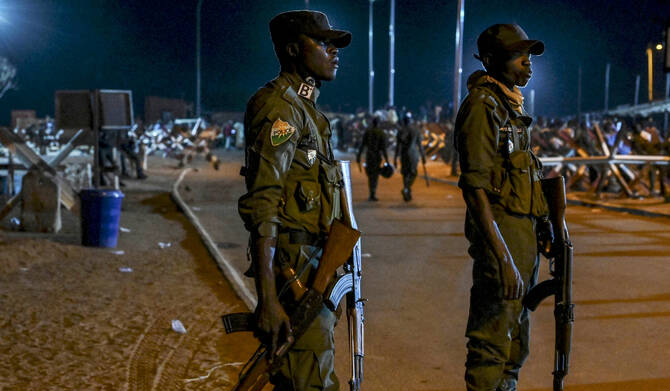
National police officers stand guard as supporters of Niger's National Council for Safeguard of the Homeland protest outside the French and Niger airbase in Niamey on September 9, 2023 to demand the departure of the French army from Niger. (AFP)
Short Url
Updated 30 March 2025
Follow

Niger withdraws from Lake Chad military force fighting terrorist groups

  • The ensuing conflict, which has drawn in other extremist groups, has killed over 40,000 people and displaced around two million, causing one of the world’s worst humanitarian crises

NIAMEY: Niger has withdrawn from the military coalition fighting terrorist groups in the Lake Chad region of west-central Africa, saying it will focus instead on protecting its oil operations from attacks.
The announcement comes amid rising tensions between the four countries bordering Lake Chad since a 2023 coup by Niger’s military.
In a bulletin read on state TV, the army said the operation under the Multinational Joint Task Force, active since 2015, would now be called “Nalewa Dole” following Niger’s withdrawal.
The move “reflects a stated intent to reinforce security for oil sites,” the bulletin stated, without further elaboration.
The four countries that surround Lake Chad — Cameroon, Chad, Niger and Nigeria — have been battling insurgencies since 2009, after a spate of violent campaigns by the Boko Haram group in Nigeria’s northeast spilled into its neighbous.
The ensuing conflict, which has drawn in other extremist groups, has killed over 40,000 people and displaced around two million, causing one of the world’s worst humanitarian crises.
But since the July 2023 coup, Niger’s military junta has accused Nigeria of supporting foreign forces in a bid to destabilize it, which Abuja denies.
Oil infrastructure in southeast Niger meanwhile, in particular a pipeline leading from the landlocked country to Benin, regularly face attacks by armed groups.
The governor of Niger’s Diffa region, General Ibrahim Bagadoma, said at a regional summit in February that “The problem is that some are making efforts, while others are undermining them. We must present a united front and end foreign regional interferences.”
Late last year, Chad had threatened to withdraw from the Joint Task Force after an attack killed around 40 of its soldiers, citing an “absence of mutualized efforts.”


Philippines eyes closer cooperation on advanced defense tech with UAE

Updated 7 sec ago
Follow

Philippines eyes closer cooperation on advanced defense tech with UAE

  • Philippine-UAE defense agreement is Manila’s first with a Gulf country
  • Philippines says new deal will also help modernize the Philippine military

MANILA: The Philippines is seeking stronger cooperation with the UAE on advanced defense technologies under their new defense pact — its first such deal with a Gulf country — the Department of National Defense said on Friday.

The Memorandum of Understanding on Defense Cooperation was signed during President Ferdinand Marcos Jr.’s visit to Abu Dhabi earlier this week, which also saw the Philippines and the UAE signing a comprehensive economic partnership agreement, marking Manila’s first free trade pact with a Middle Eastern nation.

The Philippines-UAE defense agreement “seeks to deepen cooperation on advanced defense technologies and strengthen the security relations” between the two countries, DND spokesperson Assistant Secretary Arsenio Andolong said in a statement.

The MoU “will serve as a platform for collaboration on unmanned aerial systems, electronic warfare, and naval systems, in line with the ongoing capability development and modernization of the Armed Forces of the Philippines,” he added.

It is also expected to further military relations through education and training, intelligence and security sharing, and cooperation in the fields of anti-terrorism, maritime security, and peacekeeping operations.

The UAE’s Ministry of Foreign Affairs has described security and defense as “very promising fields” in Philippine-UAE ties, pointing to Abu Dhabi being the location of Manila’s first defense attache office in the Middle East.

The UAE is the latest in a growing list of countries with defense and security deals with the Philippines, which also signed a new defense pact with Japan this week.

“I would argue that this is more significant than it looks on first read, precisely because it’s the Philippines’ first formal defense cooperation agreement with a Gulf state. It signals diversification,” Rikard Jalkebro, associate professor at the Anwar Gargash Diplomatic Academy in Abu Dhabi, told Arab News.

“Manila is widening its security partnerships beyond its traditional circles at a time when strategic pressure is rising in the South China Sea, and the global security environment is (volatile) across regions.”

Though the MoU is not an alliance and does not create mutual defense obligations, it provides a “framework for the practical stuff that matters,” including access, training pathways, procurement discussions and structured channels” for security cooperation, he added.

“For the UAE, the timing also makes sense, seeing that Abu Dhabi is no longer only a defense buyer; it’s increasingly a producer and exporter, particularly in areas like UAS (unmanned aerial systems) and enabling technologies. That opens a new lane for Manila to explore capability-building, technology transfer, and industry-to-industry links,” Jalkebro said.

The defense deal also matters geopolitically, as events in the Middle East and the Indo-Pacific region have ripple effects on global stability and commerce.

“So, a Philippines–UAE defense framework can be read as a pragmatic hedge, strengthening resilience and options without formally taking sides,” Jalkebro said.