MWL chief calls for unity during Albania’s Eid sermon

1 / 3
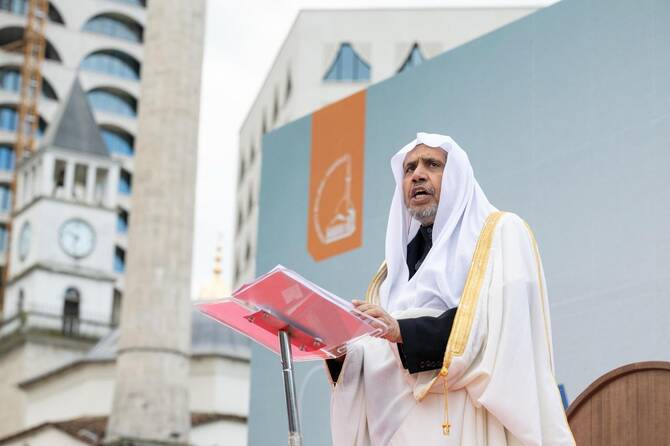
Mohammed bin Abdulkarim Al-Issa, secretary-general of the MWL, delivers the Eid Al-Fitr sermon at the Great Mosque of Tirana, largest in Albania and the Balkans. (Supplied)
2 / 3
Mohammed bin Abdulkarim Al-Issa, secretary-general of the MWL, delivers the Eid Al-Fitr sermon at the Great Mosque of Tirana, largest in Albania and the Balkans. (Supplied)
3 / 3
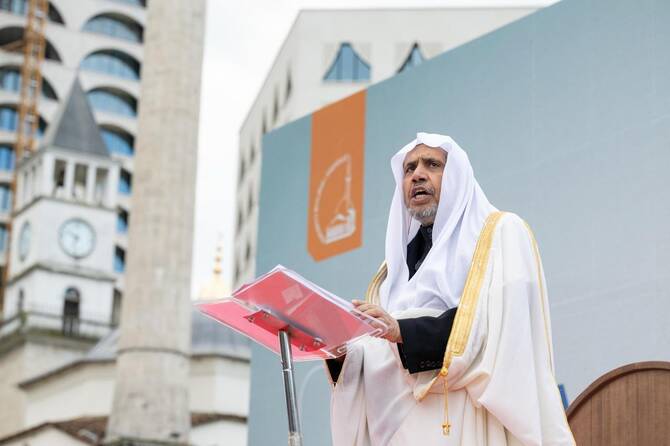
Mohammed bin Abdulkarim Al-Issa, secretary-general of the MWL, delivers the Eid Al-Fitr sermon at the Great Mosque of Tirana, largest in Albania and the Balkans. (Supplied)
Short Url
Updated 30 March 2025
Follow

MWL chief calls for unity during Albania’s Eid sermon

  • Al-Issa urges Muslims to uphold Islam’s reputation

RIYADH: Dr. Mohammed bin Abdulkarim Al-Issa, secretary-general of the Muslim World League and chairman of the Organization of Muslim Scholars, visited Albania at the invitation of President Bajram Begaj.

During his visit, he delivered the Eid Al-Fitr sermon at the Great Mosque of Tirana, the largest in Albania and the Balkans.

A large crowd attended, including prominent scholars like Sheikh Boyar Spahiu, chairman of the Islamic Sheikhdom and grand mufti of Albania.

Al-Issa began with heartfelt Eid greetings, calling it a time of joy and divine grace, as well as an opportunity to embrace Islamic values and faith-based brotherhood.

He stressed that Eid strengthens bonds of forgiveness, unity, and friendship, extending beyond Muslims to all humanity.

Focusing on the Qur’an’s virtues, he described it as “a guide to what is most upright,” leading believers in faith, worship, and conduct.

Al-Issa also reflected on the Prophet Muhammad’s role in spreading Islam with justice and high moral values. Despite attempts to undermine the faith, nearly 2 billion Muslims worldwide continue to practice it with pride, he noted.

Al-Issa urged the crowd to uphold Islam’s reputation, stating that true pride lies in actions. He emphasized that Muslims must be good ambassadors of Islam, embodying its core principles and high values, regardless of circumstances or provocations.

Praising Albania’s social harmony, he described Albanians as a model of faith, coexistence, and peace, noting that their commitment to forgiveness and morality strengthens both their nation and the global community.

He highlighted the family as society’s foundation, calling it every nation’s hope and safety net. He also stressed the vital role of Muslim women in nurturing children and instilling correct religious beliefs. 


Archbishop of York says he was ‘intimidated’ by Israeli militias during West Bank visit

Archbishop of York Stephen Cottrell poses for a photograph with York Minster’s Advent Wreath.
Updated 5 sec ago
Follow

Archbishop of York says he was ‘intimidated’ by Israeli militias during West Bank visit

  • “We were … intimidated by Israeli militias who told us that we couldn’t visit Palestinian families in the occupied West Bank,” the archbishop said

LONDON: The Archbishop of York has revealed that he felt “intimidated” by Israeli militias during a visit to the Holy Land this year.

“We were stopped at various checkpoints and intimidated by Israeli militias who told us that we couldn’t visit Palestinian families in the occupied West Bank,” the Rev. Stephen Cottrell told his Christmas Day congregation at York Minster.

The archbishop added: “We have become — and really, I can think of no other way of putting it — we have become fearful of each other, and especially fearful of strangers, or just people who aren’t quite like us.

“We don’t seem to be able to see ourselves in them, and therefore we spurn our common humanity.”

He recounted how YMCA charity representatives in Bethlehem, who work with persecuted Palestinian communities in the West Bank, gave him an olive wood Nativity scene carving.

The carving depicted a “large gray wall” blocking the three kings from getting to the stable to see Mary, Joseph and Jesus, he said.

He said it was sobering for him to see the wall in real life during his visit.

He continued: “But this Christmas morning here in York, as well as thinking about the walls that divide and separate the Holy Land, I’m also thinking of all the walls and barriers we erect across the whole of the world and, perhaps most alarming, the ones we build around ourselves, the ones we construct in our hearts and minds, and of how our fearful shielding of ourselves from strangers — the strangers we encounter in the homeless on our streets, refugees seeking asylum, young people starved of opportunity and growing up without hope for the future — means that we are in danger of failing to welcome Christ when he comes.”