

Customer preferences shifting toward pret fashion affect tailoring businesses

1 / 2
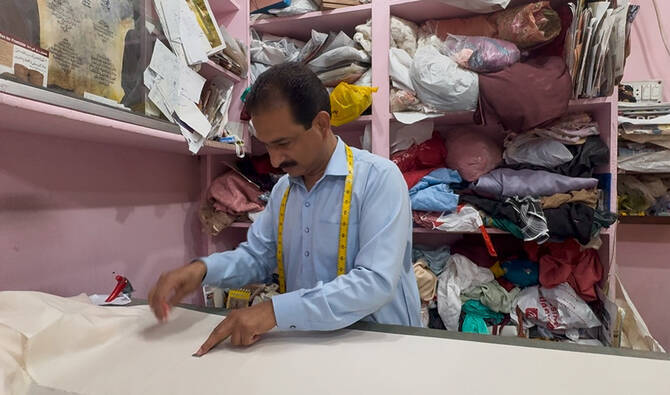
Tailor Muhammad Shafiq marks fabric before cutting it in his shop in Islamabad. (AN photo)
2 / 2
A worker at Muhammad Shafique’s tailoring shop stitches clothes in Islamabad. (AN photo)
Short Url
Updated 30 March 2025
Follow

Customer preferences shifting toward pret fashion affect tailoring businesses

  • Customer preferences shifting toward pret fashion affect tailoring businesses
  • Women say they prefer pret for its convenience, affordability and accessibility over custom tailoring 

ISLAMABAD: With a measuring tape draped around his neck, Muhammad Shafiq cut through a piece of fabric, expertly following the yellow chalk markings he had made according to the exact size of a client.

Each year, the demand for custom-made clothing skyrockets in the run-up to the Muslim festivals of Eid Al-Fitr and Eid Al-Adha, with tailoring shops in Islamabad and other cities in Pakistan bustling with women eager to get their dresses made in time.

The exercise requires long shopping trips to malls and bazaars to buy cloth in various fabrics and prints, or ordering them online, and then giving them to tailors to fashion into outfits per customized measurements and styles.

HIGHLIGHT

Pret collections also often reflect current fashion trends, allowing consumers to stay up to date with the latest styles.

But in the past few years, many tailoring businesses have had to contend with a growing preference for ready-to-wear fashion, chosen for its convenience, affordability, and accessibility, allowing women and men alike to easily find stylish and fashionable garments without the need for custom tailoring or extensive shopping trips.

“It’s not that there is no work at all but earlier we would have advance bookings almost a month before Eid,” Shafiq, 53, who has been a tailor for four decades, told Arab News at his cramped shop in the Pakistani capital earlier this month.
“But now it’s down to about 10 days (of advanced bookings). Many people don’t have the time to get clothes stitched and opt for boutique-made, ready-to-wear outfits.”

Convenience

Ready-to-wear clothing is widely available at Pakistani stores, department stores, and online platforms, making it easier to find and purchase. Pret collections also often reflect current fashion trends, allowing consumers to stay up to date with the latest styles. And instead of scheduling fittings and waiting for custom-made garments, consumers can simply try on and buy ready-to-wear pieces on the go.

Arslan Haider, a designer and store manager, said boutiques and designer brands were certainly reshaping fashion preferences on holidays like Eid.

“During events like Eid, the market sees a surge in business and new fashion trends emerge in stores, which helps businesses flourish,” Haider told Arab News. 

But tailoring is still a cheaper option in some cases, he said, and the older generation, more concerned with the perfect fitting, preferred bespoke clothing while younger people were more inclined toward pret.

“Stitched clothes come with stylish designs and they eliminate the need for multiple visits to tailors to provide measurements and other accessories,” Haider said, adding that convenience was a serious consideration for many customers.

“Unstitched clothes require at least seven to eight days with a tailor, and there’s always a risk of error. With stitched clothing, customers get a standardized product, whether they buy online or from a store,” he said.

Farida Qureshi, a UK-based customer visiting Pakistan for Eid, said she preferred ready-to-wear fashion because it saved time and effort. Getting an outfit stitched, on the other hand, did not just require buying the cloth and visiting the tailor, but also purchasing matching accessories such as lace, beads and buttons, which was a time-consuming task.

“Finding everything in one place, ready-made is far easier than visiting different shops and then waiting for a tailor,” Qureshi said. 

But there are still those who want the personalized touch of a tailor on their Eid dresses.

“I do buy ready-made clothes, but I often face size issues,” Qureshi said. “With my tailor, I get exactly what I want.”

Which is why business still thrives for many tailors like Shafiq, who work up to 16 hours a day during Ramadan to complete Eid orders.

“Some people want a perfect fit, something that ready-made clothes can’t always provide,” he said.

“I have customers who have been coming to me for years because they know I already have their measurements and can tailor their Eid clothes exactly to their liking.”


Ukraine drops NATO goal as Trump envoy sees progress in peace talks

Updated 4 sec ago
Follow

Ukraine drops NATO goal as Trump envoy sees progress in peace talks

  • The move marks a major shift for Ukraine, which has fought to join NATO as a safeguard against Russian attacks and has such an aspiration included in its constitution

BERLIN/KYIV: President Volodymyr Zelensky offered to drop Ukraine’s aspirations to join the NATO military alliance as he held five hours of talks with US envoys in Berlin on Sunday to end the war with Russia, with negotiations set to continue on Monday.
Trump’s envoy Steve Witkoff said “a lot of progress was made” as he and Trump’s son-in-law Jared Kushner met Zelensky in the latest push to end Europe’s bloodiest conflict since World War Two, though full details were not divulged.
Zelensky’s adviser Dmytro Lytvyn said the president would comment on the talks on Monday once they were completed. Officials, Lytvyn said, were considering the draft documents.
“They went on for more than five hours and ended for today with an agreement to resume tomorrow morning,” Lytvyn told reporters in a WhatsApp chat.
Ahead of the talks, Zelensky offered to drop Ukraine’s goal to join NATO in exchange for Western security guarantees.
The move marks a major shift for Ukraine, which has fought to join NATO as a safeguard against Russian attacks and has such an aspiration included in its constitution. It also meets one of Russia’s war aims, although Kyiv has so far held firm against ceding territory to Moscow.
“Representatives held in-depth discussions regarding the 20-point plan for peace, economic agendas, and more. A lot of progress was made, and they will meet again tomorrow morning,” Witkoff said in a post on X.
The talks were hosted by German Chancellor Friedrich Merz, who a source said had made brief remarks before leaving the two sides to negotiate. Other European leaders are also due in Germany for talks on Monday.
“From the very beginning, Ukraine’s desire was to join NATO, these are real security guarantees. Some partners from the US and Europe did not support this direction,” Zelensky said in answer to questions from reporters in a WhatsApp chat.
“Thus, today, bilateral security guarantees between Ukraine and the US, Article 5-like guarantees for us from the US, and security guarantees from European colleagues, as well as other countries — Canada, Japan — are an opportunity to prevent another Russian invasion,” Zelensky said.
“And it is already a compromise on our part,” he said, adding the security guarantees should be legally binding.
Russian President Vladimir Putin has repeatedly demanded Ukraine officially renounce its NATO ambitions and withdraw troops from the about 10 percent of Donbas which Kyiv still controls. Moscow has also said Ukraine must be a neutral country and no NATO troops can be stationed in Ukraine.
Russian sources said earlier this year that Putin wants a “written” pledge by major Western powers not to enlarge the US-led NATO alliance eastwards — shorthand for formally ruling out membership to Ukraine, Georgia, Moldova and other former Soviet republics.
Sending Witkoff, who has led negotiations with Ukraine and Russia on a US peace proposal, appeared to be a signal that Washington saw a chance of progress nearly four years after Russia’s 2022 invasion.
Under pressure from Trump to sign a peace deal that initially backed Moscow’s demands, Zelensky accused Russia of dragging out the war through deadly bombings of cities and Ukraine’s power and water supplies.
A ceasefire along the current front lines would be a fair option, he added.

‘CRITICAL MOMENT’
Germany’s Defense Minister Boris Pistorius said it was a “good sign” Trump had sent his envoys while fielding questions in an interview with the ZDF broadcaster on the suitability of Witkoff and Kushner, two businessmen, as negotiators.
“It’s certainly anything but an ideal setup for such negotiations. That much is clear. But as they say, you can only dance with the people on the dance floor,” Pistorius said.
On the issue of Ukraine’s offer to give up its NATO aspirations in exchange for security guarantees, Pistorius said Ukraine had bitter prior experience of relying on security assurances. Kyiv had in 1994 agreed to give up its Soviet-era nuclear arsenal in exchange for territorial guarantees from the US, Russia and Britain.
“Therefore, it remains to be seen to what extent this statement Zelensky has now made will actually hold true, and what preconditions must be met,” Pistorius said.
“This concerns territorial issues, commitments from Russia and others,” he said, adding mere security guarantees, especially without significant US involvement, “wouldn’t be worth much.”
Britain, France and Germany have been working to refine the US proposals, which in a draft disclosed last month called for Kyiv to cede more territory, abandon its NATO ambitions and accept limits on its armed forces.
European allies have described this as a “critical moment” that could shape Ukraine’s future, and sought to shore up Kyiv’s finances by leveraging frozen Russian central bank assets to fund Kyiv’s military and civilian budget.
