Aftershocks rattle Mandalay as rescuers search for survivors in Myanmar quake

1 / 3
Rubble lies near a pagoda damaged during a strong earthquake in Mandalay, Myanmar, on March 29, 2025. (REUTERS)
2 / 3
A woman clears debris in front of damaged houses in Mandalay on March 30, 2025, two days after an earthquake struck central Myanmar. (AFP)
3 / 3
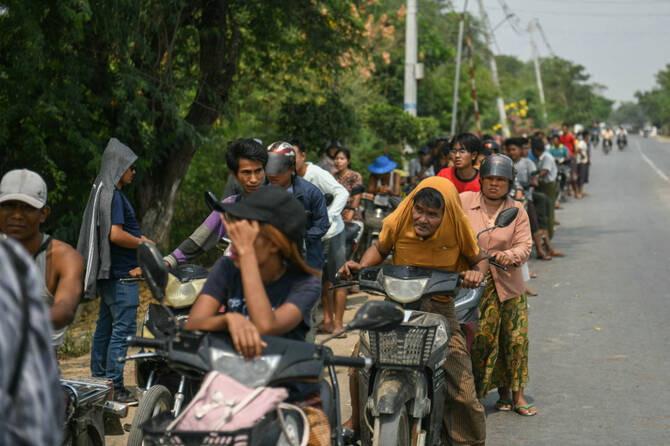
Motorists wait in line at a petrol station in Mandalay on March 29, 2025, a day after an earthquake struck central Myanmar. (AFP)
Short Url
Updated 30 March 2025
Follow

Aftershocks rattle Mandalay as rescuers search for survivors in Myanmar quake

  • Myanmar's junta said at least 1,644 people were killed, more than 3,400 injured, and at least 139 more missing
  • The junta issued an exceptionally rare appeal for international aid on Friday, indicating the severity of the calamity

MANDALAY, Myanmar: Residents scrambled desperately through collapsed buildings Sunday searching for survivors as aftershocks rattled the devastated city of Mandalay, two days after a massive earthquake killed more than 1,600 people in Myanmar and at least 11 in neighboring Thailand.
The initial 7.7-magnitude quake struck near the central Myanmar city of Mandalay early Friday afternoon, followed minutes later by a 6.7-magnitude aftershock.
The tremors collapsed buildings, downed bridges and buckled roads, with mass destruction seen in the city of more than 1.7 million people.
As dawn broke Sunday, tea shop owner Win Lwin picked his way through the remains of a collapsed restaurant on a main road in his neighborhood, tossing bricks aside one by one.
“About seven people died here” when the quake struck Friday, he told AFP. “I’m looking for more bodies but I know there cannot be any survivors.
“We don’t know how many bodies there could be but we are looking.”

About an hour later, a small aftershock struck, sending people scurrying out of a hotel for safety, following a similar tremor felt late Saturday evening.
Truckloads of firemen gathered at one of Mandalay’s main fire stations to be dispatched to sites around the city.
The night before, rescuers had pulled a woman out alive from the wreckage of a collapsed apartment building, with applause ringing out as she was carried by stretcher to an ambulance.
Myanmar’s ruling junta said in a statement Saturday that at least 1,644 people were killed and more than 3,400 injured in the country, with at least 139 more missing.
But with unreliable communications, the true scale of the disaster remains unclear in the isolated military-ruled state, and the toll is expected to rise significantly.
Junta chief Min Aung Hlaing issued an exceptionally rare appeal for international aid on Friday, indicating the severity of the calamity.
Previous military governments have shunned foreign assistance, even after major natural disasters.
Myanmar has already been ravaged by four years of civil war sparked by a military coup in 2021.
Anti-junta fighters in the country have declared a two-week partial ceasefire in quake-affected regions starting Sunday, the shadow “National Unity Government” said in a statement.
The government in exile said it would “collaborate with the UN and NGOs to ensure security, transportation, and the establishment of temporary rescue and medical camps” in areas that it controls, according to the statement, which was released on social media.
Aid agencies have warned that Myanmar is unprepared to deal with a disaster of this magnitude.
Some 3.5 million people were displaced by the raging civil war, many at risk of hunger, even before the quake struck.

Across the border in Thailand, rescuers in Bangkok worked Sunday to pluck out survivors trapped when a 30-story skyscraper under construction collapsed after the Friday earthquake.
At least 11 people have been killed in the Thai capital, with dozens more still trapped under the immense pile of debris where the skyscraper once stood.
Bangkok authorities were expected to release another statement at 9 am (0200 GMT), with fears of a further toll increase.
Workers at the site used large mechanical diggers in an attempt to find victims still trapped on Sunday morning.
Sniffer dogs and thermal imaging drones have also been deployed to seek signs of life in the collapsed building, close to the Chatuchak weekend market popular among tourists.
Authorities said they would be deploying engineers to assess and repair 165 damaged buildings in the city on Sunday.


Italian fruit detective racing to save forgotten varieties

Updated 3 sec ago
Follow

Italian fruit detective racing to save forgotten varieties

CITTA DI CASTELLO: Isabella Dalla Ragione hunts in abandoned gardens and orchards for forgotten fruits, preserving Italy’s agricultural heritage and saving varieties which could help farmers withstand the vagaries of a changing climate.
The 68-year-old’s collection of apples, pears, cherries, plums, peaches and almonds, grown using methods of old, are more resilient to the climate shifts and extremes seen increasingly frequently in the southern Mediterranean.
The Italian agronomist-turned-detective seeks descriptions of bygone local fruits in centuries-old diaries or farming documents, and sets out to find them.
Others she identifies by matching them to fruits in Renaissance paintings, where they often appear in depictions of the Madonna and Child.
Of the 150 or so varieties collected from Tuscany, Umbria, Emilia-Romagna and Marche and grown by her non-profit Archaeologia Arborea foundation, the small, round Florentine pear is among Dalla Ragione’s favorites.
“I’d found it described in documents from the 1500s, but I’d never seen it and believed it lost,” she told AFP.
“Then 15 years ago, in the mountains between Umbria and Marche, I found a tree almost in the middle of the woods,” thanks to an elderly local woman who told her about it by chance.
While old varieties are flavoursome, most disappeared from markets and tables after the Second World War as Italy’s agricultural system modernized.

- ‘Urgent’ -

Italy is a large fruit producer. Its pear production ranks first in Europe and third globally, but just five modern varieties — none of which are Italian — account for over 80 percent of its output.
“There used to be hundreds, even thousands, of varieties because each region, each valley, each place had its own,” Dalla Ragione said as she showed off wicker baskets full of fruit, stored in a little church near the orchard.
Modern markets instead demand large crops of fruits that can be harvested quickly, easily stored and last a long time.
But as global warming makes for an increasingly challenging climate, experts say a broader range of plant genetic diversity is key.
“Heirloom varieties... are able to adapt to climate change, to more severe water shortages, to extremes of cold and heat,” said Mario Marino, from the climate change division of the UN’s Food and Agriculture Organization.
“However, a much more severe disease arrives, one that improved varieties are normally more resistant to... and the local varieties perish, or perhaps don’t produce fruit,” he told AFP.
The answer lies in creating new varieties by crossing modern and old-fashioned ones, he said.
Marino, who advises Dalla Ragione’s foundation, said her work was “urgent” because “preserving one’s heritage means preserving the land, preserving biodiversity... and (allowing) us to use that DNA for new genetic resources.”

- Oral testimonies -

Researchers can access the collection, while Dalla Ragione also recreates historical gardens which can host recovered varieties as part of an EU-funded project.
“We don’t do all this research and conservation work out of nostalgia, out of romanticism,” she said as she harvested pink apples from her trees in the hilly hamlet of San Lorenzo di Lerchi in Umbria.
“We do it because when we lose variety, we lose food security, we lose diversity and the system’s ability to respond to various changes, and we also lose a lot in cultural terms.”
Dalla Ragione has sought answers to fruit mysteries in monastery orchards, the gardens of nobility and common allotments. She has pored over local texts from the 16th and 17th centuries.
She once traced a pear to a village in southern Umbria after reading about it in the diary of a musical band director.
But one of her richest sources on how best to cultivate such varieties has been oral testimonies — and as the last generation of farmers that grew the crops die, much local knowledge is lost.
That has made it difficult to know how to divide her time between researching and looking for a new variety, though she has learnt the hard way that the urgency “is always to save it.”
“In the past if I’ve delayed, thinking ‘I’ll do it next year’, I’ve found the plant has since gone.”