Eight-month peace deal reached after deadly clashes in Pakistan’s Kurram district

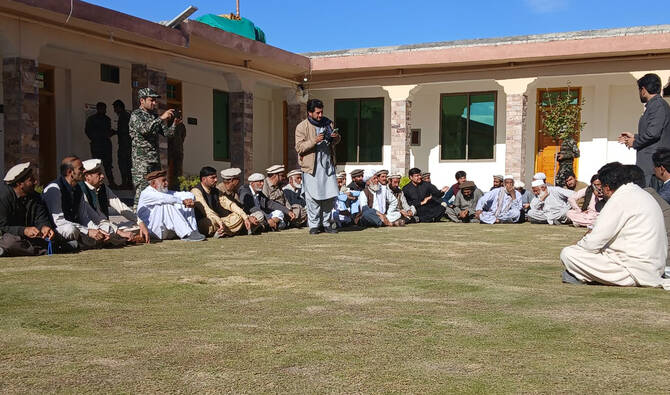
Representatives of warring factions attend a jirga in Khyber Pakhtunkhwa’s restive Kurram district on March 29, 2025. (Photo courtesy: Handout/Kurram Police)
Short Url
Updated 29 March 2025
Follow

Eight-month peace deal reached after deadly clashes in Pakistan’s Kurram district

  • The peace deal follows last year’s Kohat Agreement, which called for a ceasefire and removal of private bunkers
  • Violence in Kurram lasted for months, triggered a humanitarian crisis, cutting off access to food, fuel and medicine

PESHAWAR: An eight-month peace agreement was reached on Saturday between warring factions in Khyber Pakhtunkhwa’s restive Kurram district, with all sides pledging to resolve future disputes through legal means, according to a statement shared by a police official.
Kurram, a tribal district of around 600,000 people bordering Afghanistan, has long been a flashpoint for sectarian violence between Shia and Sunni tribes. Clashes between the two sides have killed more than 150 people since November, while militant attacks and retaliatory violence have claimed even more lives of people and security personnel during months of unrest.
The violence also created a humanitarian crisis, with road blockades cutting off access to food, fuel and life-saving medicines, leading to the reported deaths of dozens of children.
“Representatives of both sides agreed to maintain peace for a period of eight months in order to prevent any kind of conflict in the area and to work toward improving the situation,” said a statement shared by district police spokesperson Riaz Khan.
The deal was struck following a jirga, or tribal council, held in the presence of provincial authorities and the local administration.
The agreement builds on the Kohat Agreement, a peace framework developed last year that called for a ceasefire, disarmament, the dismantling of private bunkers in the area and government oversight to ensure sustainable peace.
“Under this agreement, if any untoward incident occurs on the road, legal action will be taken against the responsible party in accordance with the ‘Kohat Agreement,’” the statement continued.
“Both sides pledged that in the event of any incident that could harm peace in the area, they would consult with each other and seek a solution through legal means,” it added.
It was also agreed that the main road through Kurram, closed for months due to violence, will be formally reopened in a joint announcement by the government and state institutions to ease public hardship and facilitate travel.


Pakistan fines beverage maker Rs150 million for imitating PepsiCo. product packaging

Updated 8 sec ago
Follow

Pakistan fines beverage maker Rs150 million for imitating PepsiCo. product packaging

  • The case dates back to 2018, when PepsiCo. filed a complaint that Mezan Beverages’ ‘Storm’ energy drink was designed to imitate its ‘Sting’
  • Such rulings are a rarity in Pakistan, where prolonged litigation, frequent stay orders and jurisdictional challenges often delay enforcement

KARACHI: The Competition Commission of Pakistan (CCP) has imposed a penalty of Rs150 million ($535,283) on Mezan Beverages (Private) Limited for “deceptive marketing” in a case brought against it by PepsiCo, the CCP said on Friday.

The case dates back to 2018, when the American multinational food and beverage corporation filed a complaint alleging that Mezan Beverages’ ‘Storm’ energy drink was designed to imitate its ‘Sting’ and benefit from PepsiCo’s goodwill.

Instead of responding on merits, Mezan Beverages repeatedly challenged the CCP’s jurisdiction and initiated prolonged litigation, delaying the inquiry for several years by obtaining stay orders from the Lahore High Court in 2018 and 2021, according to the CCP.

In June 2024, the court dismissed Mezan Beverages’ petition, upheld the CCP’s authority, and ruled that early challenges to show-cause notices were not maintainable. The court observed that the Pakistani beverage maker had used litigation to delay regulatory proceedings.

“The company (Mezan Beverages) was found to have imitated the packaging and trade dress of PepsiCo’s Sting energy drink, thereby engaging in deceptive marketing practices in violation of Section 10 of the Competition Act, 2010,” the CCP said in a statement.

“Such conduct amounted to parasitic copying and constituted deceptive marketing prohibited under Pakistan’s competition law.”

Such rulings remain uncommon in Pakistan, where prolonged litigation, frequent stay orders and jurisdictional challenges often delay or dilute enforcement of competition and consumer protection laws. Regulatory actions are frequently stalled for years in courts, allowing companies accused of unfair practices to continue operating while cases remain unresolved.

In its verdict, the CCP said Mezan Beverages’ energy drink adopted a red-dominant color scheme, identical to Sting; bold, slanted white lettering with aggressive visual motifs; near-identical bottle shape and presentation; and branding elements likely to mislead an ordinary consumer with imperfect recollection.

It emphasized that deception is assessed based on the overall commercial impression, not minute differences examined side by side.

“Even though Mezan Beverages held a registered trademark for ‘Storm’... copycat branding and misleading packaging will not be tolerated, regardless of the size or local status of the company,” the commission added.