Israeli reconnaissance aircraft violate Lebanese airspace over Beirut

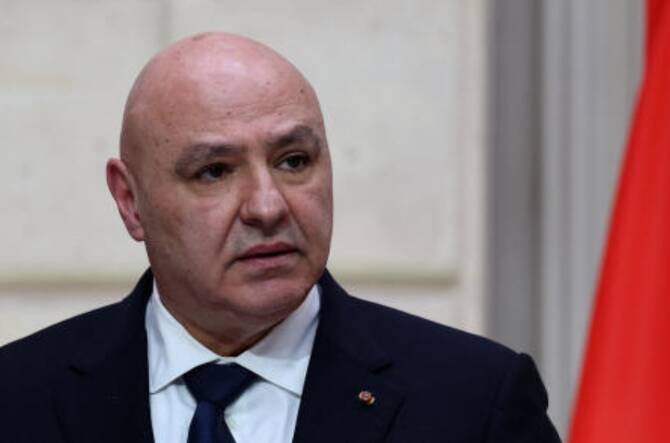
President Joseph Aoun said on Saturday that Lebanon has entered a “new phase” in its history “after decades of violence, wars, economic and financial crises, and the deterioration of the state’s structure.” (Reuters)
Short Url
Updated 29 March 2025
Follow

Israeli reconnaissance aircraft violate Lebanese airspace over Beirut

  • Lebanese army seeking those responsible for the firing of rockets toward Israel on Friday
  • ‘We have entered a new phase in our nation’s history, and there is no turning back,’ says Aoun

BEIRUT: President Joseph Aoun said on Saturday that Lebanon has entered a “new phase” in its history “after decades of violence, wars, economic and financial crises, and the deterioration of the state’s structure.”
In his address to the Lebanese people to mark Eid Al-Fitr, Aoun added: “For those who think our resolve will weaken or our determination will waver; there is no turning back.”
Aoun, who returned from Paris on Friday evening after holding talks with his French counterpart Emmanuel Macron, Syrian President Ahmed Al-Sharaa, and officials from Cyprus and Greece, continued: “What distinguishes Lebanon is its adherence to the values of unity, solidarity, and rising above selfishness and personal interests. There is no salvation for Lebanon unless we live by these values, which, alongside the implementation of laws and the realization of justice, form the only path to combating corruption, achieving structural reforms in our national institutions, and advancing Lebanon to keep pace with global progress and modernity.”
Also on Saturday, the Lebanese army continued its investigations to determine who was responsible for the rockets fired from southern Lebanon toward Israel on Friday, an event that led to an escalation of Israeli aggression unprecedented since a ceasefire agreement came into effect four months ago.
A military source said: “Night raids were conducted by army intelligence in the south and the western Bekaa aimed at finding suspects involved in launching rockets from the south.”
An Israeli airstrike on the Hadath area in the southern suburbs of Beirut resulted in the complete destruction of two buildings and damage to numerous neighboring structures, including two schools in the area. Students from those schools organized a protest on Saturday to “denounce the Israeli assaults,” and asking for clarification on “the fate of the academic year in light of the damages that hinder an immediate return to the two schools.”
Morgan Ortagus, US deputy special envoy to the Middle East, said in an interview with a local Lebanese station on Friday night that the United States “supports the Lebanese Army,” adding: “The launching of rockets from Lebanon into Israel constitutes a blatant violation of the ceasefire agreement reached between the two parties, and this escalation raises significant international concern.”
Ortagus also stated that the Lebanese government is “responsible for disarming Hezbollah,” but noted “the government is unable to control everything, which contributes to the deterioration of the security situation in the country.”
The US envoy continued: “It cannot be claimed that Israel is violating the ceasefire agreement with Lebanon,” and urged Lebanese authorities to “take responsibility instead of blaming Israel.”
Ortagus reaffirmed the US administration’s stance, urging “the full disarmament of Hezbollah, as it threatens stability in Lebanon and the region.” She also accused Iran and Hezbollah of “destroying the south and dragging Lebanon into a war that could have been avoided were it not for Iran’s interference and Hezbollah’s involvement. The US is committed to using all available measures to prevent the arming of Hezbollah, as it poses a significant threat to regional security.
“The US does not seek a larger conflict between Lebanon and Israel, but instead aims to maintain the ceasefire agreement between the two sides. As a gesture of goodwill, Israel released Lebanese prisoners, signaling its willingness to pursue a diplomatic solution. In addition, the Lebanese president supports diplomatic negotiations, making it a critical time to activate diplomacy between Israel and Lebanon,” Ortagus added.
Meanwhile, Israeli forces continued to violate Lebanon’s sovereignty. Low-altitude reconnaissance aircraft have been regularly spotted over Beirut and its southern suburbs, including the towns of Bechamoun, Aramoun, Khaldeh and Choueifat in Mount Lebanon.
In the south, an Israeli warplane dropped two stun grenades near a crowd of residents in the town square of Yaroun in Bint Jbeil.
The municipalities of Beirut’s southern suburbs have called on the residents to refrain from using firecrackers or engaging in celebratory gunfire during the Eid Al-Fitr holiday, stating that violators will be “referred to the appropriate judicial authorities.”
The municipalities have also banned merchants from selling firecrackers, “under the threat of having their shops shut down.”


Israeli minister calls West Bank measures ‘de facto sovereignty,’ says no future Palestinian state

Updated 4 sec ago
Follow

Israeli minister calls West Bank measures ‘de facto sovereignty,’ says no future Palestinian state

  • Eli Cohen’s comments on Tuesday suggest these steps prevent the establishment of a Palestinian state
  • alestinians, Arab countries, and human rights groups view the actions as annexation
RAMALLAH: A top Israeli official said Tuesday that measures adopted by the government that deepen Israeli control in the occupied West Bank amounted to implementing “de facto sovereignty,” using language that mirrors critics’ warnings about the intent behind the moves.
The steps “actually establish a fact on the ground that there will not be a Palestinian state,” Energy Minister Eli Cohen told Israel’s Army Radio.
Palestinians, Arab countries and human rights groups have called the moves announced Sunday an annexation of the territory, home to roughly 3.4 million Palestinians who seek it for a future state.
Cohen’s comments followed similar remarks by other members of Prime Minister Benjamin Netanyahu’s government, including Finance Minister Bezalel Smotrich and Defense Minister Israel Katz.
The moves — and Israeli officials’ own descriptions of them — put the country at odds with both regional allies and previous statements from US President Donald Trump. Netanyahu has traveled to Washington to meet with him later this week.
Last year, Trump said he won’t allow Israel to annex the West Bank. The US-brokered ceasefire between Israel and Hamas that aimed to stop the war in Gaza also acknowledged Palestinian aspirations for statehood.
Widespread condemnation
The measures further erode the Palestinian Authority’s limited powers, and it’s unclear the extent to which it can oppose them. Still, Hussein Al Sheikh, the Palestinian Authority’s deputy president, said on Tuesday “the Palestinian leadership called on all civil and security institutions in the State of Palestine” to reject them
In a post on X on Tuesday, he said the Israeli steps “contradict international law and the agreements signed with the Palestine Liberation Organization.”
A group of eight Arab and Muslim-majority countries expressed their “absolute rejection” of the measures, calling them in a joint statement Monday illegal and warning they would “fuel violence and conflict in the region.”
Israel’s pledge not to annex the West Bank is embedded in its diplomatic agreements with some of those countries and renewed warnings that it was a “red line” for the Emirates led Israel to shelve some high-level discussions on the matter last year.
United Nations Secretary General Antonio Guterres said he was “gravely concerned” by the measures.
“They are driving us further and further away from a two-State solution and from the ability of the Palestinian authority and the Palestinian people to control their own destiny,” his spokesperson, Stephane Dujarric, said on Monday.
What the measures mean
The measures, approved by Netanyahu’s Security Cabinet on Sunday, expand Israel’s enforcement authority over land use and planning in areas run by the Palestinian Authority, making it easier for Jewish settlers to force Palestinians to give up land.
Smotrich and Katz on Sunday said they would lift long-standing restrictions on land sales to Israeli Jews in the West Bank, shift some control over sensitive holy sites — including Hebron’s Ibrahimi Mosque, also known as the Tomb of the Patriarchs — and declassify land registry records to ease property acquisitions.
They also revive a government committee empowered to make what officials described as “proactive” land purchases in the territory, a step intended to reserve land for future settlement expansion.
Taken together, the moves add an official stamp to Israel’s accelerating expansion and would override parts of decades-old agreements that split the West Bank between areas under Israeli control and areas where the Palestinian Authority exercises limited autonomy.
Israel has increasingly legalized settler outposts built on land Palestinians say documents show they have long owned, evicted Palestinian communities from areas declared “military zones” and villages near archaeological sites it has reclassified as “national parks.”
More than 700,000 Israelis live in the occupied West Bank and east Jerusalem, territories captured by Israel in 1967 and sought by the Palestinians for an independent state along with the Gaza Strip.
Palestinians are not permitted to sell land privately to Israelis. Settlers can buy homes on land controlled by Israel’s government.
The international community overwhelmingly considers Israeli settlement construction to be illegal and an obstacle to peace.
“These decisions constitute a direct violation of the international agreements to which Israel is committed and are steps toward the annexation of Areas A and B,” anti-settlement watchdog group Peace Now said on Sunday, referring to parts of the West Bank where the Palestinian Authority exercised some autonomy.