Danish firm to train Pakistani engineers as Islamabad seeks to exploit mineral resources

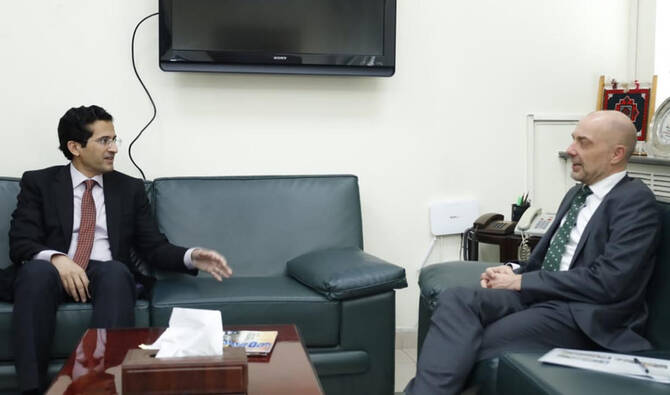
Federal Petroleum Minister Ali Pervaiz Malik meets Danish Ambassador to Pakistan Jakob Linulf (right) in Islamabad on March 28, 2025. (PID)
Short Url
Updated 29 March 2025
Follow

Danish firm to train Pakistani engineers as Islamabad seeks to exploit mineral resources

  • Pakistan’s landscape is a treasure trove of diverse mineral deposits from huge coal reserves to gold and copper deposits to gemstone
  • The South Asian country is currently making efforts to utilize these vast mineral resources to stabilize its $350 billion fragile economy

ISLAMABAD: A Copenhagen-based multinational mining company, FLSmidth, will train 100 Pakistani engineers in mining, the Pakistani government said on Friday, amid Islamabad’s efforts to utilize the country’s vast mineral resources for economic gains.
The statement by Pakistan’s Press Information Department (PID) came after Petroleum Minister Ali Pervaiz Malik’s meeting with Danish Ambassador to Pakistan Jakob Linulf in Islamabad that focused on bilateral cooperation in the energy sector, particularly in mining and technological collaboration.
Malik recognized that FLSmidth’s advanced solutions in cement production, mineral processing and decarbonization align with Pakistan’s goals of increasing efficiency and reducing environmental impact in its extractive industries, according to the PID.
He emphasized the Pakistani government’s commitment to creating an investor-friendly environment and invited Danish companies, including FLSmidth, to explore partnerships with Pakistani firms during the Pakistani Minerals Investment Forum on April 8-9.
“FLSmidth will be launching a training program named BRIMM (Bradshaw Research Initiative for Minerals and Mining) under which hundred Pakistani engineers will be provided training,” the PID said, citing the Danish ambassador.
“FLSmidth has already entered into 5 partnership agreements in minerals sector of Pakistan.”
Pakistan’s landscape is a treasure trove of diverse mineral deposits from huge coal reserves in the southern Sindh province to gold and copper deposits in the southwestern Balochistan province. The northwestern Khyber Pakhtunkhwa province is home to several gemstone mines, including emerald mines in Swat, Mardan’s pink topaz mines, and peridot mines in Kohistan.
The South Asian country is currently making efforts to utilize these vast mineral resources through foreign investment and collaboration to stabilize its $350 billion economy.
Petroleum Minister Malik expressed Pakistan’s keen interest in leveraging Danish technology and investment to optimize resource extraction and processing as the South Asian country has significant mineral reserves. He extended his full support and offered the government’s good offices to facilitate Danish investment and technology transfer in Pakistan’s growing mining sector, according to the statement.
The ambassador reaffirmed Denmark’s support for Pakistan’s energy transition and industrial growth, and said they were looking forward to Pakistan Minerals Investment Forum.
“He noted that Danish companies are eager to share their expertise in green mining solutions, automation, and digitalization to help Pakistan achieve its economic and environmental objectives,” the PID said.
The meeting concluded with an agreement to facilitate further engagement between Pakistani stakeholders and Danish technology providers, with FLSmidth playing a pivotal role in advancing modern mining practices in Pakistan.


Pakistan to press ahead with privatization after $441 million net loss in FY2024-25

Updated 5 sec ago
Follow

Pakistan to press ahead with privatization after $441 million net loss in FY2024-25

  • National Highway Authority and power distribution companies are major loss contributors
  • The government says reforms agenda is shifting ‘from diagnosis to delivery’ after PIA sale

KARACHI: Pakistan is pressing ahead with plans to privatize state-owned enterprises (SOEs) after official data released on Friday showed the sector posted a net loss of PKR 122.9 billion ($441 million) in the year ended June 2025, with the government approving new transactions involving power utilities, an international airport and other major assets.

The Cabinet Committee on State-Owned Enterprises, chaired by Finance Minister Muhammad Aurangzeb, reviewed the Annual Consolidated Performance Report of SOEs for the fiscal year ended June 2025. The report was prepared by the Finance Division’s Central Monitoring Unit, which showed SOEs remain a significant drag on public finances.

“The Committee was informed that during FY 2024-25, aggregate revenues of SOEs stood at approximately PKR 12.4 trillion [$44.6 billion], reflecting a decline largely attributable to reduced profitability in the oil sector following lower international oil prices,” said an official statement circulated by the Finance Division.

“Aggregate profits of profit-making SOEs declined by 13 percent to PKR 709.9 billion [$2.55 billion] compared to PKR 820.7 billion [$2.95 billion in the preceding year], while aggregate losses of loss-making SOEs showed improvement, declining by around 2 percent to PKR 832.8 billion [$2.99 billion],” it added. “Despite this improvement, the net result was an overall net loss of PKR 122.9 billion [$441 million] for the SOE sector, compared to a net loss of PKR 30.6 billion [$110 million] in the previous year.”

It was highlighted that losses remain heavily concentrated in a small number of entities, particularly in the transport and power distribution sectors.

“National Highway Authority and several power distribution companies continued to be major loss contributors, reflecting structural issues, high depreciation, financing costs, and the public service nature of certain operations that are not commercially viable,” the statement said.

It added the cabinet committee directed that the findings of the report be shared with relevant ministries to inform reform measures and that progress on audits, governance reforms, debt rationalization and fiscal risk containment be reviewed regularly.

In a separate post on X, government finance adviser Khurram Schehzad said the SOE reform agenda was shifting “from diagnosis to delivery,” citing recent privatizations including First Women Bank, the shutdown of Utility Stores Corporation and progress on Pakistan International Airlines.

The Privatization Commission also held a meeting during the day, saying it would also move ahead with the privatization of power distribution companies while recommending that Islamabad International Airport be included in the privatization program under an open, competitive concession model.

It also decided to restart the sale process for House Building Finance Company Limited after terminating an earlier negotiated transaction that failed to meet valuation benchmarks.

Pakistan is implementing structural reforms under a $7-billion program agreed with the International Monetary Fund, which has urged Islamabad to rein in losses at state firms and reduce fiscal risks stemming from debt and guarantees.