Rwanda bans ‘any kind of cooperation’ with Belgian government

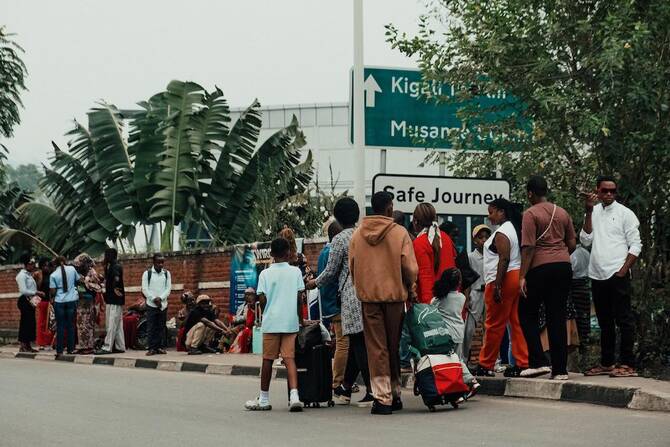
Above, people cross into Rwanda through the Corniche Border Post in Gisenyi, Rwanda, on January 26, 2025. (AFP)
Short Url
Updated 28 March 2025
Follow

Rwanda bans ‘any kind of cooperation’ with Belgian government

  • The ban also extends ‘faith-based organizations’ and common-benefit companies
  • Rwanda’s government severed links with Belgium on March 17

KIGALI: National and international NGOs working in Rwanda have been banned from cooperating with Belgian institutions, the Rwanda Governance Board said, after Kigali cut off diplomatic ties with Brussels earlier this month.
The RGB, which oversees service delivery in the east African nation, said the ban also extended to “faith-based organizations” and common-benefit companies.
Rwanda’s government severed links with Belgium on March 17, accusing it of having “consistently undermined” it during the conflict in the Democratic Republic of Congo.
Belgium, the former colonial power in Rwanda and the DRC, called the move “disproportionate” and promised tit-for-tat measures on Rwandan diplomats.
Rwandan troops are supporting the M23 armed group in the DRC, which has taken control of large swathes of the mineral-rich east of the country since 2021.
The group launched a lightning push earlier this year, capturing the cities of Goma and Bukavu, the capitals of North and South Kivu provinces.
The RGB said any current projects or agreements with the Belgian government or its affiliates were “prohibited” and “must be terminated immediately and reported.”
“No funds, grants, donations, or financial contributions shall be received from or disbursed to the government of Belgium, its institutions, affiliated agencies or programs,” it said in a statement issued Thursday.
“Any attempts to circumvent these financial restrictions, including indirect transactions through subsidiaries or partner organizations, will be subject to strict penalties.”
Political and human rights activist Pelly Prudence Iraguha said the decision should have been submitted to parliament.
But RGB chief executive Doris Uwicyeza Picard wrote on X: “RGB has powers to take such decisions backed by laws passed by parliament.
“These laws give RGB powers to suspend NGOs involved in activities that infringe on citizens unity or security.”


Russia and Ukraine trade attacks as US and European officials prepare for peace talks

Updated 14 December 2025
Follow

Russia and Ukraine trade attacks as US and European officials prepare for peace talks

Moscow pounded Ukrainian power infrastructure with drone and missile strikes on Saturday and Kyiv launched a deadly strike of its own on southwestern Russia, a day before talks involving senior European and US officials aimed at ending the war were set to resume.
Ukrainian President Volodymyr Zelensky said Ukrainian, US and European officials will hold a series of meetings in Berlin in the coming days, adding that he will personally meet with US President Donald Trump’s envoys.
“Most importantly, I will be meeting with envoys of President Trump, and there will also be meetings with our European partners, with many leaders, concerning the foundation of peace — a political agreement to end the war,” Zelensky said in an address to the nation late Saturday.
Trump’s special envoy Steve Witkoff and his son-in-law Jared Kushner are traveling to Berlin for the talks, according to a White House official, who spoke on condition of anonymity.
American officials have tried for months to navigate the demands of each side as Trump presses for a swift end to Russia’s war and grows increasingly exasperated by delays. The search for possible compromises has run into major obstacles, including which combatant will get control of Ukraine’s eastern Donbas region, which is mostly occupied by Russian forces.
“The chance is considerable at this moment, and it matters for our every city, for our every Ukrainian community,” Zelensky said. “We are working to ensure that peace for Ukraine is dignified, and to secure a guarantee — a guarantee, above all — that Russia will not return to Ukraine for a third invasion.”
As diplomats push for peace, the war grinds on.
Russia attacked five Ukrainian regions overnight, targeting the country’s energy and port infrastructure. Zelensky said the attacks involved more than 450 drones and 30 missiles. And with temperatures hovering around freezing, Ukraine’s interior minister, Ihor Klymenko, said more than a million people were without electricity.
An attack on Odesa caused grain silos to catch fire at the coastal city’s port, Ukrainian deputy prime minister and reconstruction minister Oleksiy Kuleba said. Two people were wounded in attacks on the wider Odesa region, according to regional head Oleh Kiper.
Kyiv and its allies say Russia is trying to cripple the Ukrainian power grid and deny civilians access to heat, light and running water for a fourth consecutive winter, in what Ukrainian officials call “weaponizing” the cold.
The drone attack in Russia’s Saratov region damaged a residential building and killed two people, said the regional governor, Roman Busargin, who didn’t offer further details. Busragin said the attack also shattered windows at a kindergarten and clinic. Russia’s Defense Ministry said it shot down 41 Ukrainian drones over Russian territory overnight.
On the front lines, Ukrainian forces said Saturday that the northern part of Pokrovsk was under Ukrainian control, despite Russia’s claims this month that it had taken full control of the critical city. The Associated Press was not able to independently verify the claims.
The latest attacks came after Kremlin foreign affairs adviser Yuri Ushakov reaffirmed Friday that Moscow will give its blessing to a ceasefire only after Ukraine’s forces have withdrawn from parts of the Donetsk region that they still control.
Ukraine has consistently refused to cede the remaining part of the region to Russia.
Ushakov told the business daily Kommersant that Russian police and national guard troops would stay in parts of eastern Ukraine’s Donbas even if they become a demilitarized zone under a prospective peace plan — a demand likely to be rejected by Ukraine as US-led negotiations drag on.
Ushakov warned that a search for compromise could take a long time, noting that the US proposals that took into account Russian demands had been “worsened” by alterations proposed by Ukraine and its European allies.
“We don’t know what changes they are making, but clearly they aren’t for the better,” Ushakov said, adding: “We will strongly insist on our considerations.”
In other developments, about 480 people were evacuated Saturday from a train traveling between the Polish city of Przemysl and Kyiv after police received a call concerning a threat on the train, Karolina Kowalik, a spokesperson for the Przemysl police, told The Associated Press. Nobody was hurt and she didn’t elaborate on the threat.
Polish authorities are on high alert since multiple attempts to disrupt trains on the line linking Warsaw to the Ukrainian border, including the use of explosives in November, with Polish authorities saying they have evidence Russia was behind it.