

Pakistan restores train services from Quetta after deadly hijacking

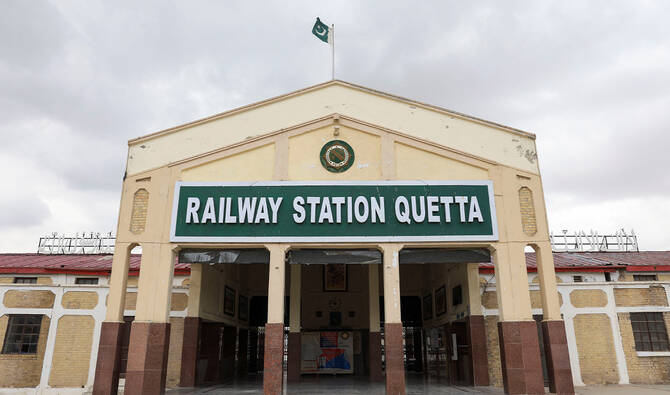
A view shows the railway station, after the train service is halted following the attack on a train by separatist militants in Bolan, in Quetta, Balochistan, Pakistan on March 14, 2025. (Reuters)
Short Url
Updated 28 March 2025
Follow

Pakistan restores train services from Quetta after deadly hijacking

  • 31 soldiers, staff and civilians killed as BLA separatists hijacked Jaffar Express train in Balochistan earlier this month
  • BLA is largest and strongest of several ethnic Baloch groups fighting for decades to win independence for Balochistan

QUETTA: Train operations from the Quetta Railway Station were restored on Friday, over two weeks after they were suspended following a deadly hijacking by militants in which 31 soldiers, staff and civilians were killed in the southwestern Balochistan province.

The separatist Baloch Liberation Army claimed responsibility for the Mar. 11 attack on the Quetta-Peshawar Jaffar Express, during which they blew up train tracks and held passengers hostage in a day-long standoff with security services in a remote mountain pass.

MP Jamal Shah Kakar and Divisional Superintendent Pakistan Railways Imran Hayat inaugurated the train service in a televised ceremony. The train departed with 400 passengers from Quetta for Peshawar in the northwestern Khyber Pakhtunkhwa province under strict security measures. 

The Jaffar Express had started services yesterday, Thursday.

“Although we don’t have enough strength of Railway Police Forces, many stations require fencing and other security equipment,” Railways Minister Hanif Abbasi told reporters earlier this week, admitting that railways facilities in the province faced security challenges. 

“We are recruiting 500 soldiers in the Pakistan Railway Police and 70 percent of the recruitment would be for Balochistan,” the minister added. “We have planned new security strategies with the frontier corps and other law enforcing agencies.” 

He also announced a special Eid train from Quetta Railway station with fool-proof security for passengers. 

“We are very much optimistic about better security to the railway’s passengers in Balochistan,” Abbasi said.

“We have repaired all damaged carriages of the attacked Jaffar Express, and new rack of carriages would be included in the train operations from Balochistan.” 

The BLA is the largest and strongest of several ethnic Baloch insurgent groups which have been fighting for decades to win independence for the mineral-rich province, home to major China-led projects including a port and gold and copper mines.


Islamabad hits back after Indian minister blames Pakistan army for ‘ideological hostility’

Updated 10 sec ago
Follow

Islamabad hits back after Indian minister blames Pakistan army for ‘ideological hostility’

  • Jaishankar tells a public forum most of India’s problems with Islamabad stem from Pakistan’s military establishment
  • Pakistan condemns the remarks, accusing India of waging a propaganda drive to deflect from its destabilizing actions

ISLAMABAD: Pakistan accused India on Sunday of running a propaganda campaign to malign its state institutions, a day after Indian External Affairs Minister Subrahmanyam Jaishankar attributed what he described as Pakistan’s “ideological hostility” toward New Delhi to the country’s powerful army.

Addressing a public forum in New Delhi, Jaishankar said most of India’s problems with Pakistan stemmed from its military establishment, which he argued had cultivated and sustained an entrenched animosity toward India.

His remarks came months after a brief but intense military confrontation between the nuclear-armed neighbors, during which both sides exchanged artillery and missile fire and deployed drones and fighter jets.

Responding to the comments, Pakistan’s Foreign Office spokesperson Tahir Andrabi called them “highly inflammatory, baseless and irresponsible.”

“Pakistan is a responsible state and its all institutions, including armed forces, are a pillar of national security, dedicated to safeguarding the sovereignty and territorial integrity of the country,” Andrabi said in a statement. “The May 2025 conflict vividly demonstrated Pakistan armed forces’ professionalism as well as their resolve to defend the motherland and the people of Pakistan against any Indian aggression in a befitting, effective yet responsible manner.”

“The attempts by Indian leadership to defame Pakistan’s state institutions and its leadership are a part of a propaganda campaign designed to distract attention from India’s destabilising actions in the region and beyond as well as state-sponsored terrorism in Pakistan,” he said, adding that such “incendiary rhetoric” showed the extent of India’s disregard for regional peace and stability.

Andrabi said that rather than making “misleading remarks about the armed forces of Pakistan,” India should confront the “fascist and revisionist Hindutva ideology that has unleashed a reign of mob justice, lynchings, arbitrary detentions and demolition of properties and places of worship.”

He warned that the Indian state and its leadership had become hostage to “this terror in the name of religion.”

India and Pakistan have fought three wars since independence in 1947. They have also engaged in countless border skirmishes and major military standoffs, including the 1999 Kargil conflict.

The four-day conflict in May 2025 ended with a US-brokered ceasefire, after Washington said both sides had expressed willingness to pursue dialogue.

Pakistan said it was ready to discuss all outstanding issues, but India declined talks.


-End