Court frees Pakistani journalist charged under controversial cybercrime law

1 / 2
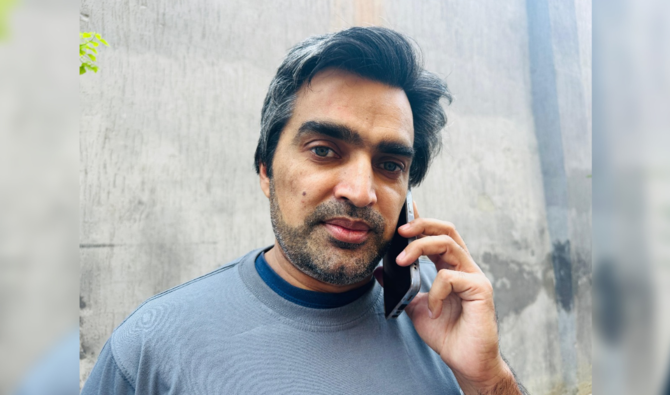
The photo taken on March 28, 2025, shows Pakistani journalist Waheed Murad speaking on a mobile phone after a local court approved his bail, in Islamabad, Pakistan. (Photo Courtesy: Farhan Khan)
2 / 2
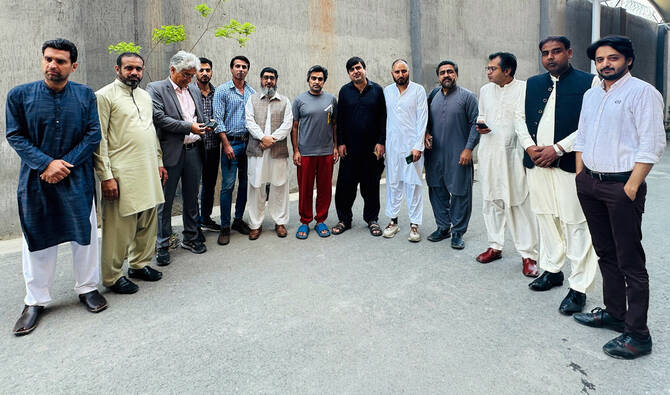
Pakistani journalist Waheed Murad (center) poses for a picture along with a group of journalists after a local court approved his bail, in Islamabad, Pakistan on March 28, 2025. (Photo Courtesy: Farhan Khan)
Short Url
Updated 28 March 2025
Follow

Court frees Pakistani journalist charged under controversial cybercrime law

  • Waheed Murad, who works for Urdu News, was taken from home by masked men Wednesday morning, his family said
  • Criminalization of online disinformation has spread fear in Pakistan, with journalists among those worried about new law

KARACHI: A judicial magistrate had approved bail and freed Pakistani journalist Waheed Murad, charged earlier this week under a controversial cybercrime law, his lawyer said on Friday.

Murad, who works with the international digital media outlet Urdu News, was taken from his home by masked men early Wednesday morning, according to his family, provoking an outcry from the local media community and international journalists’ rights bodies. 

A new cybercrime law, PECA, under which Murad has been charged, carries a prison term of up to three years and unleashed journalist protests when it was approved in January.

“Judicial Magistrate has approved the bail of journalist Waheed Murad and ordered his release,” Murad’s lawyer Imaan Zainab Mazari-Hazir told Arab News.
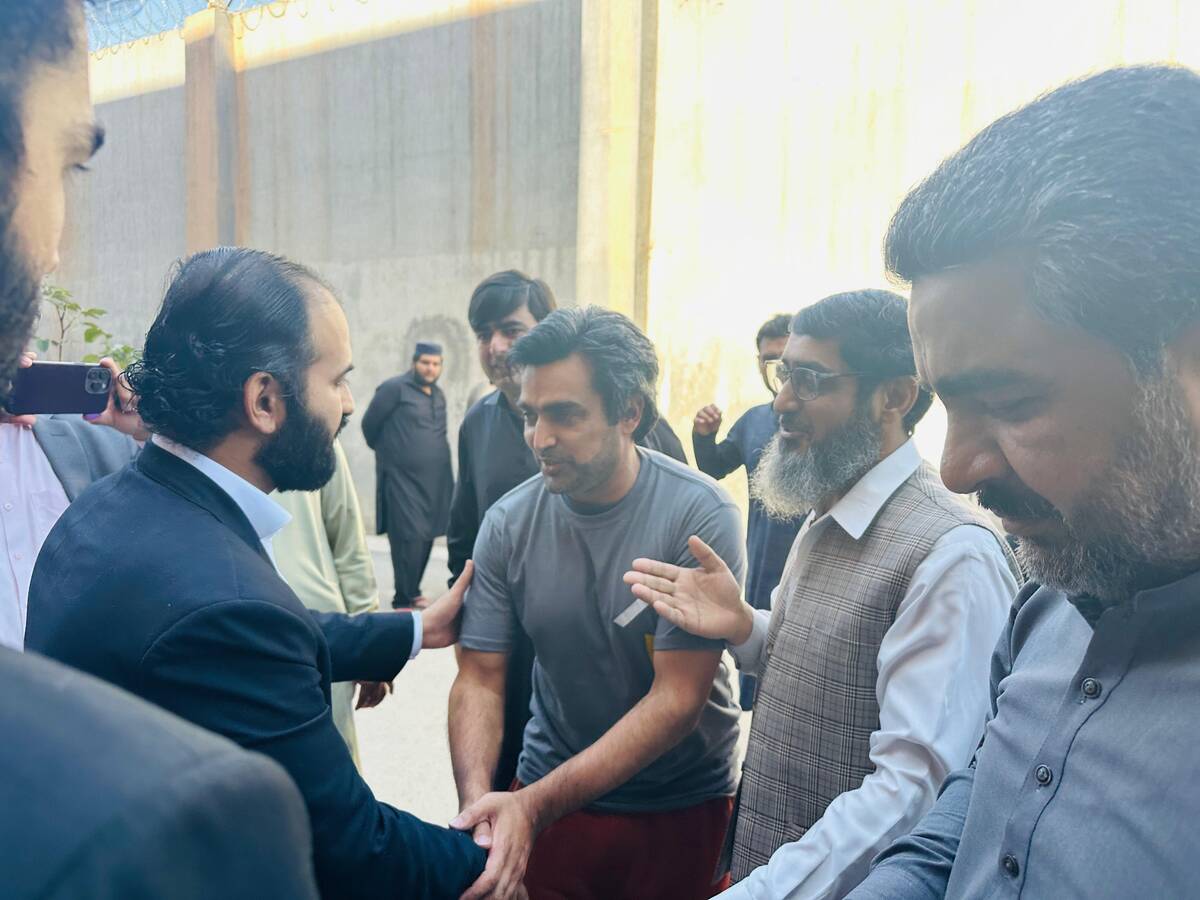


Pakistani journalist Waheed Murad greets his lawyer outside court in Islamabad, Pakistan, on March 28, 2025. (AN Photo)

The journalist was subsequently freed, with pictures widely shared on social media showing him leaving the lock-up.

The charge sheet against Murad by the Federal Investigation Agency (FIA) accuses him of sharing “misleading” information on social media, causing “hatred” against government functionaries.

“Accused Muhammad Waheed s/o Bara Khan is found sharing highly intimidating content/post on social media/Facebook and X Corp. on Wednesday, 12-03-2025 at 07:33 p.m. and 10:21 pm, in which the alleged profile has knowingly disseminated/propagated, fake, false, misleading and misinterpreted information leading to hatred against the government functionaries by stating therein that,” a copy of the complaint seen by Arab News said. 

The complaint said a case against the journalist has been registered under the Prevention of Electronic Crimes Act (PECA).

Murad’s arrest came just days after the disappearance of the brothers of exiled journalist Ahmad Noorani following the publishing of a controversial report about Pakistani army chief General Asim Munir on Noorani’s website.

On March 20, the Federal Investigation Agency also arrested Karachi-based journalist Farhan Mallick, founder of the digital media platform Raftar, on allegations of airing “anti-state” content on his YouTube channel.

International rights organizations, including the Committee to Protect Journalists, have expressed increasing concern over the deteriorating climate for press freedom. Rights defenders say the pattern reflects a shrinking space for democratic discourse in Pakistan, where journalists critical of state policies or security agencies are frequently subjected to intimidation tactics.

The criminalization of online disinformation has in particular spread fear in Pakistan, with journalists among those worried about the potentially wide reach of laws like PECA.

Pakistan is ranked 152 out of 180 countries in a press freedom index compiled by Reporters Without Borders.

Islamabad has long been criticized by watchdogs for restricting Internet access, including temporary bans on YouTube and TikTok, while X has been officially blocked since February last year. 


Pakistan PM calls for faster CPEC implementation, pledges security for Chinese workers

Updated 12 sec ago
Follow

Pakistan PM calls for faster CPEC implementation, pledges security for Chinese workers

  • Shehbaz Sharif pushes expanded cooperation in agriculture, IT and mining under CPEC phase two
  • Chinese envoy reaffirms Beijing’s support for Pakistan’s sovereignty and economic development

ISLAMABAD: Prime Minister Shehbaz Sharif on Friday called for speeding up projects under the China-Pakistan Economic Corridor (CPEC) and pledged stronger security guarantees for Chinese workers and investments, during a meeting with China’s ambassador in Islamabad.

Sharif made the remarks as the two countries strive to launch the second phase of CPEC, a multibillion-dollar infrastructure and energy initiative launched in 2015 as part of China’s Belt and Road Initiative (BRI).

CPEC’s first phase focused largely on power generation and transport infrastructure aimed at easing Pakistan’s chronic energy shortages and improving connectivity. The second phase seeks to expand cooperation into industrial development, with an emphasis on special economic zones and export-oriented growth.

“While highlighting the importance of accelerating ongoing CPEC projects, the Prime Minister stressed on the need to enhance cooperation in agriculture and IT and mining & minerals,” said a statement circulated by the PM Office after the meeting.

“He also underscored Pakistan’s resolve to provide a secure and conducive environment for Chinese personnel, investments, and institutions in Pakistan,” it added.

Chinese nationals and projects in Pakistan have faced security threats in the past, including attacks by militant groups targeting infrastructure sites and convoys. Islamabad has repeatedly vowed to tighten security and has deployed special protection units for Chinese workers.

China is Pakistan’s closest ally in the region and a key economic partner, with CPEC widely regarded by Islamabad as central to long-term economic growth.

During the meeting, the prime minister conveyed greetings to Chinese President Xi Jinping and Premier Li Qiang, particularly on the occasion of the Chinese New Year.

China’s Ambassador to Pakistan, Jiang Zaidong, reiterated Beijing’s support for Pakistan’s sovereignty and socioeconomic development, according to the statement. Both sides also exchanged views on regional and international issues and agreed to maintain close coordination.