

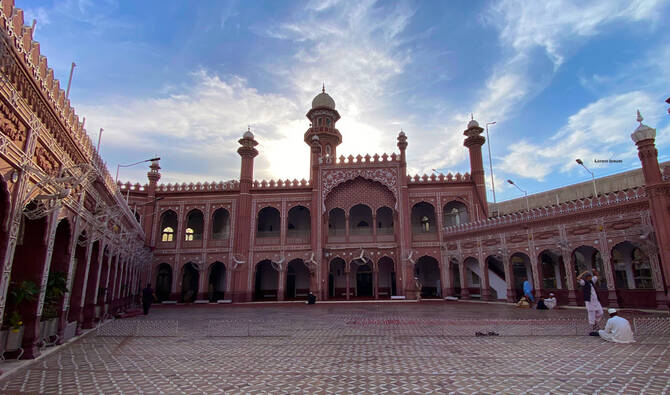
Peshawar’s iconic Sunehri Mosque sees surge of devotees in Ramadan

Worshippers pray during Ramadan at the Sunehri Mosque in Peshawar, Pakistan, on March 22, 2025. (AN Photo)
Short Url
Updated 28 March 2025
Follow

Peshawar’s iconic Sunehri Mosque sees surge of devotees in Ramadan

  • Foundation stone for mosque laid in 1946, Sunehri Masjid is famous for its gold domes, tall minarets and Mughal architecture
  • Worshippers frequent Sunehri Masjid, with capacity for 6,000 people, during Ramadan to offer prayers, recite Qur’an, attend large congregations

Peshawar: The 39-meter tall minaret is the first thing that comes into view when one arrives close to the street in Peshawar’s main Saddar Bazaar where the majestic Sunehri Masjid is located. 

Known for its considerable size, built over an impressive 1,670 sq. meters, and Mughal-style architecture, the Sunehri, or Golden, Mosque in the capital of the northwestern Khyber Pakhtunkhwa, is one of the most iconic masjids in the region.

The mosque can accommodate at least 6,000 worshippers, making it ideal for the month of Ramadan when believers flock to mosques for Tarawih — special, voluntary prayers performed typically after the Isha (night) prayer, and considered a highly recommended Sunnah, or practice of the Prophet Muhammad.

The foundation stone of the mosque was laid by Habib Ur Rehman, a Peshawar resident, in 1946 but construction work was hit by delays due unavailability of funds and security issues, and was completed in 1992, primarily funded by public donations. 

Rehman modeled the mosque after Lahore’s iconic Badshahi Mosque, built by Mughal emperor Aurangzeb, the prayer leader at Sunehri Masjid, Maulana Muhammad Ismail, told Arab News. 

“The foundation stone of our mosque was laid in 1946, but the situation deteriorated in Pakistan due to the wars (of 1965 and 1971), so work was stopped for a little time,” he said. 

Explaining the architecture, Ismail said that the central minaret, a hallmark of the mosque, was built at 39 meters (128 feet) so it could be seen from far-flung areas in Peshawar at a time when there were few tall buildings in the city.

“The need for the construction of the 128-feet-high minaret at that time was that our organizers thought that the azaan (call to prayer) of the Sunehri Masjid should reach far-flung areas,” Ismail said.

The mosque is built with red bricks and famed for its signature gold domes and intricate Mughal-style architecture that features arches, domes and pointed cupolas atop the minarets.

In Ramadan, more worshippers than usual throng to the Sunehri Masjid, filling up its halls and prayer rooms as they seek to deepen their connection with Allah, earn rewards, and ask for forgiveness from sins.

Imran Khan, 38, is one such devotee who has been offering prayers at the mosque for the past 12 years.

“This is a beautiful mosque, I come here every Ramadan to worship and recite (the Qur’an),” Khan told Arab News. “I especially visit a lot in Ramadan when I get the chance.”

Khawar Rehman, a Peshawar resident who had come for Asr prayers at the mosque, said that he frequented the place as he liked worshiping in a “known mosque” like the Sunehri Masjid. 

“This mosque has larger congregations and better rewards,” he said, “so I like to come here.”


Russia committed ‘crimes against humanity’ in deporting Ukrainian children: UN inquiry

Updated 6 sec ago
Follow

Russia committed ‘crimes against humanity’ in deporting Ukrainian children: UN inquiry

  • The inquiry said Russia had deported or transferred “thousands” of children from occupied areas of Ukraine, of which it had so far confirmed 1,205 cases
  • “Four years on, 80 percent of the children deported or transferred in the cases investigated by the commission have not returned,” it said

GENEVA: Moscow’s deportation and forcible transfer of children from Ukraine to Russia amounts to a crime against humanity, a United Nations team of investigators said Tuesday.
The UN’s Independent International Commission of Inquiry on Ukraine said it had collected evidence leading it to conclude that “Russian authorities have committed the crimes against humanity of deportation and forcible transfer, as well as of enforced disappearance of children.”
The probe was established by the UN Human Rights Council shortly after Moscow launched its full-scale invasion of Ukraine in February 2022.
The inquiry said Russia had deported or transferred “thousands” of children from occupied areas of Ukraine, of which it had so far confirmed 1,205 cases.
“Four years on, 80 percent of the children deported or transferred in the cases investigated by the commission have not returned,” it said.
Moscow has failed to establish a system facilitating returns, and has instead focused on long-term placement of the children with families or institutions in Russia, while relatives were not informed of their fate.
The commission confirmed its previous finding that Russian authorities had unlawfully deported and transferred children — as a war crime — “and that they have unjustifiably delayed their repatriation, which is also a war crime.”
These measures “were not guided by the best interests of the child,” and have violated international law, the probe found.

- Putin cited -

It said the involvement of Russian President Vladimir Putin, “including through his direct authority over entities that have steered and executed this policy, has been visible from the outset.”
In 2023, the International Criminal Court issued a war crimes arrest warrant against Putin, accusing him of “unlawfully deporting” Ukrainian children.
The issue is highly sensitive in Ukraine and remains central to negotiations for a potential peace agreement between Kyiv and Moscow.
According to Kyiv, nearly 20,000 Ukrainian children have been forcibly removed since Russia’s full-scale invasion.
Russia insists it has moved some Ukrainian children from their homes or orphanages to protect them from hostilities.
As for Russian trials in the context of its invasion of Ukraine, the commission found that Russian authorities have “systematically fabricated evidence” and “systematically violated a range of fair trial guarantees,” while judges “have not acted with independence and impartiality.”

- ‘Extreme violence’ -

The commission also probed the situation of nationals from 17 countries who were recruited — either voluntarily or through deception — to fight with Russian troops in Ukraine.
They included men from Azerbaijan, Belarus, Brazil, Cuba, Egypt, Ghana, India, Iraq, Kazakhstan, Kenya, Nepal, Somalia, Sri Lanka, Tajikistan, Turkiye and Yemen.
“After training, usually lasting between one week and 30 days, they were forced to serve on frontlines in Ukraine, often assigned extremely dangerous duties,” the commission said in its report.
Commanders arbitrarily imposed “extreme violence” as punishment for refusing orders that meant almost certain death, with soldiers describing being treated like “cannon fodder,” sent on “meat assaults” without training or necessary equipment, and “forced to advance at all costs.”
“The evidence collected demonstrates abusive behavior, cruelty, humiliation, inhuman treatment, and a total disregard for human life and dignity, perpetrated with a sense of impunity,” the report said.
Regarding Ukraine, the report voiced concern about the overly broad definition and sometimes distorted interpretation of the crime of “collaboration.”
The commission also said reports regarding violent treatment of conscientious objectors during Ukrainian mobilization were “a source of concern.”
The report will be presented at the Human Rights Council in Geneva on Thursday.
Moscow does not recognize the commission and does not answer its requests for access, information and meetings.